
Radiographic Testing Level 2 (RT-2) General Practice Exam
$69.00
- Buy to unlock unlimited access to all Quiz questions and Answers in this Quiz.
- After purchase you can print a PDF of the whole quiz at any point. The PDF will contain the questions and the correct answers.
About this Exam
The Radiographic Testing Level 2 (RT-2) certification is a vital milestone for industrial inspection professionals looking to advance their careers in non-destructive testing (NDT). This intermediate-level qualification validates an individual's ability to not only perform radiographic examinations but also to set up equipment, interpret results against acceptance standards, and supervise Level 1 technicians. This certification is crucial for industries prioritizing safety and structural integrity, where the detection of internal flaws is paramount without damaging the component. It is ideally designed for inspectors with existing foundational knowledge in NDT looking to demonstrate the proficiency required for demanding quality control roles in manufacturing, construction, and maintenance.
Ready to test your knowledge?
Buy Now to Access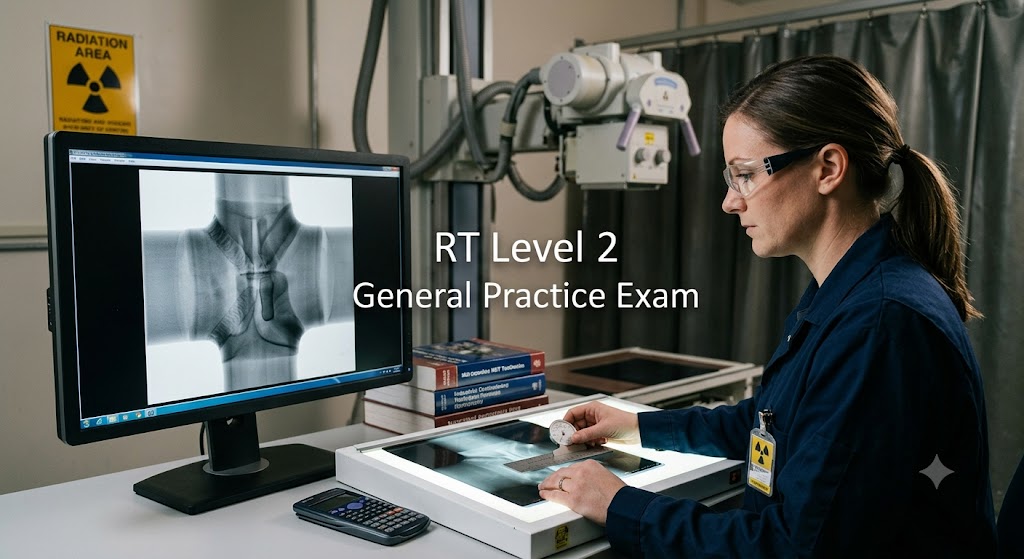
Additional Information
What the Course Entails and Exam Details
The Radiographic Testing Level 2 General Exam focuses on the theoretical and practical knowledge underpinning volumetric industrial radiography. Unlike introductory courses, RT-2 dives deep into the science of radiation, imaging principles, and advanced technique selection. Candidates must master a comprehensive range of topics. The general syllabus covers the physics of X-rays and gamma rays, including radiation production, interaction with matter, and attenuation. A heavy emphasis is placed on radiographic imaging, exploring film types and characteristics, digital radiography sensors, image quality indicators (IQIs) like penetrameters, and darkroom or digital processing techniques. Students learn exposure calculations using geometric principles, inverse square law, and specific technique charts. Crucially, the exam covers radiation safety, biological effects, regulatory requirements, and emergency procedures. Level 2 proficiency also demands competence in interpreting complex codes, standards, and acceptance criteria relevant to the material being tested.
What to Expect in the Final Exam
The full RT Level 2 certification typically involves multiple distinct examinations, and the "General" component is usually the primary written assessment. Candidates taking the Radiographic Testing Level 2 General Practice Exam should prepare for a comprehensive written test administered in a controlled environment. The exam is structured using a multiple-choice format, often containing anywhere from 40 to 100 questions depending on the certifying body (such as ASNT, ISO 9712 schemes, or internal employer programs). A passing score is generally set around 70% to 80%. There is typically a strict time limit, ranging from two to four hours, demanding both accuracy and efficient knowledge recall. The questions will rigorously test your understanding of radiographic theory, equipment, safety regulations, and standard procedures, without requiring specific applications for a particular component (which are covered in the separate "Specific" and "Practical" exams).
How to Study and Exam Centers
Preparation for the RT Level 2 General Exam demands dedicated study combining theoretical review and practical exercises. We recommend a structured approach. First, review all training materials provided during your RT-2 training course, ensuring a strong grasp of the physics of radiography and safety protocols. Utilize authoritative NDT textbooks and study guides, such as those published by ASNT. Solving practice questions, like those found in a dedicated Radiographic Testing RT Level 2 Practice Exam, is essential for identifying knowledge gaps, practicing time management, and familiarizing yourself with the multiple-choice structure. Form study groups to discuss complex exposure calculations and code interpretations. Regarding exam locations, RT Level 2 general exams are typically administered through a few channels: 1. Authorized Training Centers (ATCs) where candidates have completed their required training hours. 2. Employer-administered programs (often in accordance with SNT-TC-1A guidelines) using internal or external level III examiners. 3. Recognized national and international qualification bodies that manage certification schemes (e.g., some ASNT pathways or ISO 9712 central certification programs), which might use designated testing centers.
Job Opportunities from the Course
Earning your Radiographic Testing Level 2 certification unlocks numerous high-demand job opportunities across various industrial sectors that value strict quality control and safety standards. Organizations actively recruit certified RT Level 2 inspectors for critical roles. Common job titles and career paths available after certification include: Radiographic Inspector Level 2, NDT Technician Level 2 (RT), Quality Control Inspector (Specializing in NDT), Industrial Radiographer, Pipeline Inspector, Aerospace NDT Technician, Weld Inspector (using RT methods), Third-Party Inspection Specialist, and Maintenance NDT Technician. This qualification is highly sought after in aerospace, oil and gas, power generation (including nuclear), petrochemical manufacturing, shipbuilding, and infrastructure construction.
Frequently Asked Questions
Reviews
5.0
Based on 0 reviews
Leave a Review
No reviews yet. Be the first to review!