
Radiological Worker II Training Certification Practice Exam
$69.00
- Buy to unlock unlimited access to all Quiz questions and Answers in this Quiz.
- After purchase you can print a PDF of the whole quiz at any point. The PDF will contain the questions and the correct answers.
About this Exam
The Radiological Worker II Training Certification is an essential qualification for personnel who require unescorted access to High Radiation Areas, or who work directly with significant quantities of radioactive material. This certification is designed for technicians, engineers, scientists, and maintenance staff employed in nuclear power plants, research facilities, and DOE (Department of Energy) sites. It validates an individual's knowledge and practical ability to implement rigorous radiological safety controls, ensuring the protection of workers, the public, and the environment. Mastering the concepts within this certification is crucial for navigating hazardous environments safely and effectively.
Ready to test your knowledge?
Buy Now to Access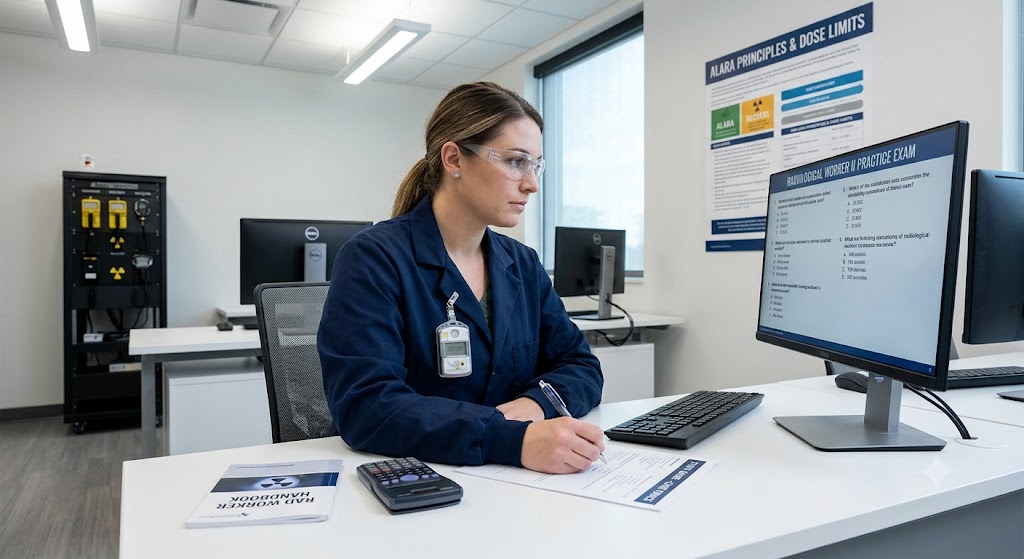
Additional Information
What the Course Entails and Exam Details
The Radiological Worker II training course provides a comprehensive deep dive into advanced health physics principles. Building significantly upon the foundation of Rad Worker I, this syllabus delves into the complex nature of ionizing radiation, including Alpha, Beta, Gamma, and Neutron radiation, and their specific biological effects on human tissue. Students master sophisticated techniques for contamination control, advanced respiratory protection, and the use of specialized air monitoring equipment. A critical component involves studying detailed case studies of previous radiological incidents to understand failure points in safety protocols and the subsequent implementation of preventative measures.
What to Expect in the Final Exam
The final certification exam is a rigorous assessment typically delivered in two distinct phases: a written theoretical test and a practical skills evaluation. The written portion generally consists of 50 to 75 challenging multiple-choice questions, covering regulatory compliance (10CFR835 or 10CFR20), advanced dose calculations, and shielding principles. A passing score of 80% is standard, and students are usually allotted 90 to 120 minutes to complete this phase. The practical evaluation requires candidates to demonstrate hands-on proficiency, such as performing a correct "swing" survey, donning complex anti-contamination clothing, and properly exiting a simulated High Radiation Area. Candidates must pass both sections to receive their certification.
How to Study and Exam Centers
A successful study strategy requires balancing theoretical review with practical simulation. Utilize comprehensive study guides provided by authorized DOE or commercial training providers, focusing heavily on rote memorization of dose limits and regulatory definitions. Re-taking a Radiological Worker II Practice Exam multiple times is essential for identifying weak knowledge areas and acclimating to the specific phrasing of the written questions. Practice mock scenarios for the practical exam, specifically focusing on systematic survey techniques and clear communication protocols. This certification is rarely offered in public testing centers like Pearson VUE; instead, exams are typically administered on-site at the employing nuclear facility, DOE national laboratories, or through specific, authorized radiological training academies that possess the necessary radioactive sources and controlled environments for the practical evaluation.
Job Opportunities from the Course
Obtaining the Radiological Worker II Certification significantly enhances employability in the specialized nuclear sector. This credential directly unlocks career paths such as: Health Physics Technician (HP Tech) and Radiation Protection Technologist (RPT). It is also a prerequisite for specialized roles including: Nuclear Decommissioning Technician, Advanced NDT (Non-Destructive Testing) Inspector, Nuclear Fuel Handler, and Environmental Remediation Specialist at contaminated sites. Furthermore, many engineering and scientific positions within national laboratories or nuclear utilities list this certification as a core requirement for their operational personnel, making it a critical asset for upward mobility in high-level radioactive work environments.
Frequently Asked Questions
Reviews
5.0
Based on 0 reviews
Leave a Review
No reviews yet. Be the first to review!