
RAF Corporal Practice Test
$69.00
- Buy to unlock unlimited access to all Quiz questions and Answers in this Quiz.
- After purchase you can print a PDF of the whole quiz at any point. The PDF will contain the questions and the correct answers.
About this Exam
The RAF Corporal promotion exam is a mandatory assessment designed for highly motivated Senior Aircraftmen and Senior Aircraftwomen (SAC/SAC(W)) who have demonstrated potential and are seeking promotion to the rank of Corporal (Cpl) within the Royal Air Force. This examination is a critical milestone in a Junior Non-Commissioned Officer's (JNCO) career, validating that the candidate possesses the leadership fundamentals, service knowledge, and professional competence required to command, lead, and manage personnel effectively at the first level of management.
Ready to test your knowledge?
Buy Now to Access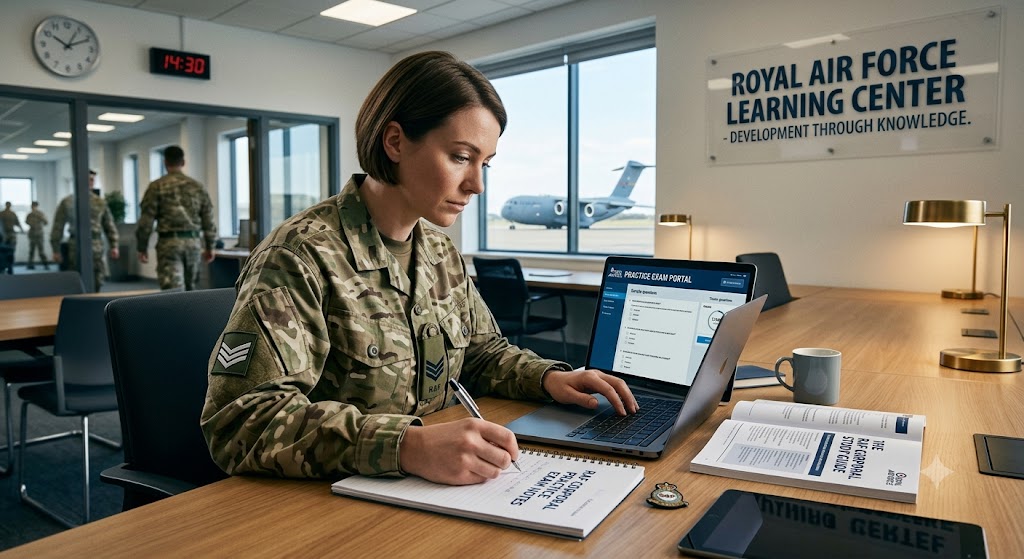
Additional Information
What the Course Entails and Exam Details
This internal examination focuses heavily on the core competencies required of a Junior NCO. The syllabus does not cover a single technical 'course' but rather tests the cumulative knowledge required for leadership.
The primary modules and topics covered include:
Leadership and Management: Testing understanding of RAF leadership models, command responsibilities, motivation, team dynamics, and effective communication skills.
Service Knowledge and Air Power: Questions on RAF ethos, history, current operations, core values, and the application of air power principles.
Core Skills: Written communication, briefing techniques, and problem-solving scenarios.
Ethos and Values: Assessment of a candidate's commitment to the RAF's core values (Respect, Integrity, Service, Excellence).
Management Administration: Basic understanding of service administrative processes, disciplinary procedures, and personnel management.
What to Expect in the Final Exam
The final assessment is generally delivered via a formal, controlled environment, often on a computer-based platform within the RAF's internal learning management system.
Key exam details include:
Format: The primary examination consists of multiple-choice questions designed to test knowledge retrieval and situational judgement. Some components may involve short written answers or analysis of leadership scenarios.
Time Limit: The computer-based test is typically timed, with approximately 60–90 minutes allocated, depending on the current iteration of the syllabus.
Passing Score: A passing score is mandatory to be considered 'Qualified for Promotion' (QFP). The exact passing percentage can fluctuate based on service requirements, but it generally requires a strong, well-rounded performance across all modules.
How to Study and Exam Centers
Preparation is key, as the content spans the breadth of a Junior NCO's required knowledge base.
Effective Study Strategies:
Utilize RAF Internal Resources: Your primary study material will be the official AP 1 (Administrative Pamphlet 1) and relevant Leadership & Management (L&M) training materials available on the RAF internal network (Moodle/DLE).
Practice with Mock Questions: Utilize any officially provided practice questions or internal RAF study forums where past candidates share common themes (always respect security protocols regarding specific questions).
Focus on the Core Values: Ensure you can define and apply the RAF core values to leadership scenarios.
Scenario-Based Review: Discuss potential leadership challenges with current Corporals and Sergeants to understand practical application.
Exam Centers:
This is an internal RAF examination. It is not available through external providers like Pearson VUE. Candidates will typically take the controlled assessment at:
Their Current Station: Most larger RAF stations have dedicated Force Development Centers (FDCs) or generic learning centres equipped for controlled assessments.
During Promotion Courses: Components of the assessment may be delivered during official Junior Supervisor (JS) or leadership courses at standard training locations, such as RAF Halton.
Job Opportunities from the Course
Successfully passing the RAF Corporal exam is the prerequisite for promotion to the rank of Corporal. This rank opens up specific, defined career paths and advanced roles that require JNCO leadership.
While not a civilian qualification, it unlocks internal opportunities:
Section Commander: Leading a specialized team within a trade (e.g., in engineering, logistics, or operations).
Trade Instructor: Delivering technical or specialized training to junior personnel at Phase 2 or Phase 3 training establishments.
Recruiting Sergeant: Representing the RAF at Armed Forces Careers Offices (AFCOs).
Drill and Discipline NCO: Taking on supervisory roles within training environments.
Advanced Trade Specialisation: Many advanced technical roles require the rank of Corporal as a starting point.
Frequently Asked Questions
Reviews
5.0
Based on 0 reviews
Leave a Review
No reviews yet. Be the first to review!