
RAF First Class Cadet CCF Practice Exam
$69.00
- Buy to unlock unlimited access to all Quiz questions and Answers in this Quiz.
- After purchase you can print a PDF of the whole quiz at any point. The PDF will contain the questions and the correct answers.
About this Exam
The RAF First Class Cadet status is a significant early milestone in your cadet career.
This qualification is designed for young individuals within the CCF who have shown commitment and have a practical interest in aviation, leadership, and adventure.
It signifies that you have acquired a foundational level of knowledge and skill required to progress within the force.
Our comprehensive RAF First Class Cadet CCF Practice Exam is the perfect tool to help you build confidence and test your understanding of the core subjects.
This resource is tailored for cadets like you, aiming to solidify their learning and move closer to achieving this coveted status.
Ready to test your knowledge?
Buy Now to Access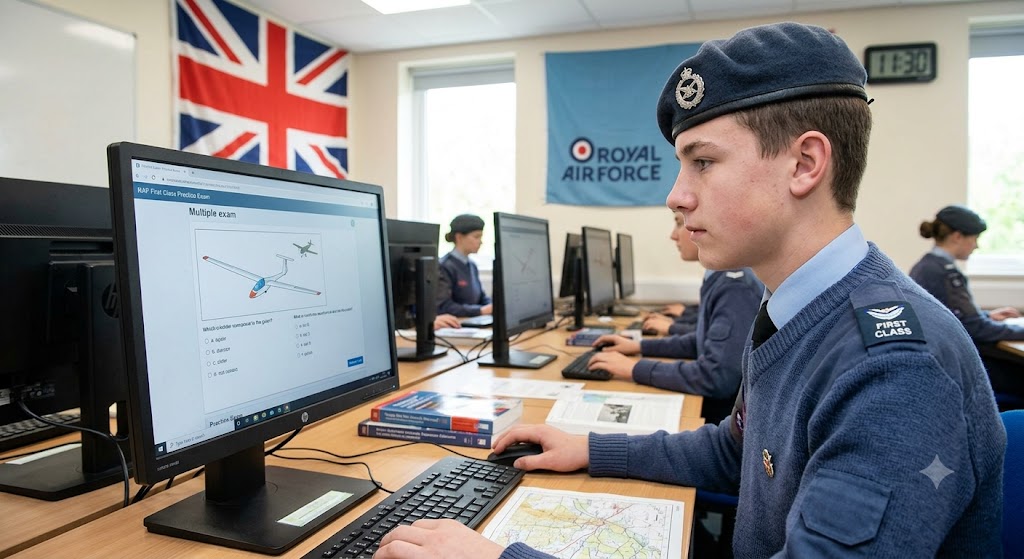
Additional Information
What the Course Entails and Exam Details
Reaching the First Class Cadet level involves a blend of practical training and theoretical learning.
While some elements of the syllabus, like Basic Foot Drill and Initial Expedition Training, focus on practical execution and are often assessed through observation and participation, the theoretical components are equally vital.
The core subjects that form the foundation of your First Class knowledge, and are reflected in this practice exam, include:
Airmanship Knowledge: Understanding the basics of flight and aviation operations.
Principles of Flight: Exploring how aircraft fly and are controlled.
Navigation (Basic): Mastering fundamental map reading skills.
CCF/RAF History & Organisation: Learning about the structure and history of the Royal Air Force and the Combined Cadet Force.
This practice exam meticulously covers these theoretical areas, providing you with questions that mirror the type of knowledge assessments you will encounter.
It allows you to focus on reinforcing your knowledge, identifying areas that need more attention, and becoming comfortable with the format.
What to Expect in the Final Exam
For many knowledge-based components of the First Class Cadet syllabus, your understanding will be formally assessed.
Typically, this part of the final assessment is conducted as a multiple-choice knowledge exam.
Here is what you can generally expect:
Format: A series of multiple-choice questions covering all theoretical subjects. This format is designed to efficiently test your recall and application of basic concepts.
Time Limits: You will be given a specific amount of time to complete the knowledge-based exam for each subject or knowledge block, often around 30 to 45 minutes, ensuring you can demonstrate your understanding within a reasonable timeframe.
Passing Score: To demonstrate proficiency, a passing score, often around 70% to 80% per subject, is typically required for successful completion of the knowledge component.
Digital or Online: Increasingly, these assessments are administered digitally through authorized online platforms, providing a secure and efficient testing process. This practice exam perfectly mirrors this format, allowing you to get comfortable with answering questions on a screen.
Please note that while the practice exam focuses heavily on the knowledge aspects, you will also need to demonstrate proficiency in your practical skills, such as drill and expedition techniques, as part of your overall evaluation for First Class Cadet status.
How to Study and Exam Centers
Preparation is key, and here is how you can effectively study for success:
How to Study:
Utilize this Practice Exam: Regularly attempt this practice material. It will help you with question recognition, timing, and knowledge reinforcement.
Review your Syllabus: Go back to your CCF training materials, workbooks, and notes for detailed explanations of all subjects.
Active Learning: Use flashcards for key terms, diagrams, and historical facts. Teaching concepts to others is also highly effective.
Form Study Groups: Collaborating with fellow cadets can make learning engaging and allow for discussion and shared problem-solving.
Ask for Guidance: Don't hesitate to ask your instructors for clarification on any challenging topics. They are there to support you!
Exam Centers:
It is crucial to understand that formal CCF assessments, including the knowledge exams for the First Class qualification, are not conducted at public testing centers like Pearson VUE.
Internal Administration: Official exams are administered internally within your authorised CCF unit. Your unit instructors and commanders will manage the process, and examinations will often take place during your regular training sessions or a designated assessment day.
Authorised Platforms: For digital exams, you will be given access to official online portals managed by the cadet force. Ensure you have the correct login details and familiarise yourself with the platform if possible before the assessment.
Practical Checks: Practical skills like drill and map work will also be assessed internally by qualified instructors at your unit.
This structure ensures you are evaluated by familiar individuals in a supportive environment, focused on your development within the force.
Job Opportunities from the Course
While completing your First Class Cadet status doesn’t directly unlock a specific job, the skills and status you gain significantly enhance your suitability and application for a wide range of career paths and opportunities:
Royal Air Force: Achieving First Class Cadet status demonstrates leadership, discipline, and an interest in aviation that is highly valued. A successful cadet record significantly bolsters your application if you decide to pursue a career as an RAF Officer or Airman.
Leadership and Management: The leadership, teamwork, and self-discipline developed are universally sought-after skills. This experience can benefit you in management roles across various industries, from corporate businesses to public sector organizations.
Aviation and Aerospace: The foundational aviation knowledge serves as a stepping stone for future roles in aviation engineering, aircraft mechanics, flight operations, or even pilot training, both military and civilian.
Emergency Services: The focus on discipline, responsibility, and teamwork is directly relevant to careers in the police, fire service, and ambulance services.
Adventure Training and Education: Leadership in outdoor activities and expeditions is valuable for outdoor instructors, expedition leaders, and youth group leaders.
Civilian Public Sector: Strong teamwork, dedication, and leadership are respected in many civilian public service roles and local government positions.
Technical and STEM Roles: The analytical and technical aspects of aviation, combined with the focus on discipline, are attractive in technical fields and engineering disciplines.
Enhanced Applications Generally: Being a committed and successful cadet, especially progressing through qualifications, provides unique, concrete evidence of dedication and achievement that sets your applications apart in any field, from job positions to university admissions.
Frequently Asked Questions
Reviews
5.0
Based on 0 reviews
Leave a Review
No reviews yet. Be the first to review!