
RAF Senior/Master Cadet: Military Aircraft Systems Practice Exam
$69.00
- Buy to unlock unlimited access to all Quiz questions and Answers in this Quiz.
- After purchase you can print a PDF of the whole quiz at any point. The PDF will contain the questions and the correct answers.
About this Exam
The RAF Senior/Master Cadet Military Aircraft Systems classification is an advanced qualification within the Royal Air Force Air Cadets (RAFAC) training syllabus. This specific subject is designed for experienced cadets who have already completed their Leading Cadet training and have a keen interest in the technical and operational aspects of modern military aviation. It provides an in-depth understanding of the complex systems that allow military aircraft to operate effectively in diverse roles, from air superiority to tactical transport. This qualification is ideal for cadets aspiring to technical roles within the RAF, or careers in the broader aerospace and engineering sectors.
Ready to test your knowledge?
Buy Now to Access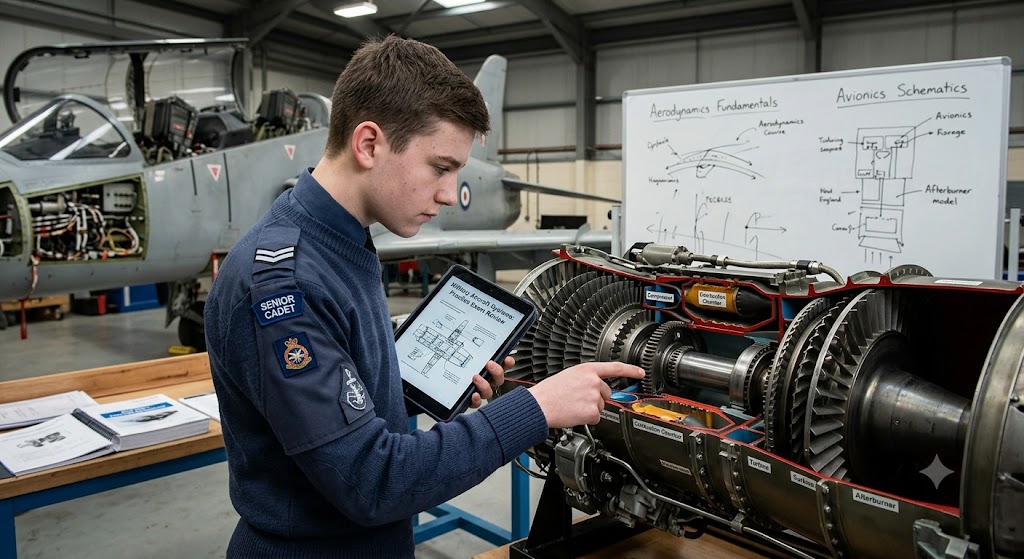
Additional Information
What the Course Entails and Exam Details
This comprehensive course delves into the intricate engineering and electronic systems found on contemporary RAF aircraft. Cadets study the principles, components, and operation of several core areas. The syllabus typically covers topics such as:
Aero-Engines: Detailed study of gas turbine jet engines, including their cycles, construction, and thrust augmentation systems (like afterburners).
Aircraft Structures & Materials: Analysis of modern airframes, the forces they encounter, and the advanced composite materials used in their construction.
Avionics & Radar: Understanding aircraft electrical systems, communication suites, navigation aids (GNSS, Inertial Navigation), and primary/secondary radar operations.
Hydraulics & Flight Controls: Exploration of hydraulic systems powering flight controls, landing gear, and the mechanics of flight control surfaces.
Weapon Systems: Introduction to aircraft weapon integration, including basic principles of guided and unguided munitions, and targeting systems.
The associated exam verifies a cadet’s theoretical knowledge and practical understanding of how these critical systems integrate and function under operational conditions.
What to Expect in the Final Exam
The final assessment for the Military Aircraft Systems classification is typically a formal, proctored examination. Cadets can expect the following:
Format: The exam usually consists of multiple-choice questions designed to test both factual recall and the application of theoretical knowledge to practical scenarios.
Specific Rules: Cadets may need to interpret diagrams, schematics, and system operational charts.
Passing Score: The pass mark is generally set at 70%, reflecting the required proficiency. Achieving a higher score (e.g., above 80% or 90%) may result in a "Pass with Credit" or "Pass with Distinction."
Time Limits: The examination is timed, typically allowing between 45 and 60 minutes, requiring cadets to demonstrate confident knowledge of the material.
The exam focuses heavily on how systems work in unison and basic troubleshooting principles, rather than just isolated component identification.
How to Study and Exam Centers
Preparation is key to succeeding in this challenging technical subject. Cadets are encouraged to use a multi-faceted study approach:
Squadron Training: The primary resource is the regular training sessions provided within the cadet squadron, delivered by qualified instructors or guest speakers with relevant background.
Ultilearn: The online learning portal (Ultilearn) provides access to the official RAFAC training materials, presentations, and sometimes self-test quizzes. Consistent review of these materials is essential.
Diagram Practice: Actively practice labeling and explaining blank system diagrams (e.g., fuel systems, hydraulic circuits, or jet engine cross-sections) until they are memorized.
Mock Exams: Utilize any practice exams or sample questions available through your squadron or Ultilearn to familiarize yourself with the question style and time management.
Exams are usually administered locally within the cadet squadron environment, facilitated by squadron staff, rather than requiring travel to external Pearson VUE or professional testing centers.
Job Opportunities from the Course
Successfully achieving the Senior or Master Cadet classification, particularly with strong results in technical subjects like Military Aircraft Systems, significantly strengthens a cadet's portfolio. While not a direct license or civilian certification, it demonstrates a proven aptitude and commitment that is highly valued. This qualification unlocks various pathways and career opportunities, such as:
RAF Career Pathways: Direct progression into RAF technical trades, including:
Aircraft Technician (Avionics)
Aircraft Technician (Mechanical)
Weapon Technician
Cyberspace Communication Specialist
Aerospace Engineering Apprenticeships: A significant advantage when applying for competitive apprenticeships with major aerospace and defense companies.
Higher Education: Strong background knowledge for pursuing degrees in Aerospace Engineering, Mechanical Engineering, or Aviation Management.
Civil Aviation Roles: Provides foundational knowledge relevant to civilian aircraft maintenance and engineering roles.
Frequently Asked Questions
Reviews
5.0
Based on 0 reviews
Leave a Review
No reviews yet. Be the first to review!