
Ramsay Maintenance Practice Test
$69.00
- Buy to unlock unlimited access to all Quiz questions and Answers in this Quiz.
- After purchase you can print a PDF of the whole quiz at any point. The PDF will contain the questions and the correct answers.
About this Exam
Embark on a successful career path in industrial maintenance with our comprehensive guide to the Ramsay Maintenance Practice Exam. This assessment is not just a test; it's a critical stepping stone for aspiring and experienced maintenance professionals seeking to validate their skills and land in-demand roles in manufacturing, logistics, and facility management. It is designed to evaluate your practical knowledge, troubleshooting abilities, and technical understanding across a wide spectrum of essential maintenance principles. Achieving a passing score on this rigorous exam signals to top employers that you have the expertise and problem-solving acumen required to keep operations running smoothly and safely.
Whether you're just starting out or looking to advance to a journey-level position, understanding the intricacies of the Ramsay test is vital. Let's delve into what this certification entails and how to prepare effectively.
Ready to test your knowledge?
Buy Now to Access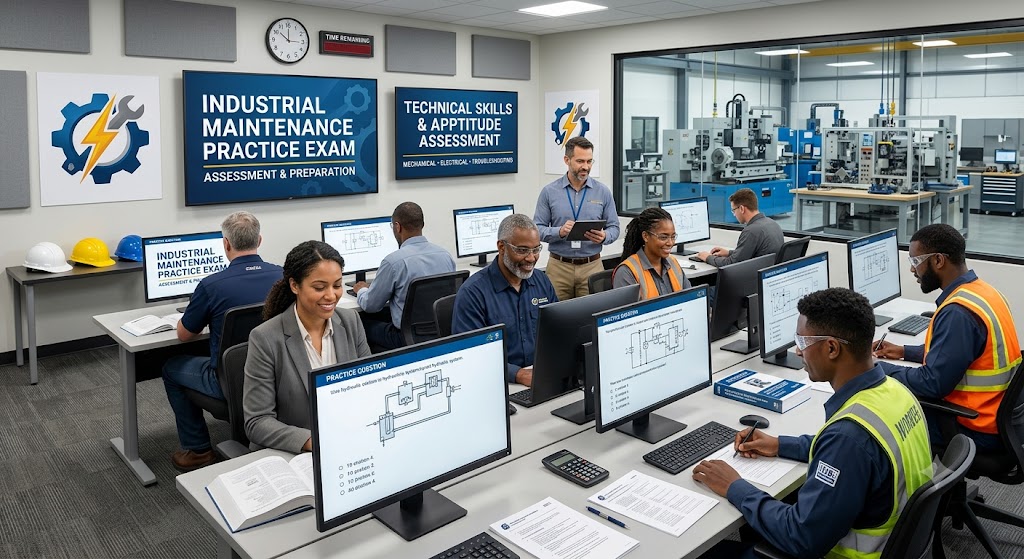
Additional Information
What the Course Entails and Exam Details
The Ramsay Maintenance assessments, often referred to under various trade-specific or multi-craft names (like the Ramsay MultiCraft Test, Ramsay MecTest, or similar), are designed to measure technical knowledge rather than abstract aptitude. The core domains covered reflect the realities of the maintenance field and include both theoretical understanding and practical application. While specific content can vary depending on the exact test variant and employer requirements, the fundamental pillars typically involve:
Mechanical Principles
This section explores your understanding of foundational mechanical concepts. Expect questions on hydraulics and pneumatics, power transmission systems (gears, belts, bearings), lubrication, pump operations, piping systems, and basic machine design. You'll likely encounter scenarios asking you to interpret system behavior, identify common failure modes, or select the correct tools and methods for repairs.
Electrical and Electronics
A crucial component for modern technicians, this area tests your knowledge of AC/DC theory, control circuits, motors and motor control (including ladder logic and PLCs), electrical safety, and the use of essential test instruments. You will be expected to read electrical schematics and diagnose electrical faults in industrial equipment.
Print Reading and Schematics
The ability to accurately interpret technical drawings is paramount. This section assesses your skill in reading and understanding mechanical blueprints, electrical schematics, hydraulic and pneumatic diagrams, and other industrial drawings, requiring you to extract measurements, identify components, and understand system function from paper.
Troubleshooting and Diagnostics
Moving beyond textbook knowledge, the Ramsay exam heavily emphasizes practical troubleshooting. You'll be presented with equipment malfunctions or operational anomalies and must apply logical reasoning to isolate the problem, eliminate improbable causes, and determine the correct course of action. This often includes scenarios combining mechanical and electrical elements.
Basic Trades and Crafts
Depending on the specific test level and trade, some variants include questions on basic welding techniques, rigging principles, shop math, safety practices, and the proper use of hand and power tools and precision measurement equipment.
The exam itself is predominantly a computer-based assessment. Questions are almost entirely multiple-choice, often presenting realistic technical scenarios with diagrams or diagrams to analyze. The focus is always on the best or most logical answer based on standard industry practices and practical application.
What to Expect in the Final Exam
While exact details can be highly specific, here are common characteristics to anticipate when taking the final, official Ramsay maintenance exam:
Format: Primarily a multiple-choice exam administered on a computer. Questions are frequently scenario-based and heavily supported by technical diagrams and schematics.
Length: The number of questions varies, but often ranges from 60 to over 100 questions per exam session, depending on the test variant. A typical journey-level test (like the MultiCraft) might be around 60 questions.
Time Limit: Exams are generally timed, typically allowing about an hour to an hour and a half (e.g., 60-90 minutes). The exact time limit will be clearly specified before you begin. Plan to manage your time effectively, as pacing is key.
Passing Score: There isn't a universally standard passing score. Employers and educational institutions set their own thresholds based on the job level and specific role requirements. Some companies aim for candidates to score in the top percentile of all test-takers or achieve a specific percentage (often 70% to 80%+ depending on the test version and employer expectations). Check with your prospective employer or certifying body for specific requirements. Incorrect answers typically do not deduct points, so always make your best guess if you are unsure.
Specific Rules: Each testing environment and body will have its rules. This often includes bans on external materials (phones, notes), pre-set instructions, and procedures for using computer interfaces. Calculators and scratch paper may or may not be provided/allowed depending on the test. Always clarify rules beforehand.
Scoring Structure: You might receive a raw score and, often, a local or national percentile ranking that compares your performance to other candidates, giving employers a better sense of your relative strength.
How to Study and Exam Centers
Preparation is the cornerstone of success. Here's a multi-faceted approach to preparing for and taking your Ramsay exam:
Actionable Study Strategies
Understand the Test Blueprint: Try to obtain a clear breakdown of the core topics for your specific exam level (entry-level vs. journey-level, single trade vs. multi-craft). Focus your efforts on the most common areas.
Refresh Core Concepts: Revisit your technical textbooks, training manuals, and reliable online resources. Dedicate equal time to both mechanical and electrical principles. Don't overcomplicate; master the fundamentals. Think Ohm's law, circuit analysis, basic hydraulic circuits, gear ratios, and safety protocols.
Practice with Real-World Schematics: Spend time reading and interpreting a variety of industrial blueprints, electrical diagrams, and hydraulic/pneumatic prints. Practice identifying components and tracing the flow of power, signals, and fluids.
Practice Troubleshooting: Engage in mental exercises. Imagine a piece of equipment is malfunctioning (e.g., "motor humming but not spinning", "hydraulic system sluggish", "control circuit not activating"). Walk through the logical steps to diagnose the problem, considering both mechanical and electrical possibilities. Review existing troubleshooting guides or cases.
Utilize Practice Tests and Questions: Look for reputable online practice platforms, study guides, and resource collections that offer Ramsay-style practice questions. This is one of the most effective ways to understand the question format and identify knowledge gaps. Look for questions with detailed explanations of correct and incorrect answers.
Time Management Practice: When taking practice tests, simulate real exam conditions and time yourself. Practice quickly eliminating obviously incorrect options to increase your answering speed. Don't spend too long on any single question; mark difficult questions and return if time permits.
Exam Centers and Access
You cannot simply register for a generic "Ramsay Exam" on a single central portal. The actual exam process is usually coordinated through specific entities:
Employer-Led Testing: Many large manufacturing companies and logistical firms (e.g., Amazon, major automotive plants, etc.) administer Ramsay tests as part of their pre-employment screening process. This can occur at company facilities, approved third-party assessment centers, or through dedicated online portals administered by the company or Ramsay Corp. on their behalf.
Educational Institutions & Training Centers: Authorized technical colleges, trade schools, and union training centers often integrate Ramsay testing into their curricula or offer it as a service to students or industry professionals. Check with local technical educational centers.
Ramsay Corporation Direct: For some certifications or customized solutions, you may be directed to a Ramsay Corporation online assessment platform. They will provide the necessary credentials and instructions.
Testing Providers: In some cases, organizations might use larger, established testing network providers for administering the exams, although this is less common than employer or institutional administration. Always follow the specific registration and location instructions provided by the organization requiring the test. They are your definitive source of information.
Job Opportunities from the Course
Successfully passing a Ramsay Maintenance Practice Test is a powerful credential that unlocks diverse and rewarding career paths within modern industry. While job titles can vary by company and region, here is a clear list of the key career opportunities made accessible by this certification:
Maintenance Technician (Level I, II, III, Senior, Journey-Level) – The most common and direct application, covering a broad range of general industrial maintenance duties.
Industrial Mechanic / Plant Mechanic – Focuses on the mechanical repair and maintenance of machinery and plant equipment.
Industrial Electrician – Specialized in electrical installation, maintenance, and troubleshooting within an industrial setting.
Multi-Craft Technician / Integrated Maintenance Technician – A highly skilled role requiring expertise across multiple trades, including mechanical, electrical, and control systems.
Automation Technician – Specialized in the installation, programming, maintenance, and repair of automated systems, robotics, and PLCs.
Facilities Maintenance Technician – Covers the upkeep and repair of building systems, utilities, and infrastructure.
Machinery & Equipment Technician – Focuses on the maintenance and repair of specific types of industrial machines.
Instrumentation and Control (I&C) Technician – Specialized in control systems, sensors, and instrumentation.
Senior Maintenance Lead / Supervisor – With experience, this certification supports advancement into leadership roles within maintenance departments.
Frequently Asked Questions
Reviews
5.0
Based on 0 reviews
Leave a Review
No reviews yet. Be the first to review!