
Ramsay Mechanical Practice Test
$69.00
- Buy to unlock unlimited access to all Quiz questions and Answers in this Quiz.
- After purchase you can print a PDF of the whole quiz at any point. The PDF will contain the questions and the correct answers.
About this Exam
The Ramsay Mechanical Practice Test is a crucial stepping stone for individuals aspiring to enter or advance within manufacturing, maintenance, and various technical industries. Employers rely on standardized Ramsay tests, such as the Mechanical Aptitude Test (MAT), to evaluate an applicant's potential and suitability for roles that require strong spatial reasoning and a sound understanding of basic mechanical principles. This practice exam is designed to build your confidence and readiness by simulating the types of questions and challenges you will encounter on the official assessment, helping you identify areas for improvement and sharpen your critical thinking skills.
Ready to test your knowledge?
Buy Now to Access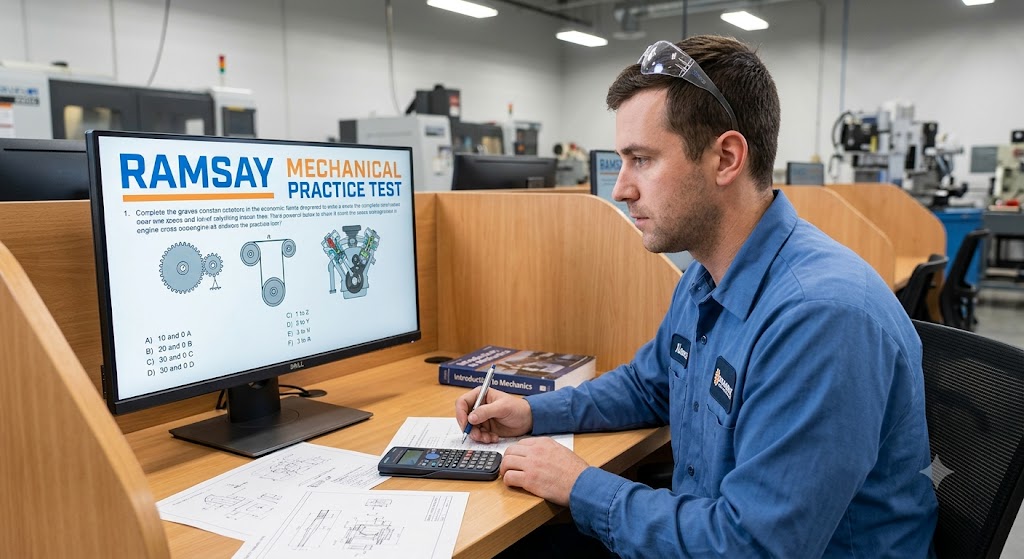
Additional Information
What the Course Entails and Exam Details
This practice test environment mirrors the official Ramsay exam, focusing heavily on core technical competencies and practical application. Topics you can expect to master through rigorous practice include: understanding fluid mechanics and systems (hydraulics and pneumatics); applying principles of thermodynamics and heat transfer; analyzing the properties and strengths of various engineering materials; mastering the fundamentals of mechanics, statics, and dynamics; interpreting complex technical drawings, blueprints, and schematics; identifying machine components like gears, bearings, and linkages; executing shop mathematics and precise measurement techniques; and understanding the essentials of equipment troubleshooting and preventative maintenance procedures.
What to Expect in the Final Exam
While specific test formats can vary depending on the exact version authorized by an employer (such as the MAT-4 or different maintenance-level tests), you should generally expect a proctored, computer-based assessment consisting of multiple-choice questions. The official test emphasizes both accuracy and speed, making time management a critical factor. Typically, the exam lasts between 20 to 40 minutes and contains approximately 30 to 60 questions designed to measure your cognitive ability in a mechanical context. There is no universal passing score; individual employers establish their own benchmark scores based on the specific job requirements for the position they are filling.
How to Study and Exam Centers
The key to succeeding on the Ramsay test is dedicated and strategic preparation. Start by taking several full-length, timed practice tests to familiarize yourself with the question styles and the pressure of the environment. Analyze your mistakes meticulously, revisiting the underlying mechanical concepts you find challenging. Create structured study notes, flashcards for definitions and key formulas, and practice reading schematics daily. Focus heavily on improving spatial reasoning by mentally visualizing object manipulations. Official Ramsay assessments are often administered through secure platforms like SHL, or directly by the hiring company's designated testing centers, which could include specific vocational schools, community colleges, or authorized testing facilities like Pearson VUE.
Job Opportunities from the Course
Successfully demonstrating your mechanical aptitude on a Ramsay test is often a mandatory requirement that can unlock diverse and rewarding career paths in modern industry. While this practice test does not confer a certification itself, strong performance on the required official exam leads directly to opportunities in roles such as: Industrial Maintenance Mechanic; Manufacturing Process Technician; CNC Machine Operator and Programmer; Mechanical Assembler and Fitter; Quality Control and Inspection Specialist; Plant Operator; Millwright; Pipefitter; and entry-level Engineering Technician positions.
Frequently Asked Questions
Reviews
5.0
Based on 0 reviews
Leave a Review
No reviews yet. Be the first to review!