
Ranger Handbook Practice Test
$69.00
- Buy to unlock unlimited access to all Quiz questions and Answers in this Quiz.
- After purchase you can print a PDF of the whole quiz at any point. The PDF will contain the questions and the correct answers.
About this Exam
The Ranger Handbook Practice Exam is a crucial tool designed for soldiers, ROTC cadets, and officer candidates preparing for one of the U.S. Army's most challenging training programs: Ranger School.
This guide distills the small-unit tactics, leadership skills, and fieldcraft required of an Army Ranger into actionable knowledge. This practice exam is specifically designed to help students master the "technical and tactical" portion of the curriculum before arriving at Fort Moore, ensuring they are mentally prepared for the academic rigors of the course.
Ready to test your knowledge?
Buy Now to Access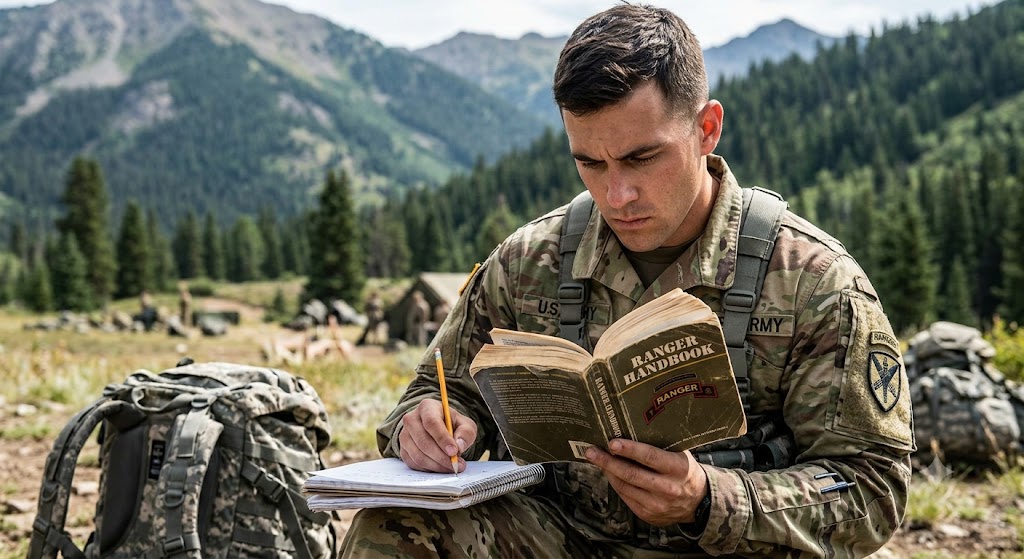
Additional Information
What the Course Entails and Exam Details
Ranger School is not just a physical challenge; it is a profound leadership development course. The curriculum relies heavily on the principles detailed in the official Ranger Handbook.
The written and practical knowledge components of the course focus on fundamental infantry skills and the ability to lead under extreme stress. Key areas covered include:
Leadership: Troop Leading Procedures (TLPs) and the Ranger Creed.
Operations: Planning, combat orders (OPORD, WARNO, FRAGO), and terrain model kits.
Patrolling: Movements, formations, and security (day and night).
Battle Drills: React to contact, ambush, raid, and area reconnaissance.
Communications: Radio operations, reports, and procedures.
Tactical Skills: Land navigation, survival, and first aid.
Specialized Operations: Mountain warfare, water operations, and demolitions.
What to Expect in the Final Exam
While the true "exam" in Ranger School is your performance during patrols, the academic requirements often begin with prerequisite written tests or land navigation evaluations that you must pass to continue training.
The written assessments are typically:
Format: Multiple-choice, matching, and tactical decision-making questions based directly on the Ranger Handbook.
Focus: High emphasis on Troop Leading Procedures and OPORD completion.
Passing Score: A minimum of 70-80% is usually required for prerequisite academic tests.
Time Limit: Time limits are often strict, testing the candidate's ability to retrieve information under pressure.
Our practice test simulates this environment, focusing on the core knowledge that candidates are expected to memorize.
How to Study and Exam Centers
Effective preparation requires consistent, daily study.
Actionable Strategies:
Master the Handbook: The primary study center is the Ranger Handbook itself. Read it multiple times.
Rote Memorization: Memorize TLPs, Battle Drills, and the Ranger Creed verbatim.
Practice OPORDs: Write out combat orders using different tactical scenarios.
Flashcards: Create physical or digital flashcards for acronyms, reports, and tactical procedures.
Take the Practice Test: Use this Ranger Handbook Practice Exam frequently to identify gaps in your knowledge.
Exam Centers: Official prerequisite written exams occur at the U.S. Army Ranger School at Fort Moore, GA, and sometimes at other pre-Ranger courses authorized by individual units.
Job Opportunities from the Course
Earning the Ranger Tab is widely respected as a sign of exceptional leadership capability. While the qualification itself is not a different MOS (Military Occupational Specialty), it opens specific career assignments and advancement opportunities within the military and later in the civilian sector.
Career paths unlocked include:
Ranger-qualified Infantry or Combat Arms Officer/NCO
Assignment to the 75th Ranger Regiment
Ranger Instructor
Small-Unit Leader in conventional forces
Special Operations candidate selection (e.g., Special Forces)
Tactical Law Enforcement (SWAT)
Corporate Leadership Trainer
Private Security and Tactical Consulting
Frequently Asked Questions
Reviews
5.0
Based on 0 reviews
Leave a Review
No reviews yet. Be the first to review!