
Rapid Intervention Crews (RIC) Practice Test
$69.00
- Buy to unlock unlimited access to all Quiz questions and Answers in this Quiz.
- After purchase you can print a PDF of the whole quiz at any point. The PDF will contain the questions and the correct answers.
About this Exam
The Rapid Intervention Crew (RIC) certification is essential for firefighters and emergency personnel, validating their readiness to perform immediate, structured rescues of distressed or downed colleagues.
This rigorous exam is designed for proactive first responders committed to ensuring safety during high-risk fireground operations.
By completing this certification, you prove your understanding of specialized RIC concepts and critical rescue protocols.
Ready to test your knowledge?
Buy Now to Access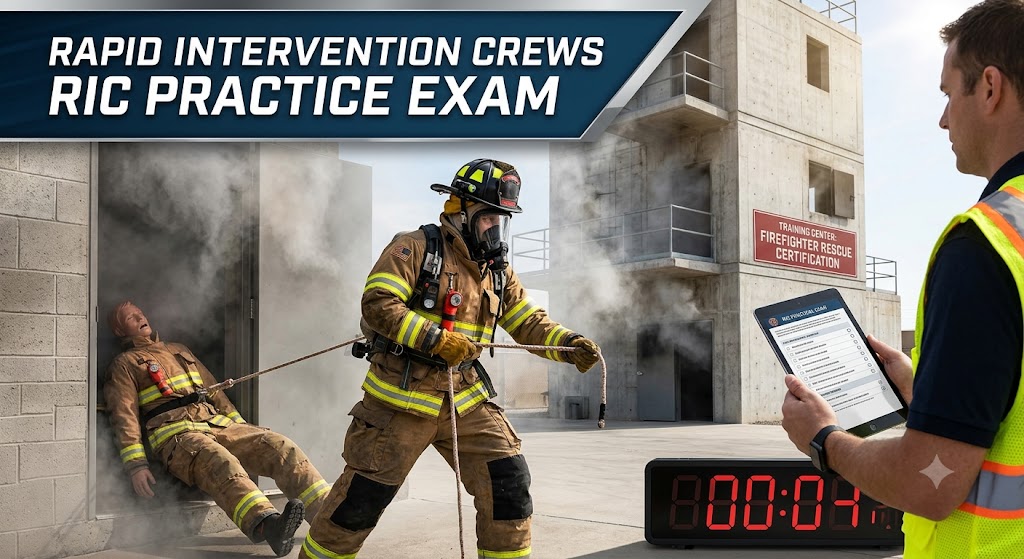
Additional Information
What the Course Entails and Exam Details
The comprehensive RIC training and its associated exam cover a wide range of vital topics and skills to ensure you are prepared for Mayday situations.
Key areas of focus often include:
RIC Philosophy and Procedures: Understanding the critical need for RIC, its proactive role, and standard operating guidelines for establishing and deploying teams.
Mayday Operations: Learning proper protocols for initiating a Mayday, establishing command during rescue, and executing search-and-rescue procedures for other firefighters.
Equipment and Specialized Tools: Training with the essential equipment carried by RIC, such as thermal imaging cameras, rescue ropes, air supply systems, and forcible entry tools.
Advanced Search Techniques: Master skills for search operations in low-visibility environments, utilizing large-area search techniques, and navigating complex structures efficiently.
Locating and Accessing Downed Firefighters: Practicing methods to safely locate distressed personnel and navigate obstructions to reach them.
Firefighter Removal and Transport: Developing the physical ability and coordination to perform proper carries, drags, and mechanical assists to extract downed personnel from hazardous areas.
What to Expect in the Final Exam
You must anticipate a multi-faceted evaluation that assesses both your theoretical knowledge and your practical proficiency under pressure.
Theoretical Knowledge Assessment: A multiple-choice written exam will test your understanding of safety regulations, equipment, search strategies, communication procedures, and command structure. Candidates typically need a passing score of 70% or higher to progress. A time limit is usually enforced.
Practical Skills Performance Evaluation: This crucial portion challenges candidates in dynamic, realistic scenarios. You will need to demonstrate your physical capabilities by performing critical RIC functions while wearing full protective equipment. Assessors evaluate aspects like PPE usage, tool mastery, communication effectiveness, and execution of search-and-rescue maneuvers. Evaluators look for safety compliance and successful completion of dynamic rescue scenarios, often using pass/fail metrics.
How to Study and Exam Centers
Effective preparation is key to success on the RIC Practice Test and final certification.
Actionable Study Strategies:
Review Official Curriculum: Study all official training manuals, standard operating guidelines, and relevant NFPA standards (e.g., NFPA 1407).
Utilize Study Guides: Look for comprehensive study guides specifically for RIC or firefighter rescue protocols to consolidate important information.
Practice with RIC Practice Exams: Continuously take practice tests to familiarize yourself with the question formats, identify weak points, and improve time management for the written portion.
Practical Repetition: Rehearse dynamic rescue skills like drags, carries, and equipment handling repeatedly in realistic scenarios until they become instinctive.
Engage in Mock Drills: Coordinate with your team or peers to perform comprehensive RIC scenarios under simulated fireground conditions, receiving feedback.
Finding Exam Centers and Information: RIC certification exams are typically hosted by state or regional fire training academies, large fire departments, or specific fire service educational institutions. Information regarding upcoming exams, official testing locations, and registration processes is available through these organizations. Physical training centers often facilitate practical assessments in modern training towers and simulation facilities.
Job Opportunities from the Course
A RIC certification significantly enhances your qualifications and creates valuable career advancement opportunities within the fire service.
Potential career paths include:
Dedicated Rapid Intervention Crew Member: Serving as a specialist on specialized RIC or rescue companies within larger fire departments.
Enhanced Fire suppression Firefighter: Improving your performance and safety during general fire control operations.
Safety Officer Roles: Demonstrating expertise in firefighter safety protocols, potentially leading to positions in health and safety divisions.
Specialized Rescue Unit Firefighter: Becoming more competitive for roles in technical rescue, structural collapse, and hazardous materials units.
Leadership and Command Positions: Building a strong foundation for future promotional opportunities, as a deep knowledge of rescue operations is vital for fire officers.
Frequently Asked Questions
Reviews
5.0
Based on 0 reviews
Leave a Review
No reviews yet. Be the first to review!