
RASA First Assist Practice Test
$69.00
- Buy to unlock unlimited access to all Quiz questions and Answers in this Quiz.
- After purchase you can print a PDF of the whole quiz at any point. The PDF will contain the questions and the correct answers.
About this Exam
The RASA Surgical First Assistant program is a comprehensive educational pathway designed for qualified Allied Health Professionals, such as Surgical Technologists and Registered Nurses, who aspire to significantly advance their careers. This program equips students with the advanced knowledge, precise clinical skills, and professional judgment required to serve as a vital link in the operating room. As a Surgical First Assistant, you provide direct aid to the surgeon across a wide spectrum of multi-specialty surgical cases, enhancing patient safety and operative efficiency. If you are a dedicated healthcare professional looking to deepen your involvement in surgical procedures, this certification is your gateway. The RASA program’s curriculum typically prepares graduates to sit for a nationally recognized certification, often the Surgical Assistant-Certified (SA-C) credential through the American Board of Surgical Assistants (ABSA).
Ready to test your knowledge?
Buy Now to Access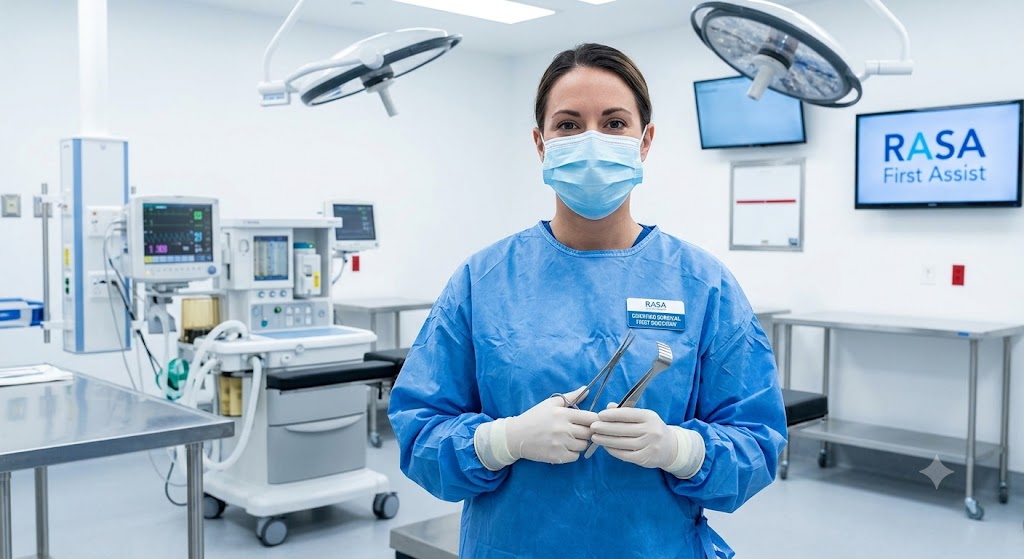
Additional Information
What the Course Entails and Exam Details
The RASA program and the subsequent certification exams are rigorous and multifaceted. The didactic portion covers essential subjects such as advanced Human Anatomy and Physiology, surgical Microbiology, Pharmacology for surgery, and the comprehensive role and responsibilities of the First Assistant. Students also delve into preoperative patient assessment, anesthesia principles, and intricate details of multiple surgical specialties, including General Surgery, Orthopedics, Neurosurgery, Cardiothoracic, and OB/GYN, among others. Crucially, the course heavily emphasizes the psychomotor learning domain. This includes mastering aseptic and sterile techniques, advanced instrumentation, electrosurgery principles, intricate wound closure training (advanced suturing and knot tying), and effective handling of intraoperative complications and emergencies. A supervised clinical internship is often a core component, where students apply their knowledge and refine their skills in a real-world operating room environment under a designated mentor.
What to Expect in the Final Exam
The national certification exam, typically the computer-based SA-C exam developed by the ABSA, is designed to validate that a candidate possesses the comprehensive cognitive knowledge and clinical understanding required for safe and effective practice. The current SA-C exam consists of 150 single-select, multiple-choice questions, which candidates must complete within a three-hour time limit. The questions are structured to assess understanding of core topics like anatomy and physiology, sterile technique, pharmacology, instrumentation, and the specific duties of a surgical assistant. While the exact passing score may be updated periodically according to psychometric standards, candidates should aim for a high level of proficiency. The exam is proctored, either through physical testing centers across the country or sometimes via approved online portals with live proctoring. Specific rules regarding permissible items, identification, and conduct are strictly enforced.
How to Study and Exam Centers
Effectively preparing for this milestone requires a combination of structured study and practical application. Leverage all the resources provided by your RASA program, including text books, online modules, and practice questions within the curriculum. Dedicate focused study time to your weakest areas, particularly intricate anatomy and physiology which is fundamental to the entire surgical process. Actively utilize your practice kit for suturing and knot-tying, and consider re-taking all provided practice exams, like the one simulated here, to familiarize yourself with question formats and time management. RASA itself may offer specific final exam preparation materials or review courses.
Registration for the SA-C exam is typically done through the American Board of Surgical Assistants (ABSA) website, and candidates should carefully follow all application and fee guidelines. The exam can generally be taken at various proctored testing centers throughout the United States, including specific commercial centers, authorized educational institutions, or potentially via online proctoring services supported by the certification body. Always check the most current information and testing locations with the ABSA directly. For additional practice, searching for a "RASA Surgical First Assist Practice Test" or "ABSA Surgical Assistant Practice Exam" can yield supplementary study aids to bolster your preparation.
Job Opportunities from the Course
Achieving certification as a Surgical First Assistant, and specifically through the RASA pathway to the SA-C credential, opens the door to a rewarding and higher-paying career in the surgical environment. Professionals with this qualification are highly valued for their ability to contribute at a high level and fill a critical, trusted role in surgical teams. Potential job titles and career paths this certification unlocks include:
Certified Surgical First Assistant
Surgical Assistant (SA-C)
Surgical First Assistant
Surgical Technologist First Assistant (STFA)
Registered Nurse First Assistant (RNFA) (Requires RN licensure & specific RNFA education in addition)
Physician Assistant (with relevant PA degree/licensure)
Specialty-Specific First Assistant (e.g., Orthopedic FA, Cardiac FA)
Operating Room Clinical Coordinator
Surgical Services Educator/Instructor
Frequently Asked Questions
Reviews
5.0
Based on 0 reviews
Leave a Review
No reviews yet. Be the first to review!