
RBT – Verbal Operants Practice Test
$69.00
- Buy to unlock unlimited access to all Quiz questions and Answers in this Quiz.
- After purchase you can print a PDF of the whole quiz at any point. The PDF will contain the questions and the correct answers.
About this Exam
The Registered Behavior Technician (RBT) designation is a fundamental credential in the growing field of Applied Behavior Analysis (ABA). RBTs work as essential paraprofessionals, delivering direct behavioral services and implementing treatment plans designed and supervised by Board Certified Behavior Analysts (BCBAs) or Board Certified Assistant Behavior Analysts (BCaBAs). Their role is pivotal in supporting individuals, particularly children and adults on the autism spectrum, as they build crucial skills and reduce challenging behaviors.
This specific guide and practice test are designed for anyone preparing for the RBT certification exam. Verbal Operants, a core component of B.F. Skinner's analysis of verbal behavior, are foundational concepts you must master to effectively implement communication-focused interventions and pass the exam.
Ready to test your knowledge?
Buy Now to Access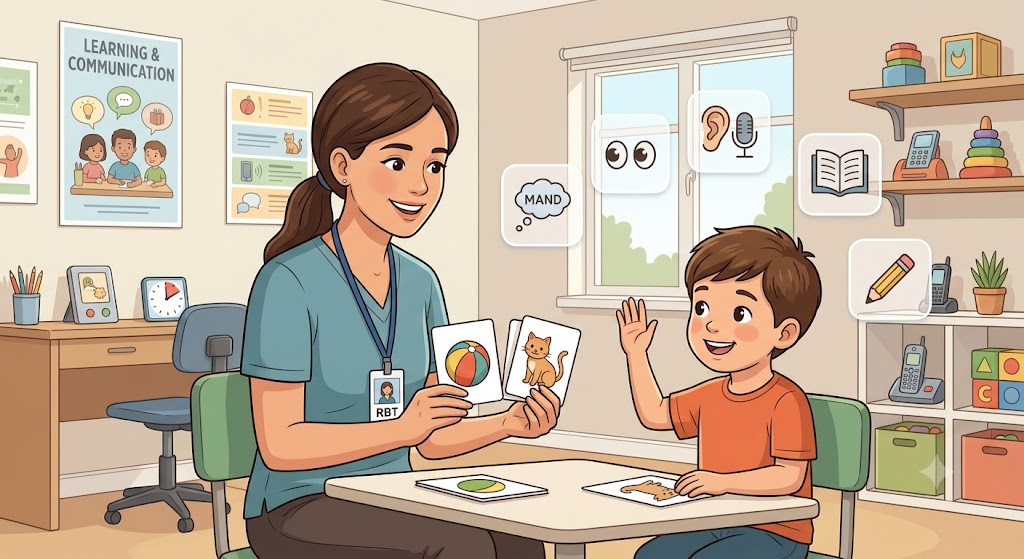
Additional Information
WHAT THE COURSE ENTAILS AND EXAM DETAILS
To become an RBT, you must complete a BACB-approved 40-hour training program. This foundational course covers six key areas of the RBT Task List: Measurement, Assessment, Skill Acquisition, Behavior Reduction, Documentation and Reporting, and Professional Conduct and Scope of Practice.
Within the Skill Acquisition domain, mastery of the Six Verbal Operants is crucial. The final exam, which this resource helps you prepare for, is comprehensive. It evaluates your understanding and ability to implement these concepts. The exam covers all areas of the task list, with significant weight on your practical understanding of fundamental ABA principles. A solid grasp of each verbal operant is essential not just for the test, but for your future professional practice.
WHAT TO EXPECT IN THE FINAL EXAM
The formal RBT exam, administered by the Behavior Analyst Certification Board (BACB) and taken via Pearson VUE, consists of 85 multiple-choice questions. Of these, 10 questions are unscored pilot questions, so your final score is based on 75 questions. Candidates are allotted 90 minutes to complete the test, demanding fluency in the concepts.
You will receive your results, an immediate "Pass" or a detailed report if you do not pass, directly after completing the exam at the testing center. To pass, you must demonstrate a required level of knowledge across all tested content areas, with no fixed percentage score published; rather, it is a passing raw score determined by the BACB for each version. The exam adheres to strict security protocols, prohibiting external aids or electronic devices, and is taken in a proctored environment.
HOW TO STUDY AND EXAM CENTERS
Success on the RBT exam requires a structured and dedicated study plan.
Thorough Training Review: Revisit your 40-hour training materials and notes systematically. Ensure you have a deep understanding of every concept, especially the practical implementation of each task on the RBT task list.
Master the Verbal Operants: Actively learn and differentiate the six verbal operants: Mand, Tact, Echoic, Intraverbal, Textual, and Transcription. Create detailed examples and scenarios for each. Understanding the unique antecedents and consequences of each operant is critical.
Use Active Recall Techniques: Employ flashcards, or the specific SAFMEDS technique (Say All Fast A Minute Everyday Shuffle), to improve speed and recall of key definitions and concepts.
Practice with Mock Exams: Take multiple full-length, timed practice tests, like this one, to simulate the actual exam environment, build stamina, and identify specific content areas that need further study.
Leverage Study Resources: Explore reliable online study guides, interactive quizzes, video breakdowns by BCBAs, and relevant forums. Connecting with others preparing for the exam can offer support and alternative perspectives.
Schedule Your Exam: Once ready and after your supervising BCBA has completed your Initial Competency Assessment, schedule your exam through your BACB account at an authorized Pearson VUE testing center, which can be found globally.
JOB OPPORTUNITIES FROM THE COURSE
An RBT certification unlocks diverse and rewarding career paths in various supportive settings:
Registered Behavior Technician (RBT)
Behavioral Technician
ABA Therapist (Entry Level)
Paraprofessional (in special education settings)
Teaching Assistant (with focus on behavior)
Direct Support Professional (in relevant settings)
Step towards BCBA (Board Certified Behavior Analyst)
Frequently Asked Questions
Reviews
5.0
Based on 0 reviews
Leave a Review
No reviews yet. Be the first to review!