
RCM Certificate Program – Level 6 Theory Practice Test
$69.00
- Buy to unlock unlimited access to all Quiz questions and Answers in this Quiz.
- After purchase you can print a PDF of the whole quiz at any point. The PDF will contain the questions and the correct answers.
About this Exam
The Royal Conservatory of Music (RCM) Level 6 Theory exam is a crucial milestone for advancing music students, typically taken alongside Level 6 practical (instrumental or voice) exams.
This comprehensive certification validates a student's understanding of intermediate music theory concepts, essential for well-rounded musicianship.
Our RCM Level 6 Theory Practice Test is designed to mirror the format, complexity, and scope of the actual RCM evaluation, providing students with an invaluable tool to gauge their readiness and build confidence.
This exam is ideal for serious music students aiming to fulfill their RCM certificate requirements and deepen their understanding of how music is constructed.
Ready to test your knowledge?
Buy Now to Access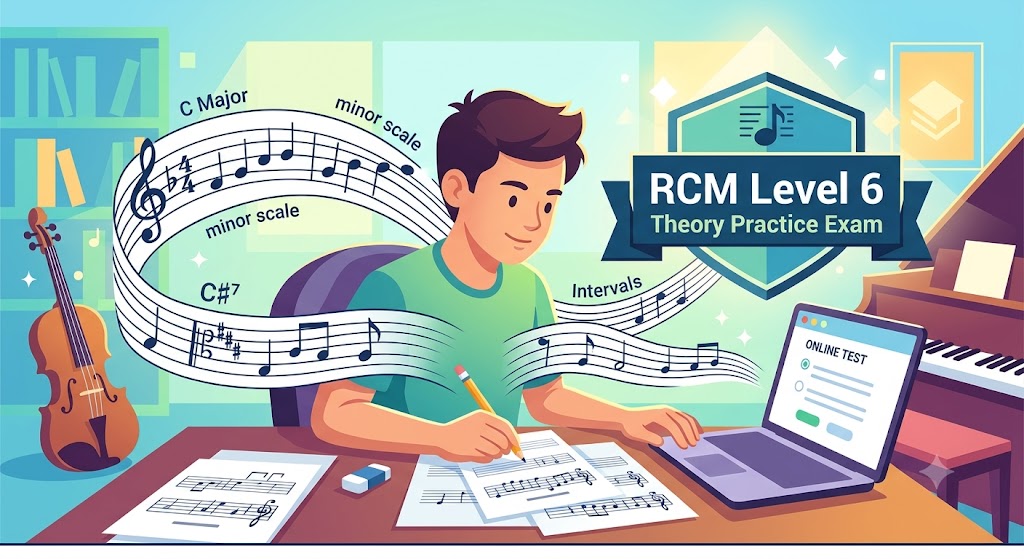
Additional Information
What the Course Entails and Exam Details
The RCM Level 6 Theory curriculum builds significantly upon previous levels, introducing more complex harmonic and structural concepts.
Core topics covered in this practice test, reflecting the official RCM syllabus, include:
Pitch and Notation: Advanced knowledge of all major and minor keys, including related keys; transposition; and C-clefs (alto and tenor).
Rhythm and Meter: Complex time signatures (including hybrid meters), irregular groupings, and advanced rhythmic dictation.
Chords and Harmony: Introduction to four-part harmony (SATB style); identification and writing of triads in all inversions; dominant 7th chords; simple progressions; and intermediate cadences.
Form and Analysis: Detailed analysis of standard musical forms, including binary, ternary, and basic sonata form, within intermediate-level repertoire.
Music History: Introduces foundational concepts of music history, focusing on key composers, styles, and genres from the Baroque and Classical eras.
Melody and Counterpoint: Creating simple melodies and understanding elementary two-part counterpoint principles.
What to Expect in the Final Exam
The actual RCM Level 6 Theory exam is a formal, written examination that must be completed within a strict time limit (usually 2 to 3 hours).
Students should expect a variety of question formats, including:
Notation and Analysis: Writing scales, chords, and intervals; identifying keys; and analyzing musical excerpts for harmony and form.
Realization: Realizing simple figured bass examples or completing a short harmonic progression in four-part style.
Melodic Composition: Completing a short melody based on given opening measures or harmonic progressions.
History and Terms: Multiple-choice or short-answer questions testing knowledge of musical terms, composers, and stylistic characteristics of the Baroque and Classical periods.
The passing grade for all RCM theory examinations is 60%. Students must manage their time effectively to address all sections of the exam.
How to Study and Exam Centers
Preparing effectively for the RCM Level 6 Theory exam requires a structured approach and consistent practice.
Use Official Resources: The primary study materials should be the official RCM Theory Series workbooks and the RCM Theory Syllabus. These provide the definitive scope of the exam.
Consistent Practice: Regular, dedicated study sessions are crucial. Focus on understanding the concepts behind the rules, especially in harmony and counterpoint.
Take Practice Tests: Utilizing practice exams like this one is essential. Mimic exam conditions (silence, time limit) to build stamina and identify weak areas that need further review.
Seek Guidance: Working with a qualified music theory teacher is highly recommended to clarify complex topics and receive personalized feedback on exercises, particularly harmonic realization.
Registration and Centers: Students must register for the exam through their RCM online account. Examinations are held during specific sessions throughout the year at authorized RCM examination centers located in various communities across Canada and the United States, or online via the RCM's remote proctoring system.
Job Opportunities from the Course
While the RCM Level 6 Theory certificate is primarily an academic milestone, it is a critical stepping stone toward advanced musical training and eventual professional careers in music. Successfully completing this level, along with subsequent advanced levels, unlocks numerous pathways.
Specific career areas where this strong theoretical foundation is necessary include:
Private Music Teacher: Required proficiency for teaching RCM curriculum.
Music Educator (School System): Essential background for classroom music teaching.
Professional Musician/Performer: Deepens interpretation and performance ability.
Composer or Arranger: Fundamental skills for creating music.
Music Director or Conductor: Necessary for score analysis and leadership.
Accompanist: Improved reading and harmonic understanding.
Music Journalist or Critic: Essential for informed analysis.
Frequently Asked Questions
Reviews
5.0
Based on 0 reviews
Leave a Review
No reviews yet. Be the first to review!