
Real Estate Council of Ontario (RECO) 1.1 Practice Exam
$69.00
- Buy to unlock unlimited access to all Quiz questions and Answers in this Quiz.
- After purchase you can print a PDF of the whole quiz at any point. The PDF will contain the questions and the correct answers.
About this Exam
Thinking about becoming a registered real estate salesperson in Ontario? This comprehensive guide, and our simulated practice exam for "RECO 1.1," are designed for you. The Real Estate Council of Ontario (RECO) regulates the real estate profession in Ontario, ensuring high standards of professional conduct. While the education program path currently administered by Humber College is the official route to registration, we have structured this guide and practice materials to help you master the foundational concepts, laws, and ethical guidelines that form the core of early real estate education in Ontario. Our "RECO 1.1" materials are ideal for students in the initial phases of their real estate studies, seeking robust practice for essential regulatory and transactional principles.
Whether you are just starting to explore a career in real estate or are actively preparing for your foundational assessments, this resource is your comprehensive companion. Let’s dive in, build your confidence, and make your real estate career dreams a reality!
Ready to test your knowledge?
Buy Now to Access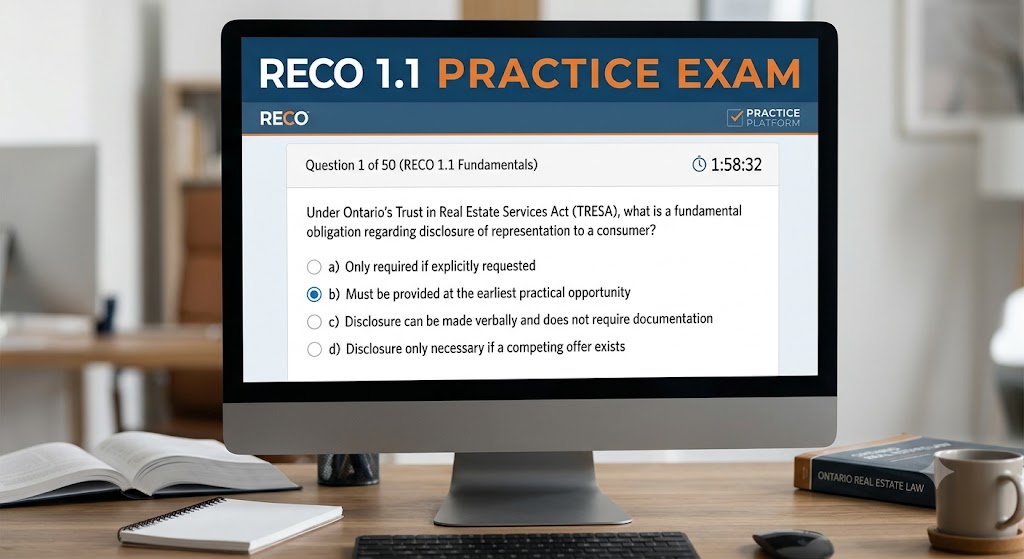
Additional Information
What the Course Entails and Exam Details
This guide and the "RECO 1.1" practice exam specifically focus on the core foundational material that aspiring agents must grasp in the early stages of the Ontario real estate education program. This typically encompasses:
RECO's Role and Structure: Understanding the function of the Real Estate Council of Ontario and the regulatory framework.
The Trust in Real Estate Services Act (TRESA): The crucial legislation governing real estate services in Ontario, including disclosures, advertising, and relationships. (Note: TRESA replaced the previous Real Estate and Business Brokers Act (REBBA)).
Ontario Real Estate Law Fundamentals: Basic principles of property law, contract law, and agency relationships in the context of real estate transactions.
Ethical Guidelines: Comprehensive review of professional conduct and ethical requirements under the RECO Code of Ethics.
Consumer Protection: How RECO and Ontario law protect buyers and sellers.
Foundational Calculations: Introduction to basic math concepts relevant to real estate transactions, commissions, and property values.
Our practice exam simulates a structured approach to assessing these principles. You will encounter multiple-choice questions designed to test your understanding of key terms, scenarios, and your ability to apply the law and code of ethics to realistic situations. This format mirrors the style common to modern assessments in the path to registration.
What to Expect in the Final Exam
While the exact structure can vary depending on the specific exam and the current education program provider (currently Humber College for pre-registration education, often proctored by Pearson VUE), our practice exam and guide prepare you for the typical requirements. For a core foundational exam like the one related to these principles, you should expect:
Exam Format: The primary format is usually a series of multiple-choice questions. This style effectively tests knowledge recall, understanding of concepts, and application to scenarios.
Time Limits: You will likely be given a specific time limit to complete the exam. Standard exam durations for these early modules are often in the range of 1.5 to 2.5 hours. It's crucial to manage your time effectively during practice.
Passing Score: The required passing score is typically set to ensure a strong grasp of the material. A pass mark of around 75% or higher is common for foundational real estate assessments in Ontario. Our practice questions will challenge you to achieve and exceed this level of proficiency.
Proctoring and Rules: Official exams are almost always formally proctored, whether in a physical testing center or through a secure online platform. Strict rules regarding identification, permitted materials (usually none or specific calculators only), and academic integrity will apply. A serious breach can lead to failure or other severe consequences. Understand all official exam policies beforehand.
Our practice materials are designed to simulate the time constraints, multiple-choice format, and the depth of knowledge needed to navigate this assessment successfully. Consistent, well-structured practice is your best tool for building the confidence and competence to excel.
How to Study and Exam Centers
Successfully navigating foundational real estate education and assessments in Ontario requires dedication and effective study techniques. Here are actionable strategies to prepare:
Leverage All Recommended Learning Materials: Thoroughly read and understand the primary study materials (currently provided online through Humber College, which includes modules, readings, and exercises). Pay close attention to definitions, case studies, and practical examples.
Active Reading & Notetaking: Don't just scan the material. Engage actively: summarize key concepts in your own words, create flashcards for definitions and laws (especially TRESA and the Code of Ethics), and develop study guides for each module.
Understand 'Why', Not Just 'What': Real estate law and ethics are principled. Don't just memorize rules; understand the underlying principles and why they exist to protect consumers and maintain professional standards.
Regular Practice & Application: Utilize all official and external practice questions, including simulation exercises and practice exams. Focus on understanding why specific answers are correct and others are not, especially in scenario-based questions.
Time Management in Practice: When taking practice exams, time yourself strictly to replicate the final exam experience and learn to manage your time effectively for each question and section.
Clarify Doubts Promptly: If a concept is unclear, use provided support systems (forums, facilitators, academic resources). Don't let confusion build up.
Group Study (if beneficial): Explain concepts to study partners or discuss scenarios to deepen your understanding. This can be a very effective way to reinforce knowledge.
Maintain Focus & Consistency: Dedicate consistent, focused study periods. Real estate education is comprehensive; consistency is key to retention and depth of knowledge.
Regarding Exam Centers:
All official Ontario real estate pre-registration exams are currently taken through Humber College's education program. These are typically:
Pearson VUE Testing Centers: Physical centers across Ontario (and potentially beyond, if permitted) that provide a secure, proctored environment for computer-based testing.
Online Proctoring: For many assessments, you can choose to take the proctored exam online using your computer with secure software and a live human proctor. This requires specific system requirements and environment guidelines.
Ensure you check the current procedures and center locations (or online requirements) for each exam well in advance of scheduling, as these details can be updated.
Job Opportunities from the Course
Successfully mastering the foundational knowledge represented by "RECO 1.1" is a critical and necessary step on your journey to becoming a registered real estate salesperson in Ontario. Once you complete the entire registration education program (currently through Humber College), pass all relevant exams and simulations, and find a sponsoring brokerage, you must apply to RECO for registration.
Achieving RECO registration unlocks several direct career paths and related job titles within the vibrant Ontario real estate sector. These include:
Registered Real Estate Salesperson (also often referred to as a Real Estate Agent or Consultant): This is the primary role, allowing you to legally trade in real estate services for clients (buying, selling, or leasing properties). You can work in:
Residential Real Estate
Commercial Real Estate
Agricultural Real Estate
Industrial Real Estate
Rental Market Representation
Brokerage Operations and Management (with experience and further education/registration): After gaining experience and completing broker-level education and registration requirements, you can progress to roles like:
Registered Real Estate Broker
Broker of Record
Branch Manager
Assistant Branch Manager
Related Specialized Roles (some may require additional certification or specialized experience): Your fundamental real estate knowledge is valuable for positions such as:
Real Estate Administrator / Brokerage Support Staff
Real Estate Marketing Coordinator
Property Management Staff (managing properties for owners)
Real Estate Investment Analyst (with analytical skills)
Real Estate Appraiser (requires separate education and licensing)
Real Estate Auctioneer (specialized area)
Frequently Asked Questions
Reviews
5.0
Based on 0 reviews
Leave a Review
No reviews yet. Be the first to review!