
Real Estate National Salesperson Practice Exam
$69.00
- Buy to unlock unlimited access to all Quiz questions and Answers in this Quiz.
- After purchase you can print a PDF of the whole quiz at any point. The PDF will contain the questions and the correct answers.
About this Exam
The Real Estate National Salesperson Practice Exam is an essential preparatory tool for aspiring real estate agents. This practice test is designed to simulate the national portion of the official licensing examination, a critical hurdle for anyone seeking to practice real estate in the vast majority of United States jurisdictions. The practice exam assesses your understanding of fundamental real estate principles, legal concepts, and industry practices that are universal across the country. It is specifically created for students who have completed their pre-licensing education and want to gauge their readiness, identify knowledge gaps, and build confidence before sitting for the high-stakes final exam. Passing the subsequent official exam is the standard path to becoming a licensed real estate salesperson.
Ready to test your knowledge?
Buy Now to Access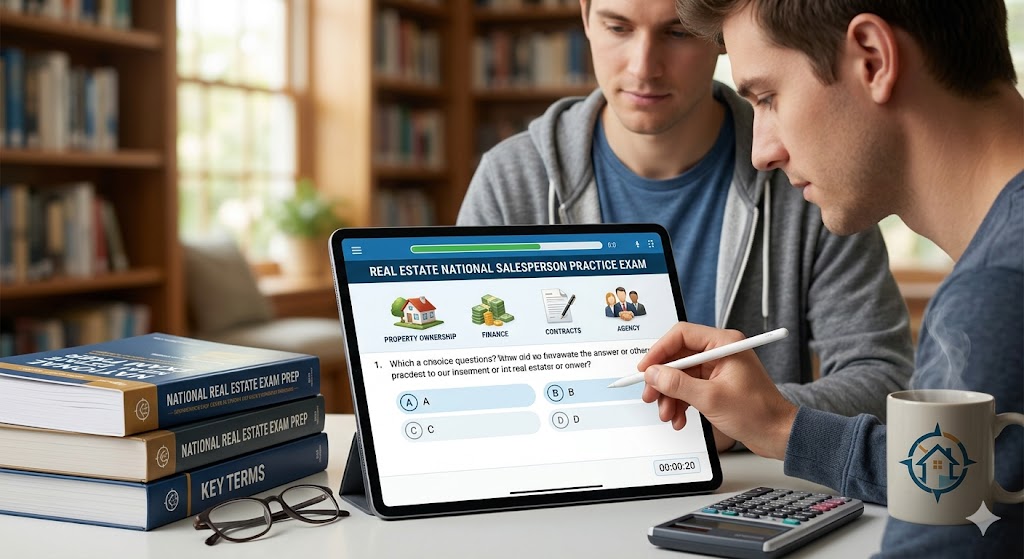
Additional Information
What the Course Entails and Exam Details
This practice exam covers the core curriculum required for national real estate licensure, mirroring the content outlines provided by major testing providers like Pearson VUE and PSI. The course of study and the practice test are structured around key domains, including:
Real Property Characteristics: Differentiating between real and personal property, understanding physical and economic characteristics of land, and mastering legal descriptions.
Forms of Ownership: Studying freeholds, leaseholds, joint tenancy, tenancy in common, and the bundle of rights.
Transfer of Title: Understanding deeds, title insurance, closing statements, and the recording process.
Valuation and Market Analysis: Grasping appraisal principles, the three approaches to value (Sales Comparison, Cost, Income), and the basics of Comparative Market Analysis (CMA).
General Principles of Agency: Learning fiduciary duties, types of agency relationships (single, dual, transactional), and disclosure requirements.
Real Estate Contracts: Mastering the elements of a valid contract, listing agreements, buyer representation agreements, and sales contracts.
Finance: Understanding mortgages, types of loans (FHA, VA, Conventional), and lending laws like TILA-RESPA.
Leasing and Property Management: Covering lease types, landlord-tenant laws, and property manager responsibilities.
The practice exam typically focuses exclusively on the national content and does not include state-specific laws, rules, or regulations, which are tested in a separate portion of the official exam.
What to Expect in the Final Exam
When you transition from the practice exam to the final, official Real Estate Salesperson Licensing Exam, you can expect a rigorous, proctored experience. While details can vary slightly by state, the standard structure for the national portion involves:
Format: The exam is entirely computer-based and primarily consists of multiple-choice questions.
Number of Questions: The national section usually contains between 80 and 120 scored questions, plus a small number of non-scored "pretest" questions used for future exam development.
Time Limit: Candidates are generally given approximately 120 to 150 minutes (2 to 2.5 hours) specifically for the national portion.
Passing Score: The typical passing score for the national section is 70% or 75%. This is a scaled score, not a raw percentage of correct answers.
Rules: Official exams require strict identification verification. You will likely be prohibited from bringing personal items, including cell phones, into the testing room. Basic, non-programmable calculators are usually allowed. There is no penalty for guessing, so you should answer every question.
How to Study and Exam Centers
Successfully passing the Real Estate National Salesperson Exam requires a strategic study plan and dedicated practice. Here are proven methods to prepare:
Simulate Exam Conditions: Take practice exams in a quiet environment without interruptions, adhering to the official time limit. This builds stamina and helps you manage your time effectively.
Focus on Weaknesses: Review your practice exam diagnostic reports. Instead of re-studying what you know, dedicate extra time to the topic areas where you scored lowest.
Master Vocabulary: Real estate has its own language. Create or use digital flashcards to memorize key terms and definitions. Misunderstanding a single word can lead to an incorrect answer.
Understand the "Why": Do not just memorize answers. Ensure you understand the underlying concept for both correct and incorrect choices in your practice test feedback.
Form a Study Group: Discussing complex concepts with peers can clarify your understanding and expose you to different problem-solving approaches.
Exam Centers:
You do not take the official licensing exam through a course provider or school. Instead, once you have your "Authorization to Test" from your state’s real estate commission, you must schedule your appointment with an authorized independent testing vendor. The most common national vendors are:
PSI Exams Online
Pearson VUE
These vendors have physical testing centers located in major cities throughout the United States. In recent years, some states have also authorized the use of remote, online-proctored testing, allowing you to take the exam from home under strict surveillance.
Job Opportunities from the Course
Successfully completing your pre-licensing course, mastering the practice exams, and passing the National and State licensing tests opens the door to a dynamic and varied career in real estate. While you must work under the supervision of a licensed broker initially, here are the primary career paths and job titles this license unlocks:
Residential Real Estate Agent: Helping clients buy, sell, or rent homes, condos, and apartments.
Commercial Real Estate Agent: Specializing in the sale or lease of income-producing properties like office buildings, retail spaces, and industrial sites.
Leasing Agent/Consultant: Working primarily for property management companies to find tenants and manage lease agreements for residential or commercial properties.
Real Estate Broker: After gaining experience and completing additional education, you can upgrade your license to manage other agents or own your own brokerage.
Property Manager: Overseeing the day-to-day operations, maintenance, and tenant relations for a property owner's investment.
Real Estate Consultant: Providing expert advice to clients on property research, analysis, and investment strategies.
Real Estate Appraiser: With further specialized training and a separate license, a real estate background is excellent preparation for valuing properties.
Frequently Asked Questions
Reviews
5.0
Based on 0 reviews
Leave a Review
No reviews yet. Be the first to review!