
RECF Computer Science Certification Practice Exam
$69.00
- Buy to unlock unlimited access to all Quiz questions and Answers in this Quiz.
- After purchase you can print a PDF of the whole quiz at any point. The PDF will contain the questions and the correct answers.
About this Exam
The RECF (Robotics Education & Competition Foundation) Computer Science/Programming Module is an essential industry credential for students aiming to validate their knowledge and skills in STEM, robotics, and fundamental programming. This module is a vital component of the comprehensive RECF Robotics Industry Certification. It is designed primarily for high school and post-secondary students who are involved in robotics programs, computer science courses, or Career and Technical Education (CTE) pathways, providing them with a tangible advantage in a competitive field.
Ready to test your knowledge?
Buy Now to Access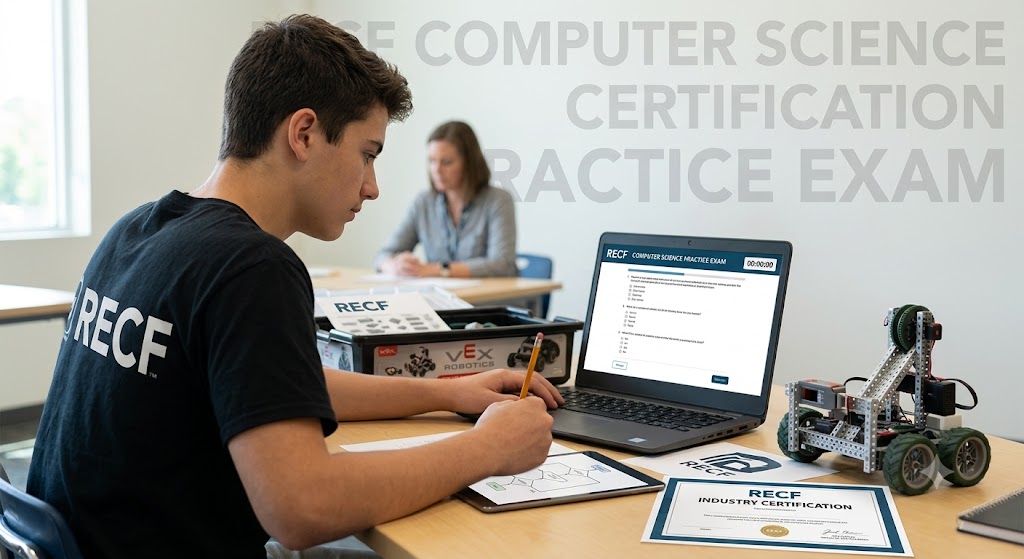
Additional Information
What the Course Entails and Exam Details
The RECF Computer Science/Programming module exam covers a broad spectrum of core competencies required for effective robotics programming and algorithmic problem-solving. While the RECF does not mandate a specific curriculum, students are tested on their ability to apply theoretical concepts in practical scenarios.
Key topics included in the exam syllabus:
Programming Fundamentals: Understanding and applying core concepts such as variables, data types, operators, and control structures (loops, conditional statements).
Data Structures: Knowledge of arrays, lists, and other fundamental ways to organize data within a program.
Algorithmic Logic and Problem Solving: Developing and analyzing algorithms, creating flowcharts, and tracing code to determine its output and efficiency.
Robotics Integration: The application of programming to control a robotic system, including sensor feedback, motor control, and autonomous decision-making.
Software Development Principles: Basic debugging, testing, and documentation practices, which are critical for building reliable systems.
What to Expect in the Final Exam
The RECF Computer Science/Programming module is a rigorous, proctored, online examination that demands a solid understanding of both theoretical and applied computer science concepts.
Format: The exam consists of approximately 90 to 100 multiple-choice and complex problem-solving questions. Some questions may require students to interpret code snippets or complete logic puzzles.
Time Limit: Students are typically given a standard, set amount of time (e.g., 90 minutes) to complete the exam. Accommodations for extended time may be available based on individual needs and school policies.
Passing Score: The minimum passing score is 70% for this and all modular RECF exams, as well as the Fundamentals of Engineering exam.
Rules: The exam must be taken in a controlled, proctored environment, ensuring the integrity of the certification. Retakes are permitted after a waiting period, typically 20 calendar days, with a maximum of three attempts per academic year.
How to Study and Exam Centers
Preparation is key to success on the RECF Computer Science/Programming exam. RECF provides a wealth of resources, including official practice exams that simulate the actual testing environment. Actionable strategies include:
Official Practice Tests: Utilize the official RECF practice exams extensively. These identify knowledge gaps and familiarize you with the question style and format.
Code Review: Rigorously review and annotate code from your robotics season or coursework. Practice writing algorithms to solve specific mechanical challenges.
Competition and Projects: Actively participate in robotics competitions and independent coding projects. This real-world application of skills is the best preparation.
Concept Mastery: Strengthen your understanding of fundamental concepts like binary logic, flowcharts, and control flow before moving on to complex applications.
Exam Centers:
The RECF exams are administered online. Students usually take the exam through their high school or post-secondary institution. Educators must register as authorized test administrators and adhere to a Proctor Agreement. This system allows for flexible scheduling within an approved, monitored testing environment, ensuring the certification is accessible to students nationwide.
Job Opportunities from the Course
Earning the RECF Computer Science/Programming module, especially when combined with other components of the full Robotics Industry Certification, opens a wide range of career and educational pathways. It demonstrates to employers and universities that you possess not only theoretical knowledge but also practical, hands-on experience.
Junior Robotics Programmer: Writing, testing, and debugging code for robotic systems in manufacturing, logistics, or research.
STEM Educator or Coach: Teaching high school or middle school students fundamental engineering and programming principles.
Robotics Technician: Maintaining, troubleshooting, and repairing complex robotic and automated systems.
Software Developer (Entry-Level): Utilizing core programming and logical reasoning skills to contribute to diverse software applications.
CAD and Systems Technician: Designing and programming automated workflows for engineering projects.
CTE Program Instructor: Leading vocational and technical education programs focused on engineering and technology.
Manufacturing Systems Associate: Working with automated equipment and control software in a manufacturing environment.
Mechatronics Apprentice: Gaining advanced practical experience in a program that bridges mechanical, electrical, and computer engineering.
Frequently Asked Questions
Reviews
5.0
Based on 0 reviews
Leave a Review
No reviews yet. Be the first to review!