
Records and Information Management (RIM) Practice Exam
$69.00
- Buy to unlock unlimited access to all Quiz questions and Answers in this Quiz.
- After purchase you can print a PDF of the whole quiz at any point. The PDF will contain the questions and the correct answers.
About this Exam
The Records and Information Management (RIM) certification exam is a prestigious milestone for professionals seeking to validate their expertise in data governance and asset lifecycle management.
It is specifically designed for records managers, compliance officers, and information governance professionals who handle sensitive organizational data.
Earning this certification proves your ability to systematically manage information from its creation through its final disposal.
By passing the RIM exam, you demonstrate to employers that you can safeguard corporate memory, reduce litigation risks, and ensure strict regulatory compliance.
Whether you are looking to break into the industry or elevate your current career, this practice exam serves as the perfect stepping stone to achieving your professional goals.
Ready to test your knowledge?
Buy Now to Access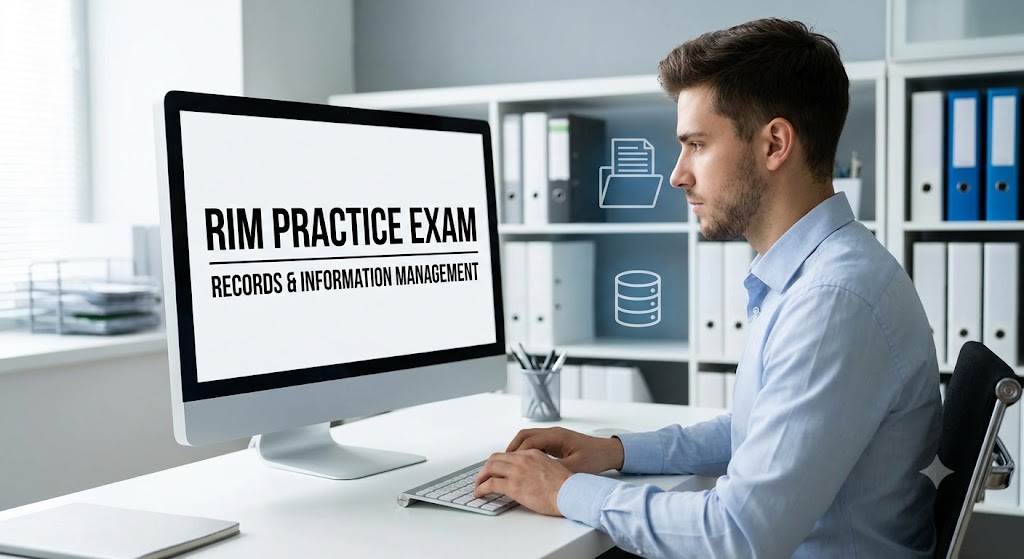
Additional Information
What the Course Entails and Exam Details
Preparing for the RIM exam requires a deep understanding of several core competencies within the information management spectrum.
The syllabus heavily emphasizes the records lifecycle, encompassing creation, storage, retrieval, archiving, and secure destruction.
You will dive into the principles of information governance, learning how to align data management strategies with broader business objectives.
The course material also covers the critical differences between managing physical records and navigating the complexities of electronic and cloud-based data.
Additionally, you will develop vital skills in regulatory compliance, risk management, and business continuity planning to protect organizations during unexpected disasters.
Mastering these topics ensures you are fully equipped to implement structured, secure, and efficient records programs in any corporate environment.
What to Expect in the Final Exam
The final certification exam is rigorously structured to test both your theoretical knowledge and your practical application of records management principles.
Typically, the exam format consists of multiple-choice questions that cover various domains of information governance.
Some advanced certification levels may also include written case studies to evaluate your strategic problem-solving abilities.
Candidates are generally given a strict time limit of about two hours to complete each specific section of the test.
To achieve certification, you will typically need to secure a passing score of 70% or higher, depending on the specific administering body.
Strict exam rules apply, including the prohibition of outside reference materials and mandatory identity verification procedures before you begin.
How to Study and Exam Centers
Success on the RIM exam requires a highly organized and consistent study strategy.
Begin by thoroughly reviewing industry standards provided by organizations like ARMA International and the Institute of Certified Records Managers (ICRM).
Taking multiple practice exams is one of the most effective methods to familiarize yourself with the question formats and identify your weak areas.
You should also create flashcards to memorize complex retention schedules, legal terminology, and regulatory acronyms.
When you are ready to test, you can easily schedule your exam through global testing networks like Pearson VUE.
These platforms offer the flexibility of taking the exam via a secure online proctored portal from your home, or at a specific authorized physical testing center near you.
Job Opportunities from the Course
Earning your RIM certification immediately unlocks a wide variety of lucrative and stable career paths across corporate, legal, and government sectors.
Here are the specific job titles you can pursue after completing the course:
Records and Information Manager
Information Governance Specialist
Chief Privacy Officer
Corporate Archivist
Document Control Manager
Regulatory Compliance Analyst
Data Retention Consultant
Electronic Discovery (eDiscovery) Specialist
Frequently Asked Questions
Reviews
5.0
Based on 0 reviews
Leave a Review
No reviews yet. Be the first to review!