
Red Cross Advanced Life Support (ALS) Practice Exam
$69.00
- Buy to unlock unlimited access to all Quiz questions and Answers in this Quiz.
- After purchase you can print a PDF of the whole quiz at any point. The PDF will contain the questions and the correct answers.
About this Exam
The Red Cross Advanced Life Support (ALS) certification is designed for healthcare professionals who direct or participate in the management of cardiopulmonary arrest or other cardiovascular emergencies. This course aims to improve outcomes for adult patients of cardiac arrest and other cardiopulmonary emergencies through high-performance team dynamics and high-quality individual skills. It is essential training for medical personnel working in critical care, emergency departments, or pre-hospital environments.
Ready to test your knowledge?
Buy Now to Access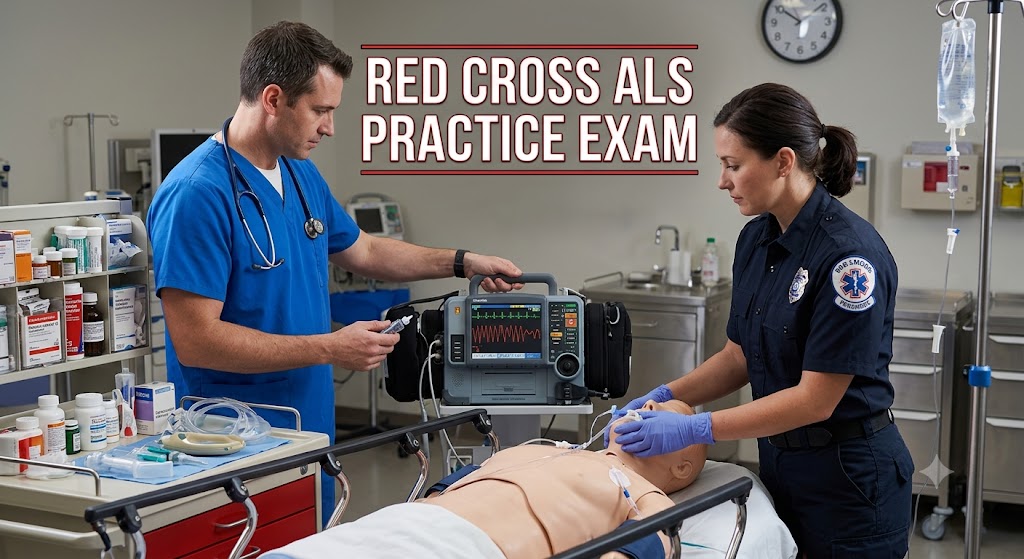
Additional Information
What the Course Entails and Exam Details
The ALS course focuses on a systems-oriented approach to emergency care. Participants will deepen their understanding of:
Recognizing and managing early signs of peri-arrest conditions (bradycardia, tachycardia).
High-quality CPR and the use of Automated External Defibrillators (AEDs).
Advanced airway management and ventilation techniques.
Relevant pharmacology, including the identification and administration of resuscitation drugs.
Management of acute coronary syndromes (ACS) and stroke.
Leading and communicating effectively as a member or leader of a resuscitation team.
What to Expect in the Final Exam
The certification process generally requires passing both a cognitive (written) exam and a psychomotor (practical) skills evaluation.
Cognitive Exam: The written assessment typically consists of multiple-choice questions covering all core concepts of the ALS algorithms, pharmacology, and ECG rhythm recognition. It usually has a set time limit (e.g., 60-90 minutes). A passing score, often 80% or higher, is required to demonstrate theoretical proficiency.
Psychomotor Exam: The practical component is a critical hands-on evaluation, often called the "mega code." Students must lead a resuscitation team through a simulated cardiac arrest scenario, demonstrating correct assessment, algorithm application, appropriate drug choices, rhythm interpretation, and effective team leadership. This is typically graded on a pass/fail basis based on critical performance steps.
How to Study and Exam Centers
Preparation is key to success on the ALS exam.
Review the Manual: Thoroughly study the current American Red Cross ALS Provider Manual. It contains the essential guidelines and algorithms you must know.
Practice Algorithms: Memorize the flowcharts for Cardiac Arrest, Tachycardia with a Pulse, Bradycardia with a Pulse, and Immediate Post-Cardiac Arrest Care.
ECG Recognition: Dedicate time to interpreting ECG rhythms quickly and accurately. This is fundamental for both the written and practical exams.
Practice Scenarios: Utilize practice scenarios to run through mock medical emergencies, practicing your team leadership and decision-making skills.
You can register for Red Cross ALS courses through the official American Red Cross website or via authorized training providers. The course includes the classroom instruction and the practical skills assessment. The cognitive (written) exam may be administered online or at the authorized training facility.
Job Opportunities from the Course
Earning your ALS certification is mandatory or highly beneficial for numerous high-demand healthcare roles, including:
Registered Nurse (specifically in ICU, ER, and Critical Care units)
Paramedic
Emergency Medical Technician (Advanced/Paramedic level)
Physician (Emergency Medicine, Critical Care, Cardiology)
Anesthesiologist
Respiratory Therapist
Flight Medic/Flight Nurse
Cardiac Catheterization Lab Personnel
Frequently Asked Questions
Reviews
5.0
Based on 0 reviews
Leave a Review
No reviews yet. Be the first to review!