
Red Hat Certified Architect (RHCA) Certification Practice Exam
$69.00
- Buy to unlock unlimited access to all Quiz questions and Answers in this Quiz.
- After purchase you can print a PDF of the whole quiz at any point. The PDF will contain the questions and the correct answers.
About this Exam
The Red Hat Certified Architect (RHCA) certification is designed for senior-level system administrators, database administrators, system integrators, and software developers who are responsible for deploying and managing many systems in large enterprise environments.
The RHCA is the highest level of certification offered by Red Hat. It serves as a capstone, proving that a candidate who is already a current Red Hat Certified Engineer (RHCE) has attained the depth and breadth of knowledge necessary to manage a robust Red Hat infrastructure. The program offers specialization tracks, allowing you to tailor your qualification towards specific enterprise needs, such as data center automation, cloud, virtualization, and application infrastructure. Earning the RHCA designation requires a candidate to pass five additional higher-level specialist exams beyond the RHCE level.
Ready to test your knowledge?
Buy Now to Access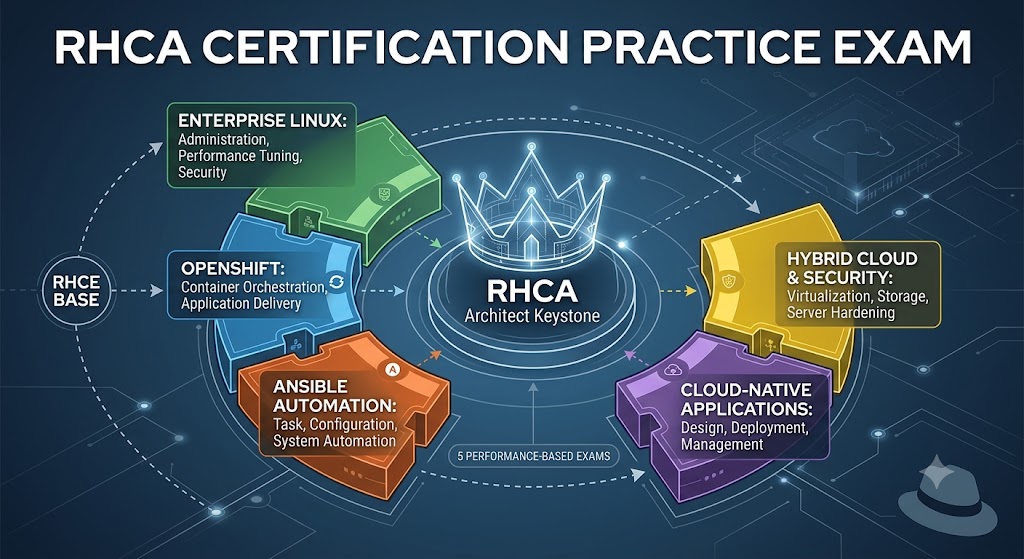
Additional Information
What the Course Entails and Exam Details
The RHCA certification journey does not follow a single course syllabus; rather, it is a modular achievement. To earn the designation, you must choose from two primary paths: RHCA in Infrastructure or RHCA in Enterprise Applications. Each path requires you to earn specific specialist certifications from Red Hat.
The 'RHCA Certification Practice Exam' in this context is a holistic preparation strategy. You do not study for one exam but master the skills required for five distinct, performance-based assessments. For example, to follow an RHCA in Infrastructure path, you might choose to take exams covering specializations like Red Hat Enterprise Virtualization, OpenShift Administration, Clustering and High Availability, Performance Tuning, or Server Hardening. The curriculum for each of these certifications is dense, hands-on, and directly reflects real-world scenarios.
What to Expect in the Final Exam
You must understand a critical point about all Red Hat certification exams: they are 100% performance-based.
Do not expect multiple-choice or true/false questions. The 'final exam' for each of the five specialist qualifications involves you logging into one or more live Red Hat systems and performing a series of tasks. You will be asked to configure, manage, deploy, troubleshoot, or secure specific technologies. Passing scores are not based on your theoretical knowledge but on your ability to produce the correct result on a live system within a strict time limit, typically three to four hours per exam.
The exams are closed-book, but you will have access to any standard documentation that is typically installed with the product on the system (e.g., manual pages, local documentation). Your ability to quickly locate information within these resources is a tested skill.
How to Study and Exam Centers
Preparation for the performance-based specialist exams must be, above all, hands-on.
Actionable Study Strategies:
Build Your Own Lab: The single most effective way to study is by doing. Set up a laboratory environment using Red Hat products on personal hardware or virtual machines. Practice installing, configuring, and breaking the technologies until you can perform common tasks from memory.
Follow Official Red Hat Training: Red Hat offers extensive training courses for every specialist exam. While not required to take the exams, these courses are highly recommended and are designed around the same objectives you will face in the testing environment.
Review Exam Objectives: Red Hat publishes detailed, public objectives for every certification exam. Use these lists as your roadmap. For every bullet point, ensure you can perform that task on a live system without guidance.
Utilize Authorized Practice Exams: For specific exams, Red Hat provides official practice exam formats. While these may not be identical to the actual test, they will mirror the structure and environment, helping you manage your time and expectations.
Exam Centers:
Red Hat provides multiple, flexible testing options:
Online Remote Exams: You can take your performance-based exams remotely, from your own home or office, using Red Hat's secure remote testing portal and live proctoring.
In-Person Testing: You can schedule exams at Pearson VUE testing centers or at authorized Red Hat Training Partners (RHPs). Red Hat has a large global network of physical testing locations.
Onsite Exams: If your company has a group of candidates, Red Hat can send a proctor and equipment to your workplace to administer exams onsite.
Job Opportunities from the Course
Earning your Red Hat Certified Architect designation opens the door to senior-level roles that define, design, and secure an organization's IT strategy. Red Hat certifications are universally recognized and sought after by major enterprise organizations, including banks, health providers, and government agencies.
This certification unlocks specific, elite career paths:
Senior Systems Architect
Platform Engineer
Infrastructure Architect
Chief Technology Officer (CTO)
Enterprise Architect
Senior DevOps Engineer
Data Center Solutions Architect
Cloud Infrastructure Manager
Principal Consultant
IT Security Architect
Frequently Asked Questions
Reviews
5.0
Based on 0 reviews
Leave a Review
No reviews yet. Be the first to review!