
Red Seal Agricultural Equipment Technician Practice Exam
$69.00
- Buy to unlock unlimited access to all Quiz questions and Answers in this Quiz.
- After purchase you can print a PDF of the whole quiz at any point. The PDF will contain the questions and the correct answers.
About this Exam
The Red Seal Agricultural Equipment Technician certification is a vital endorsement for Canadian tradespeople specializing in the maintenance and repair of modern agricultural machinery. This designation, recognized across all provinces and territories, represents the Interprovincial standard for competence in the trade. The final Red Seal exam is the culminating step in an apprenticeship or for experienced tradespersons seeking to validate their expertise. It assesses a candidate’s practical knowledge, diagnostic abilities, and critical thinking regarding complex mechanical, hydraulic, electrical, and electronic systems found on tractors, combines, and various farming implements. This practice exam is designed as a powerful preparatory tool to help you identify knowledge gaps, build confidence, and master the style of question you will encounter in the actual exam.
Ready to test your knowledge?
Buy Now to Access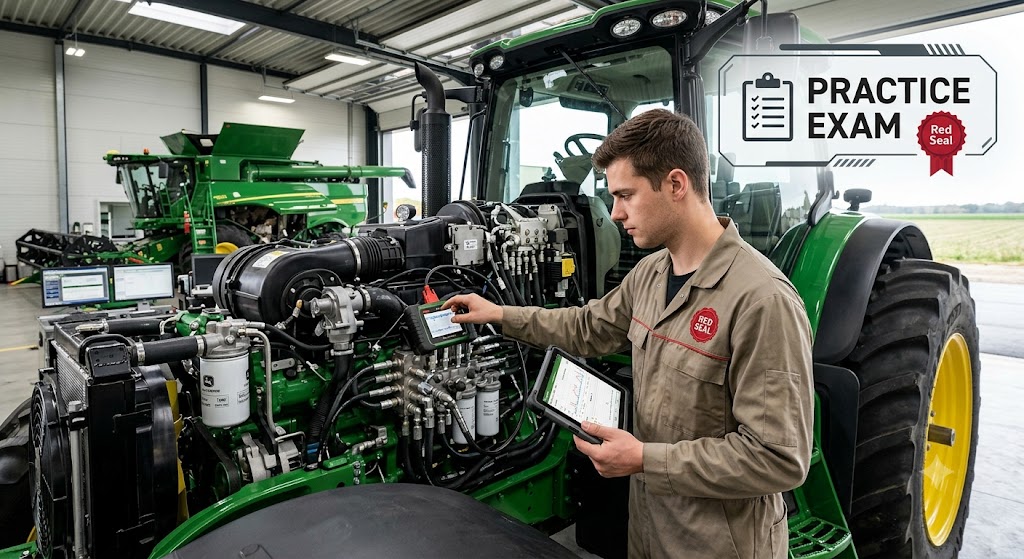
Additional Information
What the Course Entails and Exam Details
The material covered by the Red Seal Agricultural Equipment Technician exam is defined by the National Occupational Analysis (NOA) for the trade. While specific preparatory "courses" may vary, the exam itself evaluates standard interprovincial competencies. The core areas of study and examination focus are:
Common Occupational Skills: This includes health and safety, using and maintaining hand and power tools, precision measuring instruments, and effective communication and mentoring techniques.
Engines and Engine Support Systems: Diagnosis and repair of diesel engine mechanical systems, fuel systems, intake and exhaust, and lubrication/cooling.
Powertrains: Coverage of clutches, mechanical and power shift transmissions, hydrostatic drives, differential systems, and final drive assemblies.
Hydraulics, Hydrostatics, and Pneumatics: Extensive knowledge of hydraulic principles, pumps, motors, valves, and the troubleshooting of integrated open- and closed-loop systems.
Electrical and Electronic Systems: Mastering circuit fundamentals, batteries, charging/starting systems, and the complex control monitoring systems, multiplexing, and precision farming technologies.
Steering, Brakes, and Suspension: Diagnosing and repairing both mechanical and power steering, hydraulic braking systems, and suspension components for both wheeled and tracked machines.
Structural Components and Operator Stations: Work on frames, chassis, and climate control systems (HVAC) within the operator's cab.
Agricultural Equipment: Specific systems for land preparation, tillage, seeding, planting, harvesting, hay/forage, and application/irrigation equipment.
What to Expect in the Final Exam
The official Red Seal exam is a rigorous test. Here is what to anticipate on exam day:
Format: The exam consists entirely of multiple-choice questions. For the Agricultural Equipment Technician trade, there are typically 125 questions.
Time Limit: You will be given a standard four-hour time slot to complete the exam. Efficient time management is critical.
Passing Score: The pass mark is 70?ross all Red Seal trades. Your score report will break down your performance in each major work activity area.
Question Types: Questions are not just based on simple recall. They are categorized into knowledge and recall, procedural and application, and critical thinking (diagnosis and troubleshooting). The majority of the Agricultural Equipment Technician exam focuses on procedural and critical thinking questions.
Rules and Materials: The exam is strictly proctored. You must bring government-issued photo identification and your exam confirmation letter. You are generally not allowed to use personal electronic devices. A basic calculator and specific reference documents (like mathematical formulas or specialized code charts, if applicable) are provided by the testing center. You should confirm the exact allowed materials with your local apprenticeship authority.
How to Study and Exam Centers
Effective preparation for the Red Seal exam requires a strategic approach:
Study the National Occupational Analysis (NOA): This is your definitive study guide. The exam questions are developed directly from the tasks and sub-tasks listed in the NOA. Allocate your study time based on the "weighting" of each section (the percentage of questions assigned to that topic).
Utilize Practice Exams: Take advantage of practice exams that closely mimic the structure and content of the real test. They are invaluable for familiarizing yourself with the multiple-choice format, identifying your weak areas, and simulating the four-hour testing environment. Focus on critical thinking questions.
Review Textbooks and Manuals: Dig back into your technical training textbooks and, just as importantly, modern manufacturer service manuals. These contain the detailed procedural information and diagnostic charts essential for advanced questions.
Form Study Groups: Collaborating with peers can expose you to different perspectives on complex systems and provide mutual support.
Exam Centers: You cannot book the final Red Seal exam through general-purpose online portals like Pearson VUE. To write the exam, you must first be approved by your provincial or territorial apprenticeship authority (e.g., Skilled Trades Ontario, SkilledTradesBC, Alberta Apprenticeship and Industry Training). Once approved, you will coordinate with your local authority to schedule the exam. Tests are typically administered at specific government offices, authorized post-secondary colleges, or dedicated trade-specific testing facilities within your jurisdiction. Some provinces now utilize specialized online proctoring systems (e.g., rsexam.ca in Ontario), but booking always originates through the jurisdictional authority.
Job Opportunities from the Course
Achieving your Red Seal Agricultural Equipment Technician designation validates your journey-level expertise and unlocks numerous high-demand, well-paying career paths. Career titles unlocked by this certification include:
Red Seal Agricultural Equipment Technician: The primary, interprovincially recognized journey-level designation.
Farm Equipment Mechanic/Technician: Specializing in all aspects of modern farming machinery, from simple tillage tools to advanced combines.
Dealership Service Technician: Working with major manufacturers (e.g., John Deere, Case IH) providing comprehensive diagnosis, repair, and warranty work.
Field Service Technician: A dynamic role that involves traveling to on-field locations to provide mobile diagnosis and emergency repairs, often with a mobile workshop vehicle.
Heavy Duty Mechanic (Agricultural Specialization): Working in diverse shops that handle both heavy construction and agricultural machinery.
Precision Agriculture Technician: Focusing on the integration, calibration, and troubleshooting of advanced GPS, autopilot, yield monitoring, and telematics systems.
Service Manager/Service Writer: Moving into dealership leadership, managing teams of technicians, organizing scheduling, and handling customer relations.
Technical Support Specialist: Working with manufacturers, providing second-level technical guidance to dealership technicians.
Frequently Asked Questions
Reviews
5.0
Based on 0 reviews
Leave a Review
No reviews yet. Be the first to review!