
REG Certified Public Accountant (CPA) Practice Test
$69.00
- Buy to unlock unlimited access to all Quiz questions and Answers in this Quiz.
- After purchase you can print a PDF of the whole quiz at any point. The PDF will contain the questions and the correct answers.
About this Exam
The Regulation (REG) section of the Uniform CPA Examination is a critical hurdle for aspiring Certified Public Accountants, focusing on a candidate's understanding of federal taxation, ethics, professional responsibilities, and business law. This comprehensive exam ensures that CPAs possess the necessary knowledge to navigate the complex legal and regulatory landscape of accounting. It is designed for individuals who have met the educational requirements to sit for the CPA exam and are seeking to demonstrate their competence in tax compliance, planning, and professional conduct. Achieving passing scores on all four CPA exam sections, including REG, is a significant milestone that leads to licensure and opens doors to diverse career opportunities.
Ready to test your knowledge?
Buy Now to Access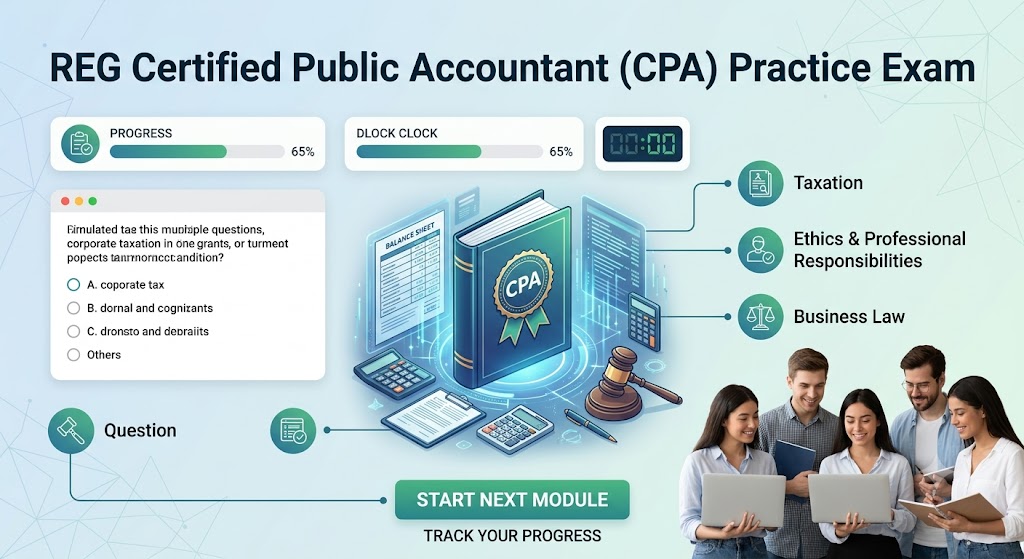
Additional Information
What the Course Entails and Exam Details
This section of the CPA exam delves deeply into several core areas, requiring both conceptual knowledge and practical application.
The core areas covered in the REG section include:
Federal Taxation: This includes individuals, entities (C corporations, S corporations, partnerships), and property transactions. Candidates must demonstrate proficiency in calculating taxable income, deductions, credits, and filing requirements.
Ethics, Professional Responsibilities, and Federal Tax Procedures: This covers the AICPA Code of Professional Conduct, Treasury Department Circular 230, and relevant federal tax procedures, emphasizing the highest ethical standards for CPAs.
Business Law: This includes contracts, agency, Uniform Commercial Code (UCC), debtor-creditor relationships, and government regulation of business. Understanding these legal concepts is essential for navigating various business scenarios.
The REG exam is a four-hour test that incorporates a combination of multiple-choice questions (MCQs) and task-based simulations (TBS). The MCQs assess candidates' knowledge and understanding of key concepts, while the TBS require them to apply their knowledge to realistic scenarios, such as preparing tax returns or analyzing legal documents.
What to Expect in the Final Exam
The REG section, like all CPA exam sections, is a rigorous assessment that requires thorough preparation. Candidates should expect a balanced mix of MCQs and TBS.
Key details of the REG exam include:
Format: 72 MCQs and 8 TBS. The exam is divided into five testlets, with two MCQ testlets and three TBS testlets.
Passing Score: A minimum score of 75 on a scale of 0-99 is required to pass the REG section.
Time Limit: Candidates have four hours to complete the exam. Effective time management is crucial to ensure all questions and simulations are addressed.
Specific Rules: Candidates are not permitted to use calculators or other electronic devices. A basic digital calculator is provided within the exam software.
The difficulty level of the MCQs adapts based on the candidate's performance on previous testlets. TBS are designed to simulate real-world tasks and may include research questions that require candidates to locate specific information in official tax resources.
How to Study and Exam Centers
Preparation for the REG section requires a structured and disciplined approach. Utilizing high-quality CPA review courses that offer practice exams, video lectures, and task-based simulations is essential.
Effective study strategies include:
Comprehensive Review: Dedicate significant time to reviewing all topics covered in the REG syllabus. Pay close attention to taxation, ethics, and business law.
Practice, Practice, Practice: Solve numerous MCQs and TBS to become familiar with the exam format and question types. This helps build speed and accuracy.
Simulate Exam Conditions: Take full-length practice exams under timed conditions to experience the pressure of the actual exam. This helps identify weak areas and improve time management.
Focus on TBS: TBS carry significant weight, so dedicate sufficient time to practicing them. Understand the process of analyzing realistic scenarios and applying your knowledge.
The CPA exam is administered at Prometric testing centers throughout the United States and internationally. Candidates must schedule their exam in advance at a time and location that is convenient for them. Online testing is not available for the CPA exam.
Job Opportunities from the Course
Earning the CPA license unlocks a wide range of rewarding career opportunities in public accounting, industry, government, and non-profit organizations.
CPAs with expertise in regulation and taxation are highly sought after for various roles, including:
Tax Manager: Leading tax departments, advising clients on complex tax strategies, and ensuring compliance with tax laws.
Corporate Tax Accountant: Managing tax affairs for corporations, including planning, compliance, and reporting.
Public Accountant: Providing tax, audit, and advisory services to clients of all sizes, from individuals to large corporations.
Government Auditor: Auditing government agencies and ensuring compliance with regulations.
Forensic Accountant: Investigating financial crimes and legal disputes.
Financial Analyst: Analyzing financial data to help businesses make informed decisions.
CFO or Controller: Leading the financial operations of an organization.
Frequently Asked Questions
Reviews
5.0
Based on 0 reviews
Leave a Review
No reviews yet. Be the first to review!