
REMSA Emergency Medical Technician (EMT) Division 1 Practice Exam
$69.00
- Buy to unlock unlimited access to all Quiz questions and Answers in this Quiz.
- After purchase you can print a PDF of the whole quiz at any point. The PDF will contain the questions and the correct answers.
About this Exam
The REMSA Emergency Medical Technician (EMT) Division 1 course is your foundational step into the high-stakes, essential world of Emergency Medical Services. This program, specifically designed and delivered by REMSA Health in Northern Nevada, prepares you to act decisively and compassionately as the first critical link in the chain of survival. If you are a dedicated individual who thrives under pressure, possesses a strong desire to help others, and wants to start a meaningful career in prehospital emergency care, this certification is for you.
This practice exam is a comprehensive tool developed to mirror the core competencies, knowledge, and practical scenarios encountered in the REMSA EMT Division 1 curriculum, leading towards state and potentially national (NREMT) certification.
Ready to test your knowledge?
Buy Now to Access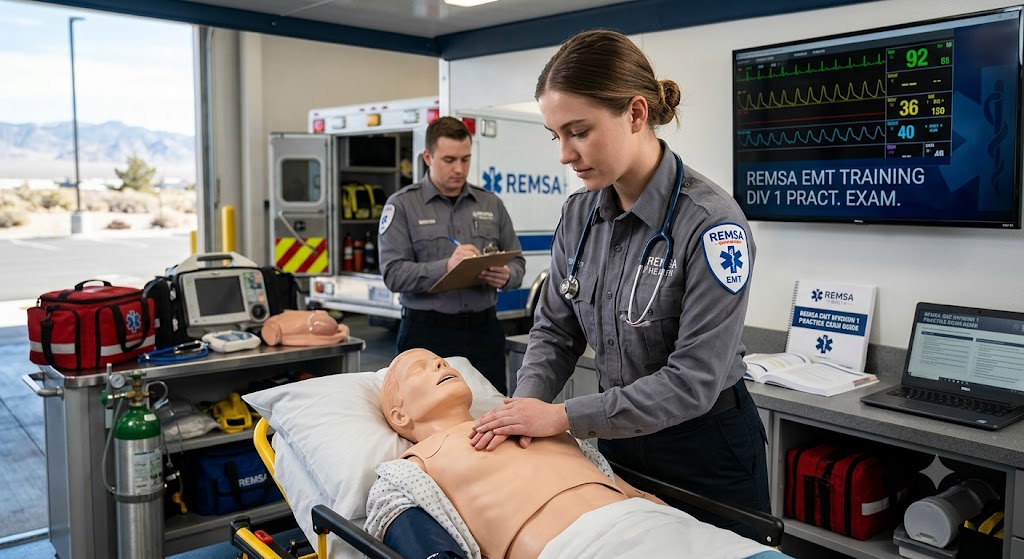
Additional Information
What the Course Entails and Exam Details
Your journey to become a REMSA EMT Division 1 certified provider involves rigorous training and assessment. The course curriculum is built upon and exceeds national and Nevada state standards, including the latest evidence-based practices in prehospital care. You will gain a deep understanding of:
EMS Systems and Safety: Learning the roles of an EMT, operating safely on scenes, and understanding communication and documentation.
Anatomy and Physiology: Acquiring foundational knowledge of the human body and how it is affected by illness and injury.
Airway Management & Patient Assessment: Mastering critical skills to secure airways and perform systematic, effective primary and secondary assessments of medical and trauma patients.
Medical Emergencies: Recognizing and treating conditions like respiratory distress, cardiac arrest, diabetic emergencies, seizures, and allergic reactions.
Trauma Care: Applying life-saving techniques for managing bleeding, shock, chest injuries, abdominal trauma, skeletal fractures, and head/spinal injuries.
Pharmacology & Medications: Learning standard medications EMTs administer and assist with, understanding dosages, and side effects.
Special Populations: Addressing the unique needs of pediatric, geriatric, and obstetric patients.
Clinical Rotations & Practicals: Essential hands-on experience through supervised clinical hours and dynamic, simulated scenarios using high-fidelity manikins and real-world equipment.
The final REMSA assessment typically consists of both a comprehensive written examination (which this practice exam simulates) and a rigorous practical skills assessment.
What to Expect in the Final Exam
The final assessment process for your REMSA EMT Division 1 certification will consist of:
Written Cognitive Exam: A comprehensive, multi-topic multiple-choice exam, often administered via a computerized adaptive format (CAT). The CAT dynamically adapts question difficulty based on your performance to gauge your entry-level competency in all key areas. Expect a diverse range of questions (historically 70–120 for national exams, time limits generally around 2 hours) across five core domains: Scene Size-Up and Safety, Primary Assessment, Secondary Assessment, Patient Treatment and Transport, and Operations. You must demonstrate sufficient competency across these areas to pass.
Practical Skills Assessment (NREMT or Equivalent): A hands-on, scenario-based examination. You will be evaluated on your ability to perform critical EMT skills smoothly, accurately, and safely, under time constraints and the observation of certified evaluators. Scenarios often include a Medical Patient Assessment and Management station, a Trauma Patient Assessment and Management station, as well as stations for specific skills like splinting, spinal immobilization, airway management, and CPR/AED. A pass in every station, or successful retesting within specific guidelines, is required.
Passing scores for the written exam are typically based on the scaled score or demonstrating a clear pass at entry-level competency, as determined by the certifying body and/or Nevada state regulations.
How to Study and Exam Centers
Preparing for your REMSA EMT Division 1 exam requires dedication and a structured approach. Actively apply these strategies:
Comprehensive Review: Systematically study your entire textbook, REMSA-provided lecture notes, and training materials. Focus on understanding the why and how behind treatments, not just memorization.
Practice, Practice, Practice: Utilize comprehensive practice exams like this one and reputable online prep services. These help you understand the question formats, timing, and identify areas where you need more focus.
Master the Skills: Attending all practical labs and seeking extra practice sessions is crucial. Role-play scenarios with classmates, ensuring you can perform the full patient assessment and each skill smoothly and explain your steps.
Form Study Groups: Collaborating with peers allows you to test each other, debate scenarios, and explain complex concepts, reinforcing your own learning.
Use Visual & Audio Aids: Leverage anatomy charts, instructional videos for skills, and EMS podcasts for reinforced learning.
Stay Physically & Mentally Prepared: Maintain good health, get adequate sleep before the exam, and arrive with a positive, focused mindset.
Upon successful completion of the course and meeting all REMSA prerequisites, you will be guided on the registration process for both the final REMSA practical and written exams. This typically involves registering through the National Registry of EMTs (NREMT) and scheduling your written exam at an authorized Pearson VUE testing center in your area (likely within Northern Nevada/Reno for REMSA students). REMSA Health typically conducts the practical skills assessments at their own accredited training facilities.
Job Opportunities from the Course
Successfully achieving your REMSA EMT Division 1 certification opens doors to a variety of impactful and career-focused roles in emergency services, including:
Emergency Medical Technician (EMT): The primary role on ambulances, fire departments, and private transport services, providing critical prehospital care.
Ambulance Attendant / Driver: Supporting paramedic or AEMT crews in responding to and transporting patients.
Emergency Room Technician: Working in hospital emergency departments, assisting with patient care, procedures, and basic tasks.
Firefighter/EMT: Many fire departments require or highly encourage EMT certification for dual roles.
Search and Rescue Technician: Utilizing EMT skills in challenging environments with rescue organizations.
Industrial EMT: Providing basic medical support at large industrial sites, events, or in occupational health settings.
Event Medic: Staffing large public events like concerts, sports games, or festivals.
Frequently Asked Questions
Reviews
5.0
Based on 0 reviews
Leave a Review
No reviews yet. Be the first to review!