
RESNA ATP Certification Practice Exam
$69.00
- Buy to unlock unlimited access to all Quiz questions and Answers in this Quiz.
- After purchase you can print a PDF of the whole quiz at any point. The PDF will contain the questions and the correct answers.
About this Exam
The Rehabilitation Engineering and Assistive Technology Society of North America (RESNA) Assistive Technology Professional (ATP) certification is a gold-standard credential for professionals specializing in analyzing the equipment and technology needs of consumers with disabilities. It is designed for occupational therapists, physical therapists, speech-language pathologists, engineers, equipment suppliers, and other dedicated individuals who provide assistive technology services and solutions. Earning the ATP certification validates your expertise, improves consumer confidence, and signals a commitment to ethical, consumer-centered practices in the dynamic field of assistive technology.
Ready to test your knowledge?
Buy Now to Access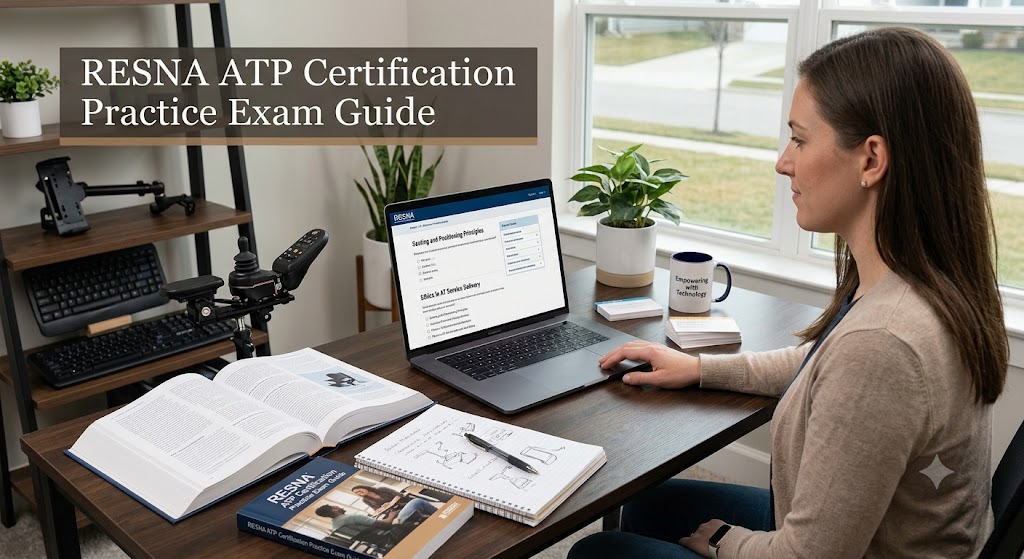
Additional Information
What the Course Entails and Exam Details
Outline the core topics, syllabus, or skills covered.
The ATP certification process ensures proficiency in essential assistive technology practices.
While a single course doesn't encapsulate the full requirement (which depends on a mix of education and experience), the core curriculum and exam content focus on comprehensive knowledge.
Key domains covered include: principles of AT service delivery; understanding individual needs and environmental factors; selecting, configuring, and modifying specific types of AT (e.g., seating and mobility, communication aids, cognitive supports); training and following up with consumers; ethics; and managing resources and safety.
The syllabus emphasizes practical application and the ATP's role in a team approach, integrating principles of assessment, implementation, and ongoing support for various disability populations across different environments.
What to Expect in the Final Exam
Detail the exam format (multiple choice, practical, etc.), passing score requirements, time limits, and any specific rules.
The final ATP certification exam is a computer-based, standardized test.
It consists of approximately 200 multiple-choice questions designed to assess an applicant's foundational knowledge and practical understanding across the defined AT practice areas.
Candidates are generally given a specific time frame, often around four hours, to complete the exam.
While the exact passing score isn't always publicly defined by a fixed percentage (as it can involve scaling), it is determined by the RESNA Professional Standards Board to reflect the necessary competence for a certified professional.
Testing environments are controlled and require government-issued photo ID. Scores are typically provided relatively quickly after completion of the exam, guiding candidates on their next steps.
The exam is psychometrically sound and rigorous, reflecting the high standards of the ATP designation.
How to Study and Exam Centers
Provide actionable study strategies and practice methods. Explain where and how to take the exam (e.g., online portals, Pearson VUE, specific physical testing centers or authorized schools).
Effective preparation for the ATP exam combines multiple strategies.
First, review the RESNA ATP Candidate Information Manual for official guidance and domain breakdowns.
Dedicated study groups and peer discussion are valuable for applying concepts.
Practice exams and sample questions (like those offered through preparatory resources or practice tests) are essential for familiarizing yourself with the multiple-choice format and style.
Many candidates find success with online preparatory courses that focus specifically on the ATP material.
To take the exam, you must first apply and be approved by RESNA.
Once approved, candidates register for an appointment.
The exam is typically administered at computer-based testing centers through a partner organization like Pearson VUE, which has numerous physical testing locations worldwide.
Online proctoring may also be an option in certain situations. Candidates are encouraged to check the RESNA website for current center availability and registration procedures.
Job Opportunities from the Course
Create a clear list or table showing the specific job titles and career paths this certification unlocks.
Achieving ATP certification can significantly broaden your career prospects in assistive technology.
This credential is widely recognized and respected, opening doors in various settings such as hospitals, rehabilitation centers, schools, state and federal agencies, community-based organizations, and the commercial AT industry.
Common job titles and career paths unlocked include:
Assistive Technology Professional (ATP) Specialist
Rehabilitation Technology Supplier
Seating and Mobility Specialist
Adaptive Equipment Coordinator
Accessible Technology Consultant
Assistive Technology Manager in schools or human services
Product Development Specialist in the AT industry
Special Education Teacher specializing in AT
Therapist (OT, PT, SLP) with ATP designation
Frequently Asked Questions
Reviews
5.0
Based on 0 reviews
Leave a Review
No reviews yet. Be the first to review!