
RHO1 Scripting and Programming Foundations Practice Exam
$69.00
- Buy to unlock unlimited access to all Quiz questions and Answers in this Quiz.
- After purchase you can print a PDF of the whole quiz at any point. The PDF will contain the questions and the correct answers.
About this Exam
Embarking on a career in scripting and programming requires a solid foundation in the core concepts of logic and computational thinking. The Scripting and Programming Foundations (RHO1) exam is designed precisely to validate this crucial knowledge for newcomers to the world of software development. It targets aspiring developers, IT professionals aiming to add scripting to their skillset, or students entering computer science programs who need to prove their understanding of how computer code truly operates at a fundamental level. Achieving a pass in this exam or mastering its concepts through a practice test demonstrates that you have grasped the logic, structure, and problem-solving techniques essential before diving deeply into specific coding languages.
Ready to test your knowledge?
Buy Now to Access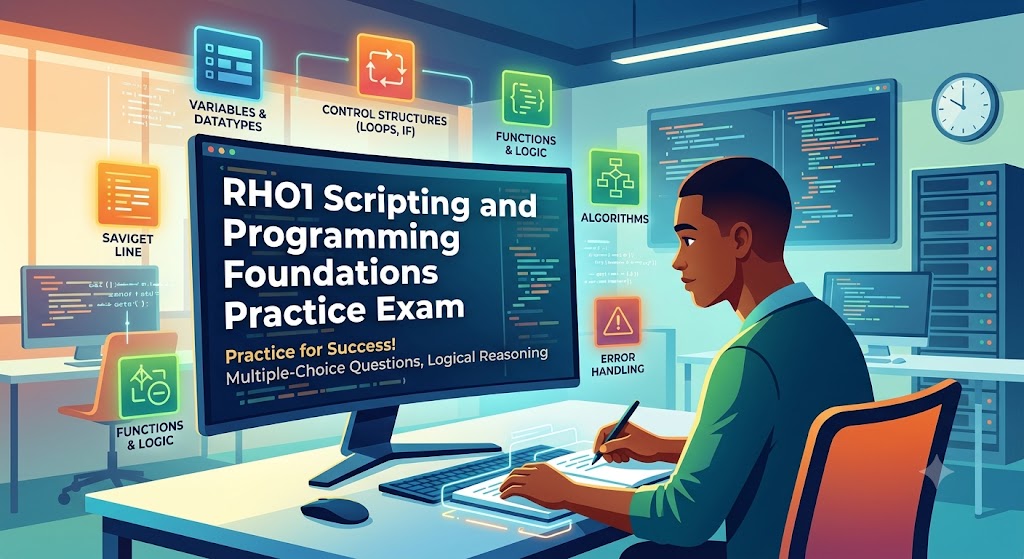
Additional Information
What the Course Entails and Exam Details
This foundational course does not dive into complex syntax of one specific programming language; instead, it focuses on the universal concepts that underpin almost all of them. A robust study approach, including utilizing practice exams, will cover topics like basic scripting structures, variable types, operators, mathematical expressions, and branching logic (like if/else statements). You’ll explore loop control structures, functional programming concepts (defining and calling functions), and understanding variable scope. Key emphasis is placed on logical operators, evaluating expressions, data types, standard algorithms (e.g., searching, sorting basics), and thinking algorithmically to solve problems. It instills fundamental skills such as identifying syntax, logic, and runtime errors. Reviewing the syllabus ensures you are prepared for questions that test these essential building blocks.
What to Expect in the Final Exam
While a practice exam is an invaluable preparation tool, knowing what the actual final exam entails sets you up for ultimate success. The final RHO1 exam typically consists of multiple-choice questions or similar assessment formats that carefully test your theoretical understanding of the concepts outlined above. You will have a defined time limit, which can vary, so practicing with a timed practice test is excellent for time management. A specific passing score (e.g., 70% or 75%) must be achieved to earn certification. Expect questions to present short code snippets or algorithmic problems and ask for the expected output, the correction needed, or the core logical concept being demonstrated. The exam is usually closed-book and non-proctored, though institutional rules can apply.
How to Study and Exam Centers
Effective studying for the Scripting and Programming Foundations (RHO1) exam, especially using practice tests, requires a strategic approach. First, thoroughly review all course materials, textbooks, and notes to solidify your conceptual understanding. Second, make extensive use of quality practice tests. Treat them as simulated exams, timing yourself and creating a focused environment to identify your weaknesses accurately. Analyze every incorrect answer on your practice tests and revisit those specific concepts immediately. Consider creating flashcards for key definitions, variable types, and logical rules. Break complex algorithms into smaller, manageable parts to understand how data flows. The real exam, often associated with specific academic or professional institutions, might be administered through various online proctoring services, internal university testing platforms, or sometimes at designated physical testing centers such as educational institutions or authorized vendors like Pearson VUE, depending on the program offering the certification. Verify the exact delivery method and center details with your course administrator.
Job Opportunities from the Course
A strong performance on the Scripting and Programming Foundations (RHO1) exam and related practice tests is a significant first step that can open doors to various introductory and specialized roles within the IT and development sectors. It signals to potential employers that you have a fundamental aptitude for logical reasoning and programming concepts. Here are some job opportunities and career paths this certification or the solid knowledge it represents can help you pursue:
Junior Software Developer Web Development Assistant IT Support Specialist with Scripting Quality Assurance (QA) Tester (Manual/Introductory Automation) Network Administrator Assistant (with basic automation tasks) Database Administrator Assistant Systems Analyst Trainee Programming Apprentice
Frequently Asked Questions
Reviews
5.0
Based on 0 reviews
Leave a Review
No reviews yet. Be the first to review!