
RHS Radiation Safety Practice Test
$69.00
- Buy to unlock unlimited access to all Quiz questions and Answers in this Quiz.
- After purchase you can print a PDF of the whole quiz at any point. The PDF will contain the questions and the correct answers.
About this Exam
The RHS Radiation Safety Certification is designed for individuals working with radioactive materials and ionizing radiation sources in various industrial, research, and medical settings. This certification verifies that an individual possesses the fundamental knowledge and skills required to safely handle, store, and manage radiation, ensuring compliance with federal and state regulations. It is essential for Radiation Safety Officers (RSOs), laboratory technicians, industrial radiographers, and medical personnel who work with X-ray machines or radioactive isotopes.
Ready to test your knowledge?
Buy Now to Access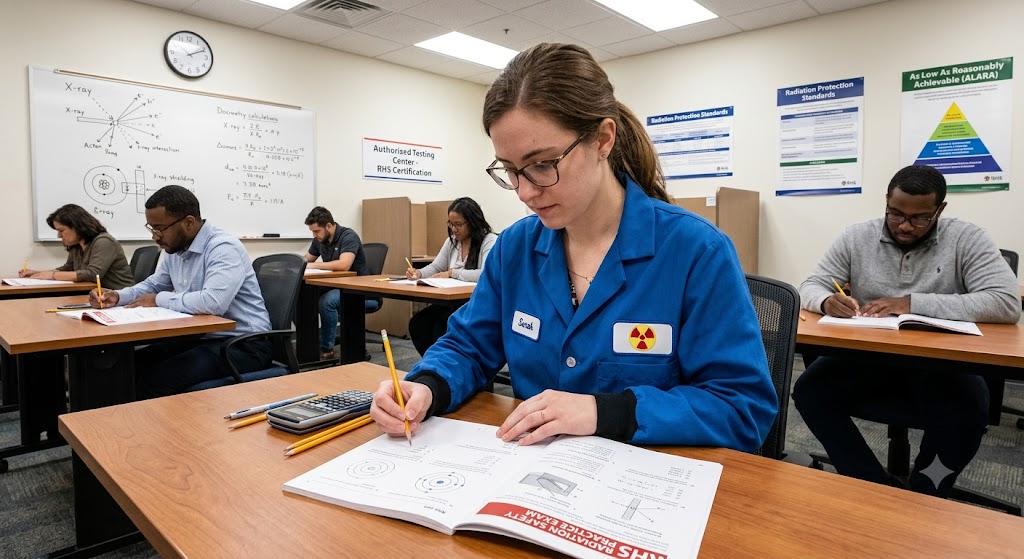
Additional Information
What the Course Entails and Exam Details
The RHS Radiation Safety course is a comprehensive program that covers the core principles of radiation protection. The curriculum typically includes:
Atomic structure and radioactive decay.
Types of radiation (alpha, beta, gamma, X-ray, neutron) and their properties.
Interaction of radiation with matter.
Radiation biological effects and risk assessment.
Units of radiation measurement (rem/sievert, curie/becquerel).
Principles of external and internal radiation protection (Time, Distance, Shielding).
Radiation detection instrumentation and monitoring techniques.
Regulatory requirements (USNRC, state agencies) and dose limits.
Emergency procedures and incident response.
Transportation and disposal of radioactive material.
What to Expect in the Final Exam
The RHS Radiation Safety final exam is a rigorous assessment of knowledge. While specific details may vary slightly depending on the certifying body (e.g., specific state programs or private organizations), you can generally expect the following format:
Format: Multiple-choice questions. Some exams may include true/false or short-answer questions.
Duration: The exam typically lasts between 2 and 4 hours.
Passing Score: A minimum score, usually around 70-80%, is required to pass and obtain certification.
Specific Rules: The exam is closed-book. You are usually not permitted to use any notes, calculators, or reference materials during the test. Verification of identity is mandatory.
How to Study and Exam Centers
To succeed on the RHS Radiation Safety Exam, a systematic approach is necessary:
Review Course Materials: Thoroughly study the provided textbook, lectures, and regulatory guides.
Utilize Practice Exams: Take multiple RHS Radiation Safety practice exams to identify knowledge gaps and get comfortable with the question style and time constraints.
Study Regulatory Guides: Familiarize yourself with the relevant regulations from the Nuclear Regulatory Commission (NRC) or your state's radiation control program.
Join Study Groups: Discussing concepts with peers can clarify complex topics.
Practical Application: If possible, participate in practical exercises involving radiation monitoring and handling (e.g., safe source handling, instrument calibration).
You can typically take the RHS Radiation Safety exam through several channels:
Authorized Training Providers: Many organizations that offer radiation safety training also administer the certification exam upon completion of the course.
State Regulatory Agencies: Some states offer their own radiation safety exams for licensure.
Online Portals: Some certifying bodies provide secure online proctoring services.
Authorized Testing Centers: Select physical locations, often affiliated with technical colleges or industry organizations, may offer the exam.
Job Opportunities from the Course
Obtaining RHS Radiation Safety Certification opens up various career opportunities in numerous fields. Potential job titles include:
Radiation Safety Officer (RSO)
Health Physics Technician
Industrial Radiographer
Laboratory Safety Specialist
X-ray Technician
Nuclear Medicine Technologist
Environmental Health & Safety (EHS) Coordinator
Radiation Shielding Specialist
Non-Destructive Testing (NDT) Technician
Frequently Asked Questions
Reviews
5.0
Based on 0 reviews
Leave a Review
No reviews yet. Be the first to review!