
RID Code of Professional Conduct (CPC) Practice Exam
$69.00
- Buy to unlock unlimited access to all Quiz questions and Answers in this Quiz.
- After purchase you can print a PDF of the whole quiz at any point. The PDF will contain the questions and the correct answers.
About this Exam
The RID Code of Professional Conduct (CPC) Practice Exam is an essential tool for interpreters seeking to uphold the highest ethical standards in the field of sign language interpretation. The Registry of Interpreters for the Deaf (RID) established this code to provide clear ethical guidelines for certified and associate members, as well as for all participants in the certification process. This practice exam is specifically designed for aspiring interpreters preparing for the National Interpreter Certification (NIC) interview and performance exam, as well as working professionals who want to ensure their decision-making aligns with current industry standards. Mastery of the CPC is not just about passing a test; it is about demonstrating the professional judgment and integrity necessary to serve the Deaf and hard-of-hearing communities effectively and respectfully.
Ready to test your knowledge?
Buy Now to Access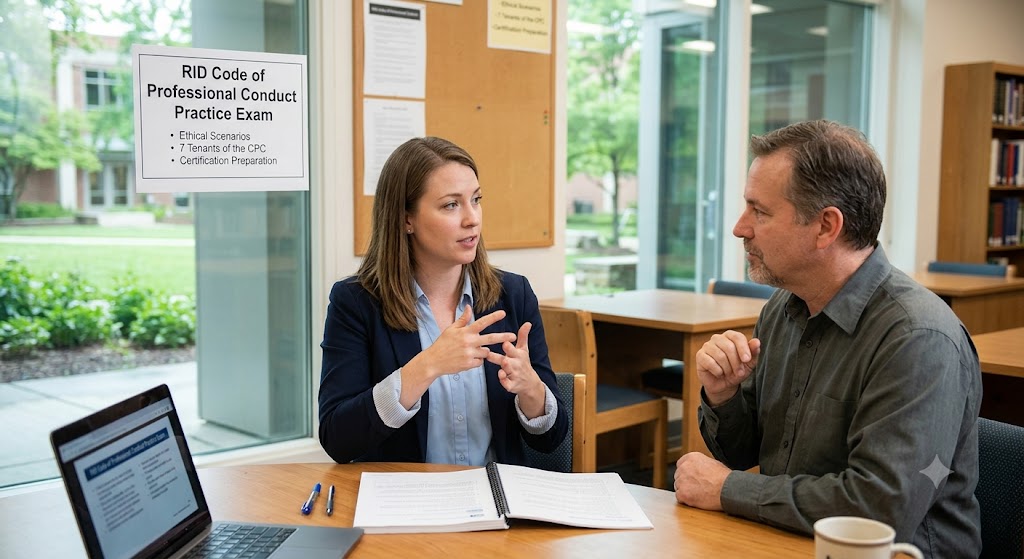
Additional Information
What the Course Entails and Exam Details
This practice resource focuses on the application of the seven tenets that form the foundation of the RID Code of Professional Conduct. The tenets covered include:
Confidentiality: Adhering to standards of confidential communication.
Professionalism: Possessing the professional skills and knowledge required for the specific interpreting situation.
Conduct: Conducting oneself in a manner appropriate to the specific interpreting situation.
Respect for Consumers: Demonstrating respect for consumers (Deaf and hearing clients).
Respect for Colleagues: Demonstrating respect for colleagues, interns, and students of the profession.
Business Practices: Maintaining ethical business practices.
Professional Development: Engaging in professional development.
The practice exam provides various scenarios that require you to apply these tenets. Understanding these areas ensures that interpreters can navigate complex interpersonal dynamics and ethical dilemmas common in the field.
What to Expect in the Final Exam
While RID does not offer a standalone "CPC Exam," ethical judgment based on the Code of Professional Conduct is a critical component of the National Interpreter Certification (NIC) process. In the formal NIC testing process, you can expect the following:
Exam Format: Ethical application of the CPC is primarily tested within the NIC Interview and Performance Exam. Candidates are presented with interpreting vignettes and ethical dilemmas, which may require written or signed responses.
Question Types: You will likely encounter problem-solving scenarios. You must identify the core ethical conflict, reference the relevant CPC tenets, and propose a professional course of action.
Passing Score: RID determines the passing score for the NIC exam through psychometric analysis. Candidates must demonstrate competence across all domains tested.
Time Limits: The NIC Interview and Performance Exam has a specific time allotment. Candidates must be prepared to synthesize the scenario, form an ethical decision, and articulate that decision efficiently.
How to Study and Exam Centers
Effective preparation requires a deep internalization of the CPC tenets, not just memorization. Here are actionable study strategies:
Study Strategies:
Analyze the Core Document: Download and meticulously review the full RID Code of Professional Conduct, paying close attention to the illustrative behaviors provided for each tenet.
Scenario-Based Practice: Utilize study guides and practice forums (like those provided by RID or interpreter training programs) that offer ethical dilemmas. Discuss these scenarios with mentors or study groups to gain different perspectives on CPC application.
Relate to Real-World Experience: If you are working as an intern or an associate interpreter, reflect on past assignments and consider how the CPC applies to the situations you encountered.
Exam Centers:
When you are ready to take the formal NIC certification exam, you will not register for a generic test center like Pearson VUE for the performance portion.
RID Authorized Test Sites: The NIC Interview and Performance exam is typically administered through RID Authorized Test Sites (ATS). These sites are often located within university interpreter training programs or other Deaf-related organizations. You can find a list of current sites on the official RID website.
Job Opportunities from the Course
A strong understanding of the CPC is required for any professional interpreting role and is mandatory for maintaining RID certification. Mastering this content is essential for career paths such as:
Educational Interpreter (K-12 or Post-Secondary)
Medical Interpreter
Legal Interpreter
Video Relay Service (VRS) Interpreter
Freelance Community Interpreter
Mental Health Interpreter
Frequently Asked Questions
Reviews
5.0
Based on 0 reviews
Leave a Review
No reviews yet. Be the first to review!