
ROC 3 Part 1 Practice Exam
$69.00
- Buy to unlock unlimited access to all Quiz questions and Answers in this Quiz.
- After purchase you can print a PDF of the whole quiz at any point. The PDF will contain the questions and the correct answers.
About this Exam
The ROC 3 Part 1 Certification is a premier, foundational credential for professionals aiming to establish a career in the rapidly growing field of fiber optics and advanced network infrastructure. This exam is meticulously designed to validate a candidate's comprehensive understanding of fiber optic theory, safety protocols, and essential installation and maintenance skills, with a particular focus on FTTH (Fiber to the Home) and FTTx (Fiber to the X) architectures. It is the ideal first step for telecommunications technicians, network installers, field engineers, and anyone seeking to formally document their expertise and practical proficiency in modern optical networks.
Ready to test your knowledge?
Buy Now to Access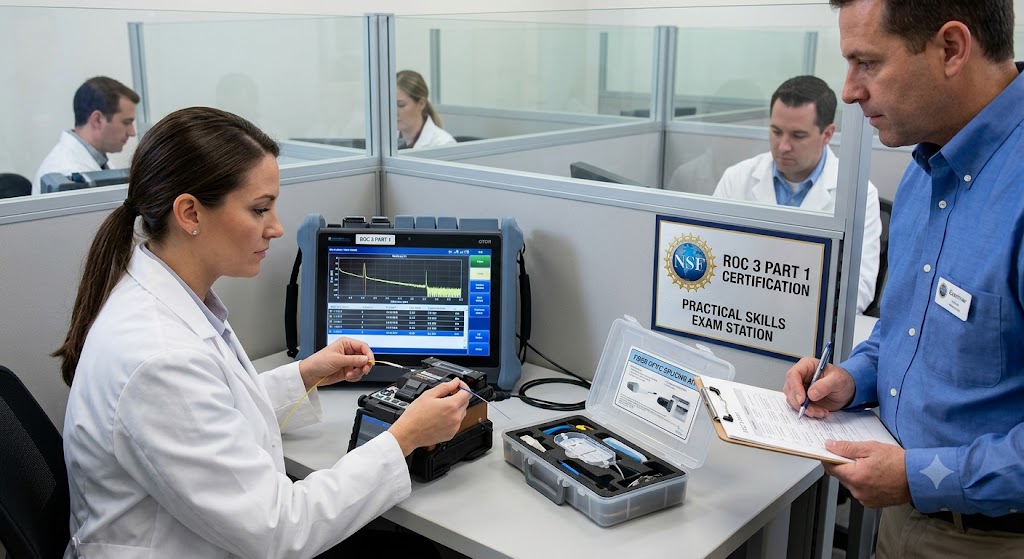
Additional Information
What the Course Entails and Exam Details
The curriculum for the ROC 3 Part 1 comprehensive exam is rigorous, balancing critical theoretical knowledge with practical, hands-on application. It is structured into core modules to ensure all aspects of the modern fiber optic ecosystem are covered. Key areas include:
Fiber Optic Theory and Principles: Understanding the physics of light propagation, different fiber types (single-mode, multi-mode), and optical properties like attenuation and dispersion.
Safety Standards: Strict adherence to industry and OSHA safety regulations, specifically regarding laser safety, handling fiber shards, and working with high-voltage equipment.
Cable Preparation and Termination: Mastering techniques for stripping, cleaning, and cleaving both inside-plant and outside-plant fiber optic cables for various connector types.
Splicing Techniques: Comprehensive training and testing on both fusion splicing and mechanical splicing, including splice protection and tray management.
Testing and Troubleshooting: Proficiency in using essential test equipment, most notably the OTDR (Optical Time Domain Reflectometer) and Optical Loss Test Sets (OLTS), to analyze network performance, measure loss, and locate faults.
Network Design and Documentation: Basics of reading network schematics, understanding physical topologies, and the importance of accurate record-keeping.
What to Expect in the Final Exam
The ROC 3 Part 1 examination is unique and demanding, designed to test both your cognitive knowledge and manual dexterity. It is a dual-component assessment that must be completed successfully to achieve certification:
Component 1: Theory Exam: This is a closed-book, multiple-choice assessment, typically consisting of 75 to 100 questions. Candidates must demonstrate deep understanding of all topics outlined in the syllabus. The time limit is 90 minutes. A passing score of 70% is required.
Component 2: Practical Skills Exam: In this component, candidates must complete a series of hands-on tasks at an authorized testing station. Evaluators grade performance on accuracy, safety, and adherence to accepted industry practices. Specific tasks include preparing a 12-fiber ribbon cable, performing four successful fusion splices with a maximum loss of 0.05 dB, and correctly configuring and interpreting a trace on an OTDR to identify a simulated macrobend fault. This portion is timed, usually allowing 2.5 hours, and is graded on a pass/fail basis. Candidates must pass all required skills to succeed.
How to Study and Exam Centers
Achieving the ROC 3 Part 1 certification requires a blend of focused self-study and practical experience. We recommend the following multifaceted strategy:
Official Study Guide: The 'ROC 3 Certification Handbook and Study Guide' is the primary source material and is essential reading.
Interactive Practice Exams: Our [ROC 3 Part 1 Practice Exam] is a critical tool for identifying knowledge gaps and becoming familiar with the types of questions and formatting of the theory component.
Hands-on Lab Training: We strongly advise enrolling in a dedicated 2- or 3-day boot camp with an authorized fiber optic school. This provides the guided practical instruction necessary to master splicing and testing, which cannot be learned through a book alone.
Testing Centers: The theory portion of the ROC 3 Part 1 exam can be taken through Pearson VUE at their authorized locations worldwide. However, the specialized hands-on practical skills exam must be completed at an ROC-authorized hands-on training facility or designated testing organization, ensuring standard evaluation conditions.
Job Opportunities from the Course
Successfully obtaining the ROC 3 Part 1 certification opens a wide range of lucrative and stable career opportunities across the telecommunications, data center, and construction industries. This credential directly qualifies you for roles that require a verified level of technical expertise:
Fiber Optic Technician: Responsibilities include installing, testing, and maintaining fiber networks for residential, commercial, and industrial clients.
Outside Plant (OSP) Technician: Specializing in the construction and repair of the primary, large-scale fiber backbone, both aerial and underground.
Inside Plant (ISP) Technician: Focus on the installation of fiber infrastructure within buildings, data centers, and central offices, often involving complex splicing and termination.
Certified Cabling Test Technician (CCTT): A role dedicated to using high-level test equipment like OTDRs to certify network performance and generate detailed compliance documentation.
FTTH/FTTx Installer: A high-demand position focusing on the 'last mile' connection to customers, installing ONTs and drop cables.
Fiber Optic Splicer: A specialized role focused entirely on high-precision fusion and mechanical splicing for large-scale network deployments and data centers.
Frequently Asked Questions
Reviews
5.0
Based on 0 reviews
Leave a Review
No reviews yet. Be the first to review!