
RP 33 Fleet Oceanographic and Acoustic Reference Manual Practice Test
$69.00
- Buy to unlock unlimited access to all Quiz questions and Answers in this Quiz.
- After purchase you can print a PDF of the whole quiz at any point. The PDF will contain the questions and the correct answers.
About this Exam
The RP 33 Fleet Oceanographic and Acoustic Reference Manual Practice Test is an indispensable study tool designed for Navy personnel and maritime professionals preparing for official advancement and certification exams. The foundational text, RP 33, is the "bible" of underwater acoustics for the U.S. Navy. It serves as the definitive guide to understanding the complex relationship between the ocean environment and the behavior of underwater sound. This practice test is specifically engineered for members of the Meteorology and Oceanography (METOC) community, Sonar Technicians (ST), Aviation Warfare Operators (AWO), and any Fleet operator involved in Anti-Submarine Warfare (ASW), Undersea Warfare (USW), or sonar operations. Mastering the concepts within RP 33 is vital for optimizing sensor performance and gaining a decisive tactical advantage.
Ready to test your knowledge?
Buy Now to Access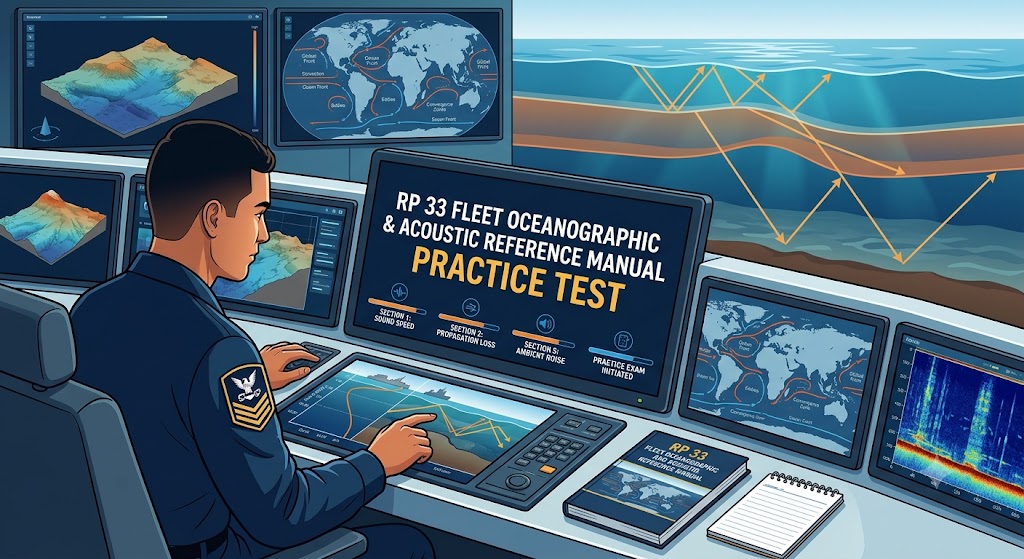
Additional Information
What the Course Entails and Exam Details
The material covered by RP 33, and consequently this practice test, is extensive, demanding both theoretical understanding and practical application. Candidates must demonstrate proficiency in:
Fundamentals of Sound: Understanding acoustic energy, wave motion, intensity, and units of measurement.
The Ocean Environment: Analyzing the physical, chemical, and geological structure of the deep and shallow ocean, including temperature, salinity, and pressure.
Sound Speed Profiles (SSP): Interpreting how sound speed changes with depth and identifying key features like the surface duct, sonic layer, deep sound channel, and critical depth.
Acoustic Propagation Paths: Predicting how sound will travel through the water, including direct path, bottom bounce, convergence zone (CZ), and surface duct propagation.
Ambient Noise and Reverberation: Identifying sources of noise, including wind, shipping, and biological activity, and understanding how they affect sonar detection.
Tactical Application: Applying environmental data to calculate sonar range predictions, figure of merit (FOM), and optimal sensor deployment.
While the "course" is the self-study or guided study of the RP 33 manual itself, the exam is a critical component of Navy Rating Advancement Exams and specialized qualification programs. It is primarily a test of cognitive knowledge and data interpretation.
What to Expect in the Final Exam
When taking an official exam where RP 33 is a primary reference, such as a Navy Advancement Exam for the ST or AWO rates, candidates can expect a demanding evaluation of their applied knowledge. The final exam is typically multiple-choice and timed. While RP 33 is a reference manual, the exam is not open-book. Instead, it tests your ability to recall definitions, apply formulas, and, most importantly, interpret graphical data. You will be presented with Sound Speed Profiles, ray trace diagrams, and environmental data charts and asked to solve problems related to sonar detection ranges, optimal submarine search depths, and acoustic vulnerabilities. The passing score varies by rank and the specific requirements of the advancement cycle, but high scores are essential for promotion in competitive ratings. There are no practical, hands-on components for the RP 33 section, though it may be paired with a practical exam for a related qualification.
How to Study and Exam Centers
Preparation for the RP 33 Practice Test and the subsequent official exams requires a dedicated, multi-faceted approach. Your primary strategy should be a thorough, multi-pass reading of the official RP 33 Fleet Oceanographic and Acoustic Reference Manual. As you read, focus on creating annotated diagrams of Sound Speed Profiles and acoustic propagation paths. Join study groups with experienced Sailors or METOC personnel who can offer real-world examples of how this knowledge is applied in ASW.
Actionable methods for study include:
Use the Practice Test: Repeatedly take practice tests, focusing not just on correct answers but on the why behind each solution.
Analyze Diagrams: Draw and interpret SSPs, identifying the effects of seasonal changes, time of day, and location on sound propagation.
Flashcards: Memorize definitions, acronyms, and key formulas related to sound speed, transmission loss, and sonar performance.
Review Bibs: Check the official Navy advancement bibliographies to confirm that RP 33 remains a current reference for your specific rating and exam cycle.
Official exams are administered under strict proctoring guidelines at authorized U.S. Military testing centers, typically located on military installations worldwide or aboard deployed vessels. Unlike commercial certifications, these exams are not taken through portals like Pearson VUE; they are part of the military’s internal professional development system.
Job Opportunities from the Course
A strong command of RP 33 is a cornerstone skill for several highly specialized and critical roles within the maritime and defense sectors. Excelling in this subject area directly opens doors and unlocks promotion potential for career paths including:
Sonar Technician (Surface and Submarine)
Aviation Warfare Operator (AWO - Acoustic and Non-Acoustic)
Meteorology and Oceanography (METOC) Analyst
Anti-Submarine Warfare (ASW) Specialist
Tactical Oceanographer
Undersea Warfare (USW) Mission Planner
Defense Contractor specializing in Underwater Acoustics or Sonar Systems
Frequently Asked Questions
Reviews
5.0
Based on 0 reviews
Leave a Review
No reviews yet. Be the first to review!