
RTBC Advanced Exposure Factors Practice Test
$69.00
- Buy to unlock unlimited access to all Quiz questions and Answers in this Quiz.
- After purchase you can print a PDF of the whole quiz at any point. The PDF will contain the questions and the correct answers.
About this Exam
The RTBC Advanced Exposure Factors certification is a prestigious credential designed for Registered Technologists (R.T.) seeking to elevate their expertise in the art and science of radiographic imaging. This advanced exam focuses on the complex calculations, technical principles, and clinical application required to optimize image quality while minimizing radiation dose, particularly in challenging scenarios and with diverse patient populations. It is designed to bridge the gap between fundamental training and the masterful command of exposure factors needed for high-level specialized roles.
Ready to test your knowledge?
Buy Now to Access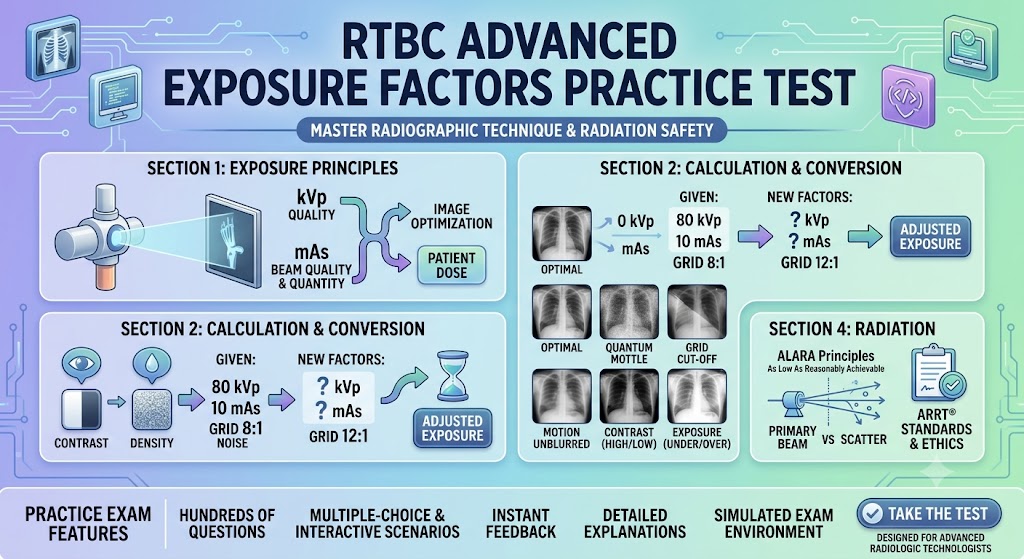
Additional Information
What the Course Entails and Exam Details
The RTBC Advanced Exposure Factors curriculum and practice test cover a rigorous syllabus focused on mastery of:
Deep Beam Mechanics: Mastering the interaction of x-rays with various grid ratios, collimation, filtration, and image receptors.
Complex Exposure Calculations: Advanced application of the 15% rule, density maintenance formula, distance conversions (including inverse square law), and grid conversion factors.
Patient-Specific Technique: Adapting exposure for dynamic conditions, contrasting anatomy, pediatric, geriatric, and bariatric patients.
Image Artifact Analysis: Identifying, troubleshooting, and preventing technical artifacts related to exposure selection, processing, and equipment malfunction.
Radiation Safety & ALARA: Beyond the basics, this section focuses on advanced methods for reducing occupational and patient dose through technique and technology.
Digital Image Acquisition & Post-Processing: Understanding the role of digital algorithms, dynamic range, and exposure indicators in final image quality.
What to Expect in the Final Exam
The final RTBC Advanced Exposure Factors exam is a comprehensive evaluation designed to simulate the decision-making of a senior technologist. While specific formats can vary by administrator, it generally consists of:
Format: A computer-based test composed of multiple-choice questions, which may include interactive case studies or formula application scenarios.
Number of Questions: Typically ranges from 75 to 125 scored items.
Time Limit: Candidates are usually given 90 to 120 minutes to complete the exam.
Passing Score: The required passing score is often 75% or higher, reflecting the advanced nature of the content.
Clinical Scenario Focus: Many questions will present a detailed clinical scenario, including a sample radiograph, and ask the candidate to select the correct adjusted exposure factors or identify the technical error.
How to Study and Exam Centers
Preparation for this advanced test requires dedicated study and practical application:
Actionable Study Strategies: Start with a self-assessment to identify weak areas. Re-read core radiography textbooks, focusing on chapters on technical principles and exposure. Utilize flashcards for all key formulas and conversion factors. Participate in online forums or peer study groups.
Practice Methods: The single most effective tool is a comprehensive practice test that mimics the format and difficulty of the real exam. Repeatedly take simulated tests to build stamina, improve question-reading speed, and reinforce technical knowledge.
Where to Take the Exam: The RTBC Advanced Exposure Factors exam is administered through authorized professional testing centers, such as Pearson VUE or specialized healthcare credentialing portals. For official certification exams, candidates often must create an account and register through the credentialing body, which will then generate an authorization to test at their chosen location or online.
Job Opportunities from the Course
Earning the RTBC Advanced Exposure Factors certification demonstrates a commitment to technical mastery that unlocks advanced career paths, including:
Lead Radiologic Technologist
Imaging Department Supervisor
Clinical Instructor or Educator in Radiologic Technology
Special Procedures Technologist (e.g., IR, Cath Lab)
Quality Assurance (QA) / Quality Control (QC) Technologist
Radiation Safety Officer (RSO) or Assistant RSO
Frequently Asked Questions
Reviews
5.0
Based on 0 reviews
Leave a Review
No reviews yet. Be the first to review!