
RTBC Digital Radiography Assessment Practice Test
$69.00
- Buy to unlock unlimited access to all Quiz questions and Answers in this Quiz.
- After purchase you can print a PDF of the whole quiz at any point. The PDF will contain the questions and the correct answers.
About this Exam
The RTBC Digital Radiography Assessment is a specialized evaluation designed for medical imaging professionals seeking to demonstrate their proficiency and knowledge in modern digital radiography (DR) technology and practice. This assessment validates a candidate's understanding of digital imaging systems, image acquisition, processing, quality control, and radiation safety specific to digital environments. It is ideally suited for registered radiologic technologists looking to specialize, or for students nearing completion of their radiography programs who want to confirm their readiness for the shift to digital platforms.
Ready to test your knowledge?
Buy Now to Access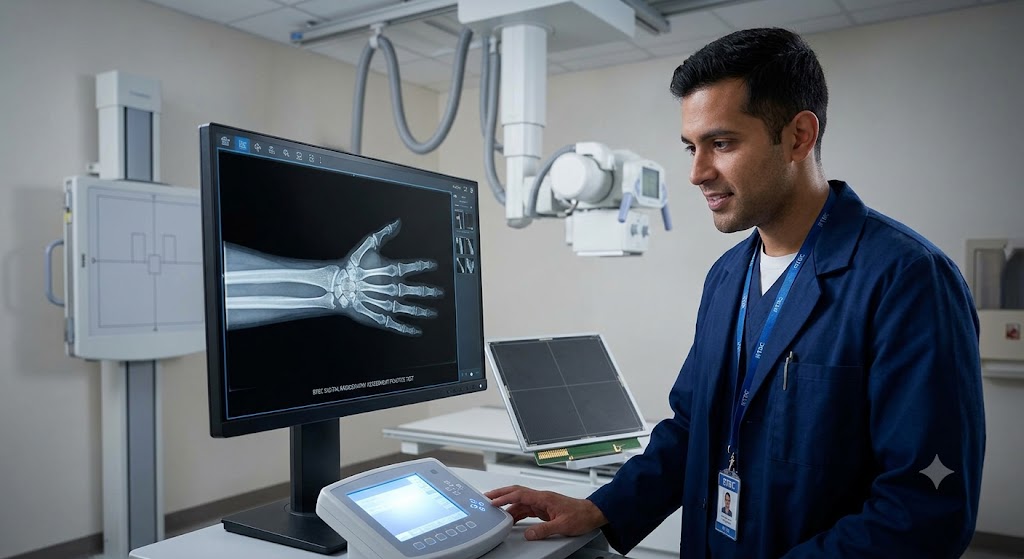
Additional Information
What the Course Entails and Exam Details
This comprehensive assessment covers crucial domains that define modern digital imaging. While not a structured course with set lectures, preparation involves understanding a broad syllabus:
Digital Image Acquisition: Understanding detector technologies, such as photostimulable phosphor (PSP) and flat-panel detectors (direct and indirect capture).
Image Processing and Post-Processing: Mastering concepts like dynamic range, bit depth, spatial resolution, exposure indicators (EI), and manipulation tools (windowing, leveling).
Quality Control (QC) in DR: Implementing specific protocols for digital systems, including phantom testing, artifact identification, and system calibration checks.
Radiation Safety and Dose Optimization: Applying ALARA principles specifically to digital imaging, maximizing image quality while minimizing patient dose.
Informatics and PACS: Familiarity with DICOM standards, workflow, and image storage systems.
Candidates should possess foundational knowledge equivalent to that gained in an accredited radiography program.
What to Expect in the Final Exam
The RTBC Digital Radiography Assessment is a rigorous, computer-based exam designed to simulate real-world imaging challenges.
Format: The exam consists primarily of multiple-choice questions. A significant portion of these questions are case-based, often requiring candidates to view grayscale digital medical images (like the hand X-ray seen in the associated image) and make decisions regarding exposure factors, image quality assessment, or artifact correction.
Question Count: The assessment typically features 50 to 70 questions.
Passing Score: The passing standard is psychometrically determined but generally aligns with a minimum scaled score of 75.
Time Limit: Candidates are usually allotted 90 to 120 minutes to complete the test.
Testing Rules: The exam is closed-book and requires a valid government ID for entry. No outside resources are permitted.
How to Study and Exam Centers
A successful outcome requires focused preparation. A recommended strategy involves:
Practice Tests: Utilizing simulated exam platforms is essential. Reviewing practice questions, especially those requiring image analysis, helps build confidence and speed.
Review Textbooks: Focus on recent editions of radiography textbooks that dedicate significant sections to digital imaging physics and procedures.
Clinical Experience: Hands-on time with digital radiography systems in a clinical setting is invaluable for understanding workflow and QC procedures.
Assessment Scheduling: The exam is administered through authorized testing centers, which may include dedicated Pearson VUE facilities or computer labs within accredited radiography schools. Registration and scheduling are typically managed through the RTBC online portal.
Job Opportunities from the Course
Achieving a passing score on the RTBC Digital Radiography Assessment provides a distinct advantage in a competitive job market. Professionals holding this validation are highly sought after by modern medical facilities that are fully transitioning to, or exclusively operating, digital imaging systems.
Completion unlocks opportunities for roles such as:
Digital Radiography Specialist: A focused technologist role in hospitals or large imaging centers.
Lead Radiologic Technologist: Taking on supervisory roles with oversight of digital imaging protocols and quality control.
PACS Administrator (Imaging Informatics): Transitioning into IT, managing the image archiving and communication systems.
Applications Specialist (for Imaging Manufacturers): Training other technologists on new digital equipment.
Quality Control Coordinator: Managing equipment compliance and optimization for a radiology department.
Frequently Asked Questions
Reviews
5.0
Based on 0 reviews
Leave a Review
No reviews yet. Be the first to review!