
RTBC Radiation Detection Devices Practice Exam
$69.00
- Buy to unlock unlimited access to all Quiz questions and Answers in this Quiz.
- After purchase you can print a PDF of the whole quiz at any point. The PDF will contain the questions and the correct answers.
About this Exam
The [RTBC Radiation Detection Devices Practice Exam] is designed for professionals and students aiming to validate their technical knowledge and practical skills in operating essential radiation safety equipment.
This certification is ideal for individuals pursuing careers in medical imaging, nuclear medicine, industrial radiography, or any field involving the regular use of ionizing radiation, such as Non-Destructive Testing (NDT) technicians or quality control inspectors.
By mastering the concepts covered in this exam, candidates demonstrate their competence in crucial areas of radiation measurement, instrument calibration, and personnel monitoring, ensuring they can work safely and compliant with all regulatory requirements.
Ready to test your knowledge?
Buy Now to Access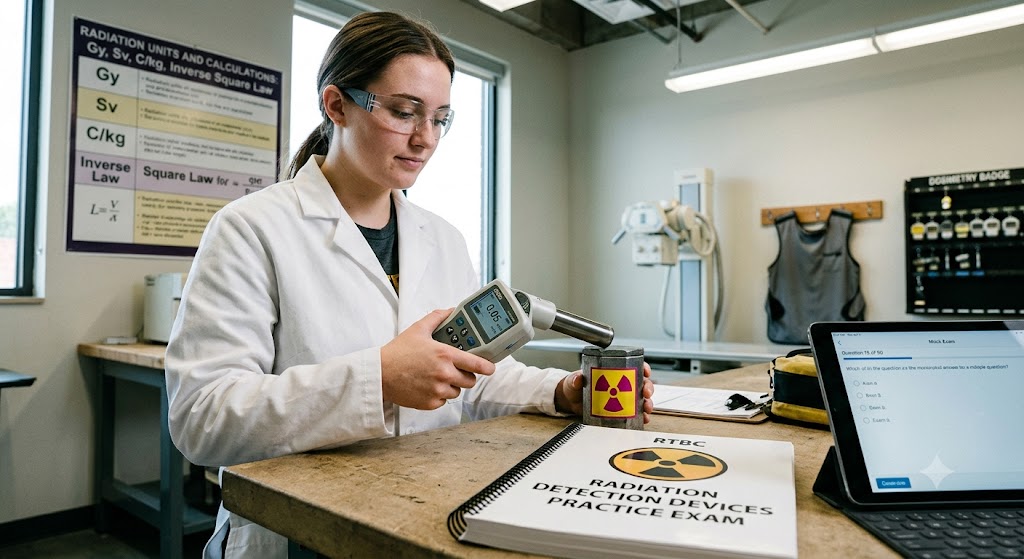
Additional Information
What the Course Entails and Exam Details
The core curriculum for the RTBC Radiation Detection Devices examination covers a comprehensive range of topics essential for the safe and effective use of radiation detection instruments.
Candidates must show a deep understanding of radiation physics, including types of ionizing radiation (alpha, beta, gamma, X-rays) and their distinct interactions with matter.
The syllabus places significant emphasis on radiation units and advanced calculations, such as the Inverse Square Law, defining absorbed dose (Gray, Gy), equivalent dose (Sievert, Sv), and exposure (Coulombs per kilogram, C/kg).
The core of the exam tests knowledge on the construction, theory, and practical application of various detection devices, including gas-filled detectors (Geiger-Müller counters, ionization chambers), scintillation detectors, and semiconductor detectors.
Additionally, candidates are evaluated on their knowledge of survey techniques, equipment calibration protocols, the interpretation of results, and the selection of appropriate instruments for specific scenarios.
What to Expect in the Final Exam
The final exam for the [RTBC Radiation Detection Devices Certification] is a rigorous, proctored assessment, typically administered in a computer-based format.
The exam consists of a predetermined number of multiple-choice questions—often ranging from 50 to 100—that require a mixture of theoretical recall and the application of principles to practical problems.
A strong grasp of mathematical formulas for radiation calculations is required, and candidates should expect multiple questions requiring calculation.
The time limit for the exam is generally between 90 and 120 minutes, demanding efficient time management.
A minimum passing score, typically 70% or 75%, must be achieved to earn the certification. In some jurisdictions or specific training programs, a practical hands-on component demonstrating the ability to calibrate or operate a specific device may also be required before final certification.
How to Study and Exam Centers
Preparation for the RTBC Radiation Detection Devices exam requires a combination of structured learning, practical practice, and dedicated revision.
The best approach is to use the [RTBC Radiation Detection Devices Practice Exam] as a core study tool, identifying weak areas and simulating true exam conditions.
Incorporate hands-on experience with as many types of radiation detection devices as possible, reinforcing theoretical concepts with real-world application.
Create a robust set of flashcards for key terms, radiation units, and formulas, and review them daily.
Study a reliable, up-to-date textbook on radiation safety and detection, ensuring you understand the regulatory standards relevant to your specific industry.
To take the final exam, candidates must register through an authorized training provider, specialized technical school, or official test proctor.
While many professional exams are administered via Pearson VUE or a similar network, the specific centers and online portals for the [RTBC Radiation Detection Devices Exam] are typically dictated by the training organization or state-level regulatory body overseeing the certification.
Job Opportunities from the Course
Upon earning the [RTBC Radiation Detection Devices Certification], individuals unlock a wide range of career opportunities across multiple critical industries. A partial list of potential job titles includes:
Non-Destructive Testing (NDT) Technician (Radiographic Testing)
Industrial Radiographer (Level I or II)
X-ray Technician / Medical Imaging Technologist
Radiation Safety Officer (RSO) Assistant
Health Physics Technician / Radiation Protection Technician
Quality Control Inspector (in manufacturing or construction)
Nuclear Medicine Technologist (with appropriate clinical training)
Environmental Radiation Monitoring Specialist
Frequently Asked Questions
Reviews
5.0
Based on 0 reviews
Leave a Review
No reviews yet. Be the first to review!