
RTBC X-ray Tube and Components Practice Test
$69.00
- Buy to unlock unlimited access to all Quiz questions and Answers in this Quiz.
- After purchase you can print a PDF of the whole quiz at any point. The PDF will contain the questions and the correct answers.
About this Exam
This comprehensive practice exam is specifically designed for students and professionals preparing for the RTBC X-ray Tube and Components certification. Whether you are a radiologic technology student aiming for your initial license or an experienced technologist looking to specialize, mastering the intricate details of X-ray production is crucial. This test focuses on the core equipment that makes medical imaging possible: the X-ray tube. It assesses your knowledge of physics principles, engineering, operation, and the essential components that generate and control the X-ray beam, ensuring you are fully prepared for the challenges of the actual examination.
Ready to test your knowledge?
Buy Now to Access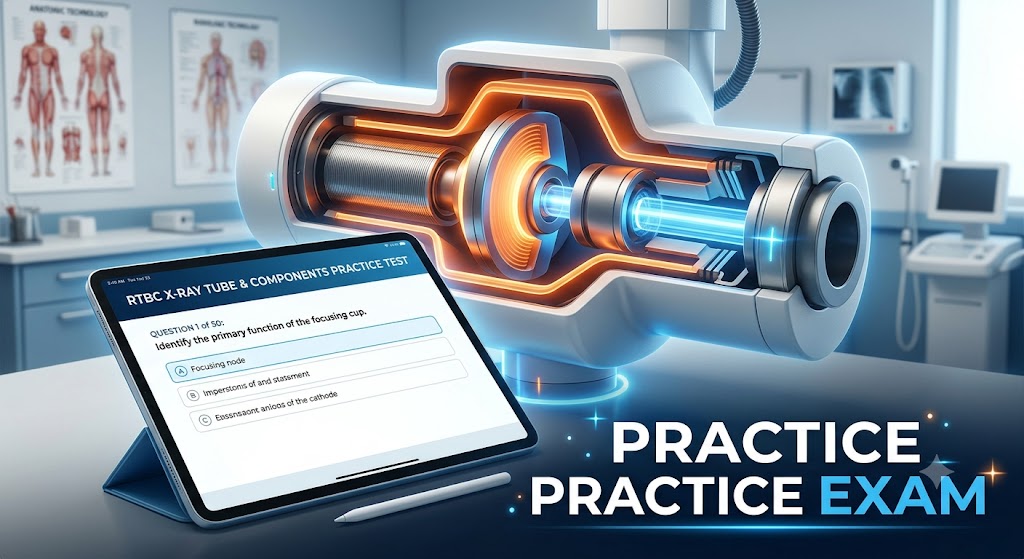
Additional Information
What the Course Entails and Exam Details
The RTBC X-ray Tube and Components curriculum covers a deep and diverse set of technical topics. Candidates are expected to have a thorough understanding of X-ray tube physics, including electron interaction and bremsstrahlung and characteristic radiation production. The course details the physical construction of both stationary and rotating anode tubes, the cathode assembly, filament design, focusing cup mechanics, and the role of the glass or metal envelope. Crucial operational concepts such as target angle, line-focus principle, heel effect, tube rating charts, and anode cooling curves are explored in detail. Proper understanding of these elements is necessary for safe, efficient equipment operation and high-quality image production.
What to Expect in the Final Exam
The final certification exam is a rigorous assessment of your theoretical knowledge. It typically consists of approximately 100 to 120 multiple-choice questions, which may include diagrams and calculations. The exam is administered under strict, proctored conditions with a strict time limit, usually ranging from two to three hours. A passing score, often around 75% or higher depending on the specific RTBC standards, is required to achieve certification. Questions will test both basic recall and complex application of principles to clinical scenarios. For example, you might be asked to interpret a tube rating chart for a specific exposure or troubleshoot common tube failures based on given symptoms.
How to Study and Exam Centers
Preparation for the RTBC X-ray Tube and Components exam requires a dedicated and multifaceted approach. Start by thoroughly reviewing the official RTBC study guides and recommended textbooks. Utilize digital resources and interactive modules that provide a visual, 3D understanding of tube components. Creating detailed flashcards for key terms, formulas, and diagrams is highly effective. The most crucial part of your strategy, however, is practical application. Take this comprehensive practice test multiple times to get a feel for the question style, identify your weak points, and improve your time management.
For the final, official certification, the RTBC partners with specialized testing organizations. Candidates must register through the official RTBC website, where they can choose from a network of authorized physical testing centers or, in some cases, remote online proctoring options. It's advisable to check the RTBC portal early for a complete list of approved testing locations near you, especially at major medical schools and dedicated vocational testing facilities, to secure a testing date that fits your schedule.
Job Opportunities from the Course
Earning the RTBC X-ray Tube and Components certification is a powerful career accelerator. While not always a mandatory credential for basic entry-level roles, it is a significant distinction that signals advanced knowledge and specialization to employers. This certification can lead to a variety of specialized roles:
Radiologic Technologist (with equipment specialization)
Imaging Department Quality Control Specialist
X-ray Equipment Sales Representative
Field Service Engineer for Medical Imaging Systems
Clinical Applications Specialist (supporting new equipment installations)
Radiologic Technology Instructor or Educator
Frequently Asked Questions
Reviews
5.0
Based on 0 reviews
Leave a Review
No reviews yet. Be the first to review!