
SAE TMC Form A Practice Exam
$69.00
- Buy to unlock unlimited access to all Quiz questions and Answers in this Quiz.
- After purchase you can print a PDF of the whole quiz at any point. The PDF will contain the questions and the correct answers.
About this Exam
The Self-Assessment Examination (SAE) TMC Form A Practice Test is a vital resource for aspiring respiratory therapy professionals. This practice test, particularly Form A, is designed to emulate the challenges and format of the Therapist Multiple-Choice (TMC) Examination administered by the National Board for Respiratory Care (NBRC). It serves as a diagnostic tool, allowing candidates to evaluate their knowledge and readiness before attempting the actual credentialing exam. The primary audience for this practice test includes individuals preparing to take the NBRC TMC Examination to become a Certified Respiratory Therapist (CRT) and/or to meet the requirement for the Clinical Simulation Examination (CSE) for the Registered Respiratory Therapist (RRT) credential. Successfully passing this practice test is not a certification itself, but it is a major stepping stone and a strong indicator of preparedness for the final NBRC exam.
Ready to test your knowledge?
Buy Now to Access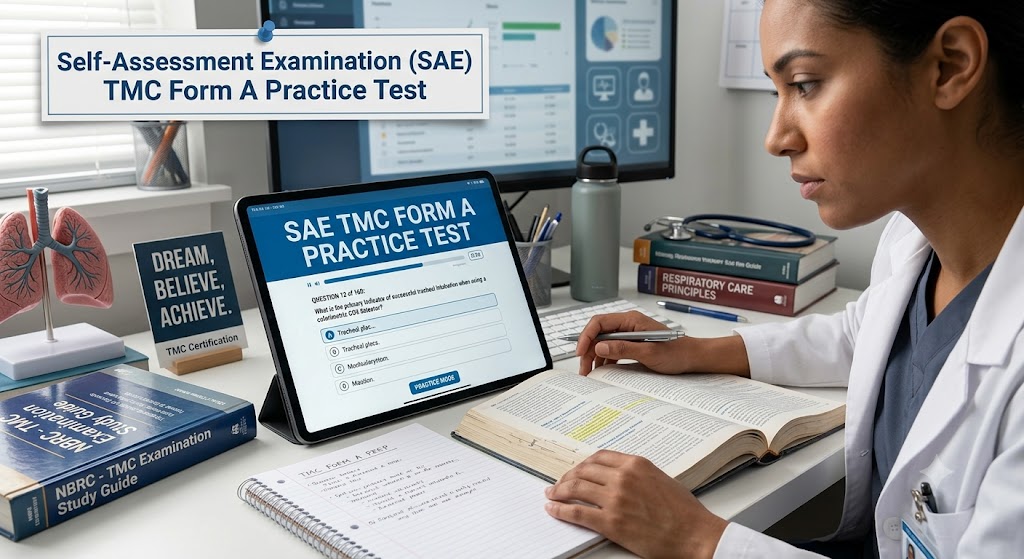
Additional Information
What the Course Entails and Exam Details
The core purpose of this practice test, as an official self-assessment tool, is to help students practicing for the comprehensive topics covered in the NBRC TMC Examination. This means that while the practice test itself does not "entail a course," its content is directly reflective of the respiratory therapy coursework and knowledge required for the field and the official TMC exam.
Key areas a student should expect to cover and which the practice test assesses include:
Patient Data: Includes data collection, physical assessment, lab values, and diagnostic information.
Troubleshooting & Quality Control of Devices: Covers the operational principles, safety, and function of respiratory care equipment.
Infection Control: Ensures understanding of standard precautions and principles of sterilization and disinfection.
Initiation & Modifications of Interventions: Focuses on treatment modalities, mechanical ventilation, pharmacology, airway clearance, and emergency care.
Evaluation & Recommendations: Includes understanding clinical scenarios, interpreting results, and suggesting appropriate courses of action or changes in patient care plans.
What to Expect in the Final Exam
This section provides details on the NBRC Therapist Multiple-Choice (TMC) Examination, for which the SAE TMC Form A Practice Test prepares you.
Exam Format: The actual NBRC TMC Examination is a multiple-choice test. It consists of 160 multiple-choice questions (140 are scored, and 20 are unscored, pretest questions that are being validated for future exams).
Time Limit: Candidates are typically given 3 hours to complete the examination.
Scoring and Credentials: The NBRC uses a two-tiered scoring system for the TMC exam.
CRT Credential (low cut score): Achieving the low cut score results in being awarded the Certified Respiratory Therapist (CRT) credential.
CSE Eligibility (high cut score): Achieving the high cut score makes a candidate eligible to take the Clinical Simulation Examination (CSE), which is required to earn the Registered Respiratory Therapist (RRT) credential.
Rules & Conditions: The official NBRC TMC exam is held under secure testing conditions at approved testing centers (e.g., specific testing service locations like PSI or designated physical centers, and sometimes through secure online proctoring, always following strict guidelines). The SAE practice test may have different, self-directed access but the actual final exam has formal procedures.
How to Study and Exam Centers
Access and Practice: The SAE TMC Form A Practice Test, as an official NBRC self-assessment tool, can often be accessed and taken online through the NBRC portal. Focus on simulating the actual exam experience. Take the full test, respect the time limit, and review your performance. The official SAE provides feedback on the rationale for the best response to each question. Utilize this feedback!
Analyze Performance: Use the practice test results to identify your areas of strength and weakness across the main content domains. Dedicate more study time to topics where you scored lower.
Comprehensive Review: Use your respiratory therapy textbooks, lecture notes, and reliable study guides and review courses alongside the practice test feedback. Understand the why behind each correct and incorrect answer.
Practice Questions: Beyond the official SAE Form A, seek out other reputable practice questions, mock exams, and review tools (NBRC may offer a free shortened practice exam and other SAE forms). Continued practice builds familiarization with question styles, improves time management, and identifies recurring knowledge gaps.
Exam Centers:
For the Practice Test (SAE): The SAE is typically taken online, self-paced, or in a practice setting wherever you have internet access and have registered with the NBRC.
For the Final NBRC TMC Exam: Official credentialing examinations are held at secure, designated professional testing centers. NBRC exams are commonly offered at approved PSI test centers throughout the United States and internationally. Check the NBRC website and apply directly for the examination to find details on how to select and schedule a date at a physical center near you. Certain other authorized physical locations or secure remote online proctoring might be available depending on current policies and offerings.
Job Opportunities from the Course
Successfully completing your respiratory therapy education and passing the NBRC TMC Examination (and subsequent credentials) opens up various career opportunities in healthcare. Possible job titles include:
Certified Respiratory Therapist (CRT)
Registered Respiratory Therapist (RRT)
Hospital-based Respiratory Therapist (Adult, Pediatric, Neonatal)
Critical Care/ICU Respiratory Therapist
Emergency Department Respiratory Therapist
Pulmonary Function Technologist
Home Care Respiratory Therapist
Sleep Disorder Center Technician
Respiratory Therapy Educator or Instructor
Respiratory Therapy Manager or Supervisor
Frequently Asked Questions
Reviews
5.0
Based on 0 reviews
Leave a Review
No reviews yet. Be the first to review!