
SARTECH II Practice Exam
$69.00
- Buy to unlock unlimited access to all Quiz questions and Answers in this Quiz.
- After purchase you can print a PDF of the whole quiz at any point. The PDF will contain the questions and the correct answers.
About this Exam
The Search and Rescue Technician Level II (SARTECH II) certification is the cornerstone intermediate qualification for all aspiring and active ground search and rescue personnel.
This certification, provided by the National Association for Search and Rescue (NASAR), is specifically designed for individuals who function as field searchers during actual search and rescue missions. It is the gold standard for operational readiness, ensuring that responders possess the critical knowledge, decision-making abilities, and practical field skills needed to operate effectively and safely in wilderness and rural environments.
SARTECH II is ideal for volunteer searchers, members of specialized SAR teams, and professionals from related fields who participate in search and rescue operations as part of their duties.
Ready to test your knowledge?
Buy Now to Access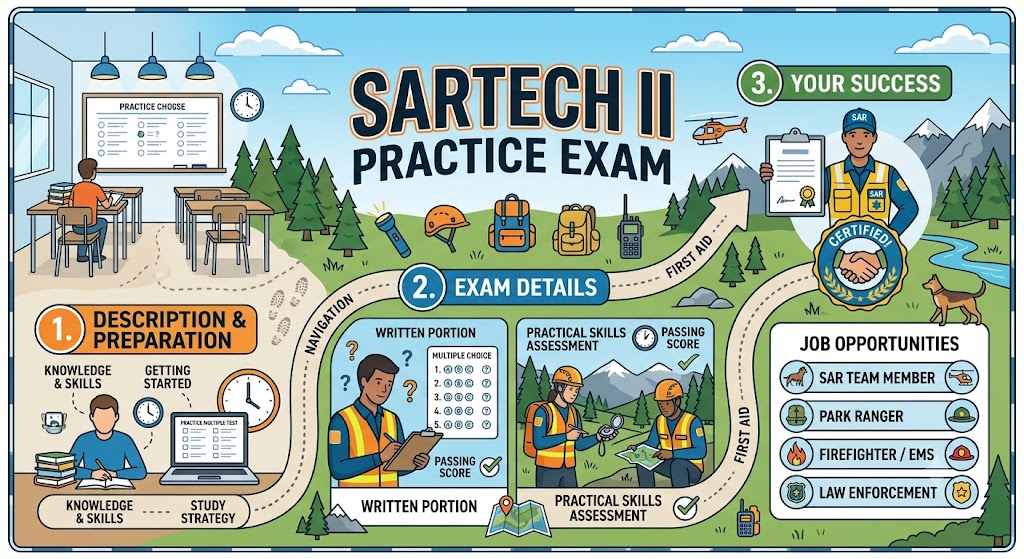
Additional Information
What the Course Entails and Exam Details
To prepare for the SARTECH II certification, candidates typically complete the Fundamentals of Search and Rescue (FUNSAR) course, which provides the theoretical and practical foundation.
The scope of knowledge covered is extensive, bridging the gap between basic awareness and advanced leadership. Core topics and skills you must master include:
SAR Fundamentals: Comprehensive definitions of search, rescue, recovery, and survival.
Organizational Systems: Mastery of the National Incident Management System (NIMS) and the Incident Command System (ICS) as applied to SAR.
Search Theory & Management: A deep dive into determining Probability of Area (POA), Probability of Detection (POD), search tactics (hasty, grid, containment), clue awareness, and tracking methodologies.
Navigation: Advanced map and compass skills, map-to-terrain association, and use of Global Positioning System (GPS) receivers, including coordinating in various formats like UTM.
Survival & Wilderness Travel: Essential wilderness survival principles, environmental emergencies, and techniques for safe movement over difficult terrain.
Technical Skills: Introduction to rope rescue, including knots, simple systems, rappelling, and patient packaging for transport.
What to Expect in the Final Exam
The final evaluation for the SARTECH II certification is a rigorous two-part process that tests both your mental and physical capabilities.
1. The Written Examination:
This is the first component, which you must pass to proceed to the practical evaluation.
Format: The exam typically consists of approximately 145 questions, covering the entire body of SAR knowledge. It often includes multiple-choice questions, and notably, about 20 scenario-based navigation problems that require direct input (e.g., coordinates, bearings, distances) using a supplied topographic map.
Time Limit: Candidates are generally given three hours to complete the written portion.
Rules: The written exam is often conducted as an "open-book" evaluation, using the current edition of the FUNSAR textbook.
Passing Score: The required passing score is 70% (approximately 102 correct answers). Successfully passing this written test also inherently certifies you at the SARTECH III (Introduction to SAR) level, even if the practical exam is not later completed.
2. The Practical Evaluation (6-Station Exam):
Upon successful completion of the written exam, you must challenge the practical component.
Format: This consists of six (6) physical skill stations, where a candidate's performance is evaluated by authorized NASAR lead evaluators.
Skills Tested: Stations typically require candidates to demonstrate proficiency in: building an emergency shelter, building a fire, performing topographic map reading, executing day navigation, executing night navigation, and demonstrating various search techniques and knowledge.
Rules: Should a candidate fail any station, they may repeat up to two stations on the day of the exam. If needed, re-testing for failed stations can be completed at any subsequent SARTECH II evaluation within one year at no additional cost to NASAR.
Medical & Other Prerequisites:
Starting in 2021, NASAR requires all candidates to hold a current medical certification of Wilderness First Aid (WFA) or higher and satisfy other prerequisites such as completing FEMA ICS-100, ICS-200, and ICS-700.
How to Study and Exam Centers
Preparation is paramount for the SARTECH II evaluation. Success depends on a combination of rigorous study and consistent, hands-on practice. Actionable strategies include:
Complete FUNSAR: Enrolling in and completing the NASAR Fundamentals of Search and Rescue (FUNSAR) course is the single most important step. The written exam is directly based on this material.
Master Navigation: Do not underestimate the navigation section. Practice finding locations, calculating bearings, and converting between magnetic and true headings daily until it becomes second nature.
Practice Practical Skills: You cannot "study" fire starting or night navigation in a classroom. Actively practice all potential practical exam stations, including shelter building, knot tying, and wilderness travel, in varying weather conditions.
Utilize Study Guides: Leverage official NASAR study guides, practice question banks, and flashcards that are specifically aligned with the SARTECH II Body of Knowledge to reinforce core concepts.
Exam Centers and Testing:
Unlike exams administered at commercial centers like Pearson VUE, SARTECH II evaluations are hosted and administered directly by NASAR and its network of authorized instructors, evaluators, and search teams.
To find a testing opportunity, you must:
Check the NASAR Course Schedule: Visit the official National Association for Search and Rescue (NASAR) website to find upcoming FUNSAR courses and SARTECH II evaluation dates. Evaluations are typically scheduled at the conclusion of a FUNSAR class.
Contact Local SAR Teams: Many regional and local search and rescue teams host their own FUNSAR courses and evaluations. Inquire directly with teams in your area about their training and testing schedules.
Job Opportunities from the Course
A SARTECH II certification provides immense value, not just as a credential of operational readiness, but as a key enabler for career advancement and professional development within emergency response and public safety fields.
Specific job titles and career paths this certification unlocks, both in a professional and a highly-skilled volunteer capacity, include:
Professional Search and Rescue Technician (Operational Level): In agencies and organizations with dedicated SAR units.
National Park Ranger: Critical for performing search, rescue, and medical aid in national parks and recreation areas.
Law Enforcement Officer (Wilderness SAR Specialist): A distinct advantage for officers in state, county, or municipal agencies handling missing persons in wildland areas.
Firefighter (Wilderness and Technical Rescue): Fundamental skills for fire departments that respond to calls outside urban areas.
Emergency Management Specialist: Understanding field operations is crucial for the overall management of search and rescue incidents at the local and state levels.
Specialized SAR Resource: A gateway to advancing into niche roles, such as Canine Handler, Man-tracker, UAS Operator (Drone Pilot for SAR), and Technical Rescue Technician.
Frequently Asked Questions
Reviews
5.0
Based on 0 reviews
Leave a Review
No reviews yet. Be the first to review!