
SCI Security Practice Exam Guide
$69.00
- Buy to unlock unlimited access to all Quiz questions and Answers in this Quiz.
- After purchase you can print a PDF of the whole quiz at any point. The PDF will contain the questions and the correct answers.
About this Exam
This Sensitive Compartmented Information (SCI) Security Practice Test is specifically designed for security professionals and personnel working within, or aiming to join, the United States Intelligence Community (IC) and its associated contractors. It provides a comprehensive assessment of the protocols required to protect the nation's most critical and sensitive intelligence. Whether you are a Special Security Officer (SSO), a Program Security Manager, or an analyst handling Top Secret information, this course is your essential tool for ensuring readiness to handle SCI in accordance with the strict standards set by the Director of National Intelligence (DNI). This practice test prepares you for the critical security responsibilities that are integral to safeguarding national security.
Ready to test your knowledge?
Buy Now to Access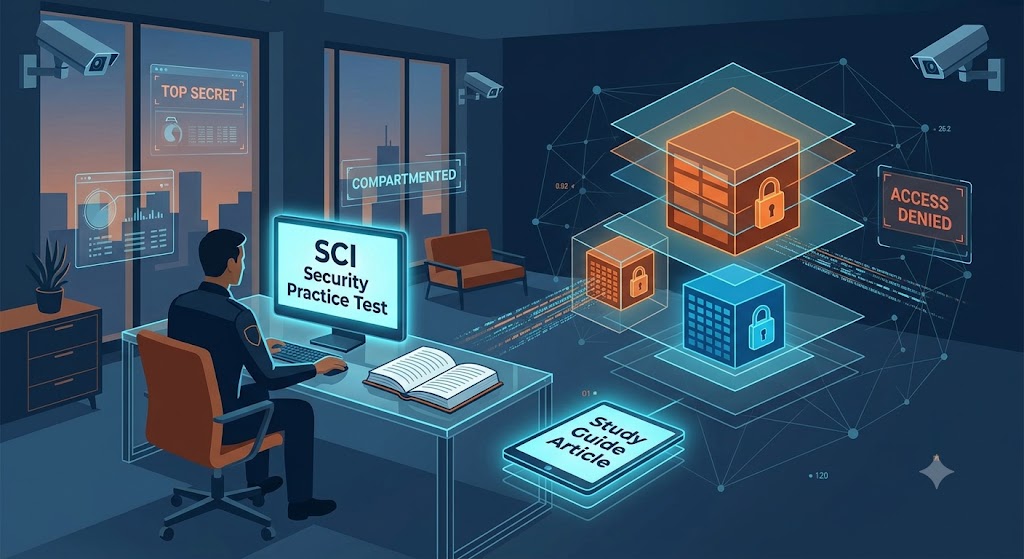
Additional Information
What the Course Entails and Exam Details
The course encompasses the foundational principles and practical applications of SCI security.
You will delve deeply into the critical aspects of protecting compartmented information, including:
Understanding Classification Levels: Gaining a clear comprehension of the differences between Confidential, Secret, Top Secret, and the specific overlay of Sensitive Compartmented Information.
Compartmentalization Principles: Mastering the concepts of 'need-to-know', established control systems (e.g., KDK, SI, TK, G), and Special Access Programs (SAPs).
The Lifecycle of SCI: Learning the secure procedures for creating, marking, handling, storing, and destroying SCI material.
Personnel Security (PERSEC): Exploring the rigorous background investigation process, including the Single Scope Background Investigation (SSBI), adjudicative guidelines, and continuous evaluation.
Physical Security: Understanding the strict standards for Sensitive Compartmented Information Facilities (SCIFs), including construction requirements, access control, and alarms.
Information Security (INFOSEC): Analyzing the regulations regarding electronic processing of SCI, approved systems, and data transfer protocols.
Reporting Requirements: Knowing your mandatory obligations regarding foreign travel, financial changes, and security infractions.
Incident Response: Identifying and reacting to data spills and security compromises.
What to Expect in the Final Exam
This final exam is a formal assessment of your knowledge.
While the exact structure can vary by agency or specific certification, here is what you can generally expect:
Format: The exam typically consists of multiple-choice and scenario-based questions designed to test both your recall of policies and your ability to apply them in real-world situations.
Question Count: Expect approximately 50 to 75 questions.
Time Limit: You will typically be given 90 to 120 minutes to complete the test.
Passing Score: A passing grade is usually set at 75% to 80%, reflecting the high standard of security knowledge required for SCI access.
Delivery: This exam is often proctored. It may be administered via a secure government network, at an agency-specific testing facility, or, for certain government-wide certifications, at an authorized professional testing center like Pearson VUE within a cleared facility.
How to Study and Exam Centers
Effective preparation is essential for success in this challenging field.
We recommend the following actionable study strategies:
Read Official Directives: The most critical resources are Intelligence Community Directives (ICDs), specifically ICD 703 (Protection of Classified National Intelligence), ICD 704 (Personnel Security), and ICD 705 (Physical Security Standards for SCIFs). Review agency-specific manuals (e.g., DoD Manual 5105.21).
Take Multiple Practice Tests: Use a variety of practice exams to get comfortable with the wording and types of scenarios you will encounter.
Focus on 'The Why': Don't just memorize rules; understand the national security reasons behind each protocol.
Study the Markings: Become an expert in applying and interpreting security classification markings on documents and media.
Exam Centers: This exam is not taken in a public setting. For government employees, it is administered through agency-specific training portals or security offices. For contractors, you will likely take the exam at a designated security office within your facility or, occasionally, at a specialized, high-security Pearson VUE testing site that handles cleared personnel. Check with your Facility Security Officer (FSO) or your sponsor's training coordinator for exact scheduling details.
Job Opportunities from the Course
A certification or strong performance on this exam is often a prerequisite for a wide range of career paths within the defense and intelligence sectors.
This qualification unlocks opportunities in roles such as:
Special Security Officer (SSO)
Personnel Security Specialist
Information System Security Officer (ISSO)
Program Security Manager
Government Contractor (with SCI access requirements)
Counterintelligence Analyst
Intelligence Analyst (various agencies like CIA, DIA, NSA, FBI)
Operations Security (OPSEC) Manager
Facility Security Officer (FSO)
Industrial Security Specialist
Frequently Asked Questions
Reviews
5.0
Based on 0 reviews
Leave a Review
No reviews yet. Be the first to review!