
ScribeAmerica Introductory Training Practice Exam
$69.00
- Buy to unlock unlimited access to all Quiz questions and Answers in this Quiz.
- After purchase you can print a PDF of the whole quiz at any point. The PDF will contain the questions and the correct answers.
About this Exam
The ScribeAmerica Introductory Training is the first step in a career as a medical scribe with the nation’s leading scribe company. This comprehensive course and its associated practice test are designed for aspiring healthcare professionals—especially pre-med, pre-PA, and pre-nursing students—who want to gain invaluable clinical experience. By working one-on-one with physicians, scribes manage medical documentation, allowing providers to focus on direct patient care. This practice test is a crucial self-assessment tool to ensure you are fully prepared for the final exam and your future role.
Ready to test your knowledge?
Buy Now to Access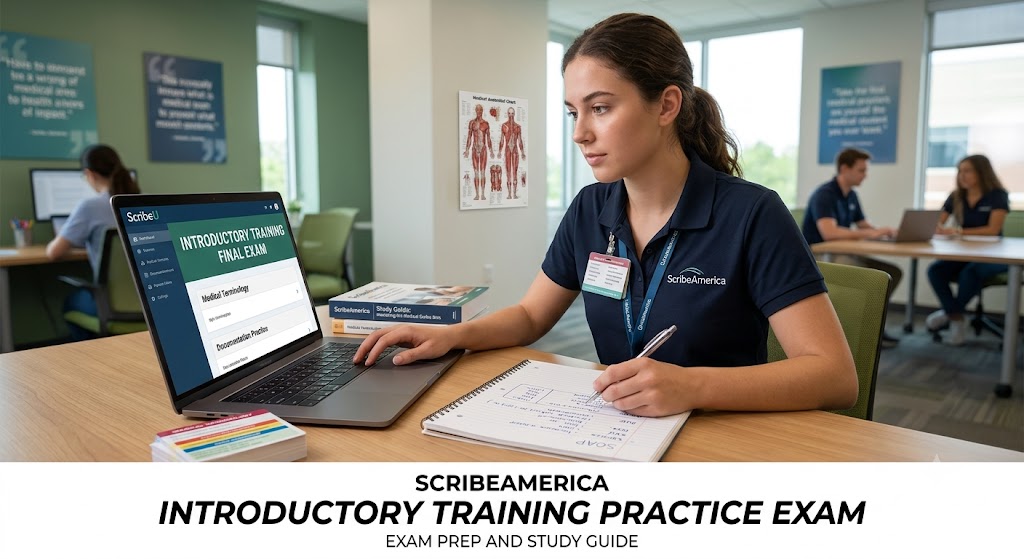
Additional Information
What the Course Entails and Exam Details
This training, often referred to as "ScribeU," is an intensive program that blends classroom or online instruction with initial clinical floor training. The final introductory exam assesses your mastery of the fundamental skills required for accurate, real-time medical documentation.
The core areas covered include:
Medical Terminology and Abbreviations: Understanding complex medical terms, root words, prefixes, suffixes, and standard shorthand.
Anatomy and Physiology Basics: Knowledge of major body systems, anatomical terminology, and common pathophysiological processes.
HIPAA and PHI Compliance: Deep understanding of the Health Insurance Portability and Accountability Act to protect patient privacy.
Medical Documentation Standards: Mastery of the SOAP note format, specifically focusing on how to document the Subjective (HPI, ROS), Objective (Physical Exam), and Assessment and Plan sections.
Electronic Health Records (EHR): Introduction to navigation and basic data entry within leading EHR systems like Epic and Cerner.
Medical-Legal Liability: Understanding the scope of practice for a scribe and ensuring documentation meets legal and billing standards.
Professionalism: Learning the expected conduct in a fast-paced clinical environment.
What to Expect in the Final Exam
The ScribeAmerica Introductory Training Final Exam is the final hurdle to entering your supervised clinical shifts. It is typically administered online through ScribeAmerica's learning management system, ScribeU.
The exam format is diverse and rigorous, designed to test both your recall of facts and your ability to apply concepts. You should expect a mix of multiple-choice questions, matching, and fill-in-the-blank items. The exam is comprehensive, covering all training material. The required passing score is generally 80% or higher. Students are typically given a specific time limit to complete the test, demanding efficiency and accuracy. If a student does not pass on the first attempt, ScribeAmerica may allow up to two additional retakes, depending on individual implementation manager discretion and specific site policy. Failing to achieve a passing score can lead to dismissal from the program.
How to Study and Exam Centers
The key to succeeding in the ScribeAmerica final exam is dedicated, multi-modal study. Start by thoroughly reviewing all proprietary materials, slide decks, and audio/video exercises provided during the ScribeU classroom phase. Create comprehensive flashcards, both physical and digital, for medical terminology, common abbreviations, and body systems. Many students have found that creating personal reference guides or cheat sheets (not for use during the exam) is highly effective. Practicing mock charting using practice patient scenarios is essential for building real-world charting speed and SOAP note accuracy. Furthermore, your typing speed is critical; aim to hit and exceed the 60 WPM mark with high accuracy through daily practice.
Unlike a standardized national certification, this is an internal assessment. The introductory final exam is completed online within the ScribeU portal after finishing the structured curriculum. It does not require you to travel to a physical, third-party testing center like Pearson VUE. Instead, you will take the exam from a designated computer or location specified by your ScribeAmerica implementation manager or head scribe.
Job Opportunities from the Course
ScribeAmerica is an entry point into several specialized roles and prepares you for future career advancement. Successful completion of the introductory training and final exam primarily unlocks employment within the company. This clinical experience is invaluable for those pursuing graduate-level medical education.
Here is a list of the specific job titles and career paths this training prepares you for:
Medical Scribe (Emergency Department): Documenting in a high-acuity, fast-paced setting.
Medical Scribe (Outpatient Clinics): Working in various specialties, including cardiology, orthopedics, or primary care.
Virtual Scribe: Providing remote medical documentation support via telehealth platforms.
Scribe Trainer / Lead Scribe: For experienced scribes to train new hires.
Implementation Manager: Leading the establishment of new scribe programs.
Additionally, the experience is designed to strengthen applications for:
Physician Assistant (PA) Programs.
Medical Doctor (MD) and Doctor of Osteopathic Medicine (DO) Programs.
Nurse Practitioner (NP) Programs.
Medical Administration and EHR Management.
Medical Coding and Billing.
Frequently Asked Questions
Reviews
5.0
Based on 0 reviews
Leave a Review
No reviews yet. Be the first to review!