
SCW Safety Practice Exam
$69.00
- Buy to unlock unlimited access to all Quiz questions and Answers in this Quiz.
- After purchase you can print a PDF of the whole quiz at any point. The PDF will contain the questions and the correct answers.
About this Exam
The Seabee Combat Warfare (SCW) Qualification is a prestigious designation within the United States Naval Construction Force (the Seabees), signifying comprehensive competence in construction skills, combat tactics, and operational knowledge. This comprehensive program is designed for active duty and selected reserve Navy personnel assigned to qualifying Seabee units. Within this challenging path to qualification, the specific "Safety Practice Exam" (or preparation phase) targets one of the most critical aspects of any Seabee's effectiveness: personnel well-being and operational risk management. This guide and the conceptual practice resources it references are tailored to help candidates master safety principles, ensuring that as a Seabee, you not only "Can Do" but can do so safely and professionally in all environments. This guide is an invaluable resource for sailors seeking to achieve their SCW insignia, reinforcing their knowledge and readiness through dedicated study.
Ready to test your knowledge?
Buy Now to Access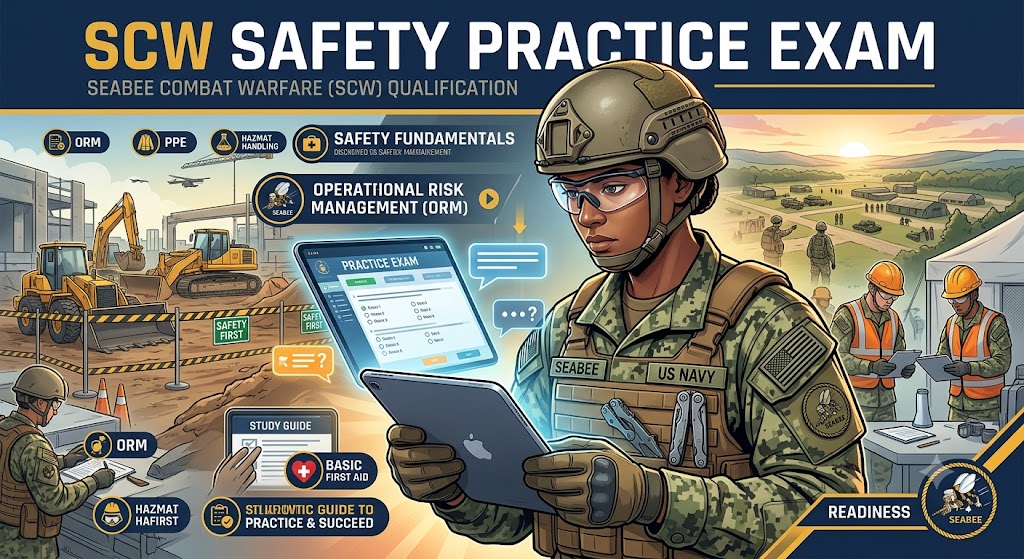
Additional Information
What the Course Entails and Exam Details
Preparing for the safety component of the SCW Qualification involves a deep dive into standard operating procedures and best practices in military and construction safety. This encompasses diverse areas of knowledge essential for effectiveness and survivability. Core topics typically covered in this study domain include:
Operational Risk Management (ORM): The principles of identifying, assessing, and managing risks in all tasks and environments.
General Naval occupational safety and health (NAVSOH): Workplace standards, hazard communication, and personal protective equipment (PPE).
Construction Site Safety: Recognizing and preventing common construction hazards (fall protection, electrical, etc.) in a military context.
Specific Equipment Safety: Operating heavy machinery and power tools according to strict safety protocols.
Hazardous Material Handling: Understanding, labeling, storing, and responding to hazardous substances safely.
Basic First Aid and CPR: Essential life-saving skills.
Operational/Combat Safety: Safety considerations specific to military operations and defensive postures.
Standard Operating Procedures (SOPs): Unit-specific and Navy-wide directives. The exam that assesses this knowledge is part of a larger qualification process which can include written tests, oral boards, and practical demonstrations within your command. The conceptual "Safety Practice Exam" mentioned in this guide is a valuable tool you would utilize to prepare for the official testing administered during your SCW journey.
What to Expect in the Final Exam
While the exact structure of the internal written and practical assessments can vary between Seabee commands, here is a general idea of what a knowledge-based exam focused on the safety component may entail:
Format: Typically composed of multiple-choice questions designed to test knowledge retention and the application of safety protocols to specific scenarios. Matching and true/false questions are also common.
Time Limit: Time is a valuable asset in the military, so anticipate a designated timeframe for completing the exam efficiently, often tailored to the number and complexity of the questions. Commands will provide specific details on the expected duration.
Passing Score Requirement: Achieving the high standards expected of a Seabee Combat Warfare professional requires diligent study. Candidates should aim for a passing score in line with Navy-wide military qualification standards, often set around 80% to demonstrate proficiency.
Practical Component: In addition to the written knowledge assessment, you will likely be required to demonstrate safety practices during practical construction exercises or combat training. The oral qualification board also heavily emphasizes understanding the importance and implementation of ORM. Be prepared to discuss how safety principles apply to operational realities. The official qualification process is multi-faceted and is ultimately assessed and awarded within the command's rigorous standards. Diligent use of study guides and practice assessments is the best way to ensure readiness.
How to Study and Exam Centers
Preparation is paramount to success in the SCW program. Here are effective strategies and an explanation of the testing environment:
Official Navy Resources: Utilize provided materials, including OPNAVINST instructions, NAVEDTRA study guides, and Seabee-specific handbooks (e.g., the Seabee Combat Handbook). Your command Master Chief and designated SCW coordinators will provide the most current curricula.
Practice Exams: Leverage available practice assessments, command-specific study banks, and conceptual resources. Treat these practice sessions as opportunities to identify knowledge gaps and build test-taking confidence. Analyze any incorrect answers in depth using reference materials.
Standard Operating Procedures (SOPs): Commit essential command SOPs and safety protocols to memory, as these are critical for practical and operational safety.
Study Groups: Form study groups with other candidates. Discussing concepts and quizzing each other strengthens retention and offers new perspectives.
Operational Risk Management (ORM) in Everything: Constantly practice applying ORM principles to every task, big or small, whether during training or in daily life. Discuss real-world or scenario-based ORM applications.
Command Testing & Review Board: Unlike general civilian exams taken at public test centers, the official Seabee Combat Warfare (SCW) exams and all aspects of the qualification are administered directly within the candidate's Seabee command by designated personnel, qualification coordinators, and finally, a Qualification Review Board of senior SCW-qualified members. There are no public or external exam centers. Practice materials and assessments might be available via digital command portals or in physical study guides, but all official testing is handled internally as part of military duty and advancement processes.
Job Opportunities from the Course
Earning the SCW Qualification, with its integrated mastery of construction and combat safety, signifies a significant professional milestone and opens the door to numerous enhanced roles and advancement opportunities. This designation not only boosts your military career but also positions you favorably for diverse roles in the civilian construction and safety sectors upon transition. Specific job titles and career paths directly influenced by achieving the SCW qualification include:
Seabee Construction Specialist (within specific Seabee ratings)
Construction Electrician (Navy/Seabee)
Engineering Aide (Navy/Seabee)
Builder (Navy/Seabee)
Utilitiesman (Navy/Seabee)
Steelworker (Navy/Seabee)
Equipment Operator (Navy/Seabee)
Seabee Combat Instructor
Naval Construction Force (NCF) Leader/Manager (with associated leadership roles)
Operational Risk Management (ORM) Specialist
Construction Project Manager (within/outside Navy)
Civilian Construction Site Safety Inspector
Facility Manager (with required skills in both construction and safety)
Civilian Construction Safety Officer
Occupational Health and Safety (OSHA) Compliance Specialist The leadership and commitment to safety demonstrated by the SCW qualification make Seabees highly sought after in numerous critical roles both within the Navy and the civilian world.
Frequently Asked Questions
Reviews
5.0
Based on 0 reviews
Leave a Review
No reviews yet. Be the first to review!