
SCWS Practice Exam
$69.00
- Buy to unlock unlimited access to all Quiz questions and Answers in this Quiz.
- After purchase you can print a PDF of the whole quiz at any point. The PDF will contain the questions and the correct answers.
About this Exam
The Seabee Combat Warfare Specialist (SCWS) qualification is a prestigious personal warfare designation for enlisted personnel and officers in the United States Navy's construction battalions. This program is specifically designed to validate a Seabee's understanding of mission effectiveness, combat readiness, and survivability. It establishes a standard level of knowledge regarding how an individual unit’s mission fits into and supports naval doctrine. Earning the SCWS pin—silver for enlisted and gold for officers—is a significant career milestone, demonstrating expertise far beyond basic rating skills. It is an optional but highly encouraged qualification for Seabees billeted with qualifying units, such as Naval Mobile Construction Battalions (NMCBs), Naval Construction Groups (NCGs), and other expeditionary forces.
Ready to test your knowledge?
Buy Now to Access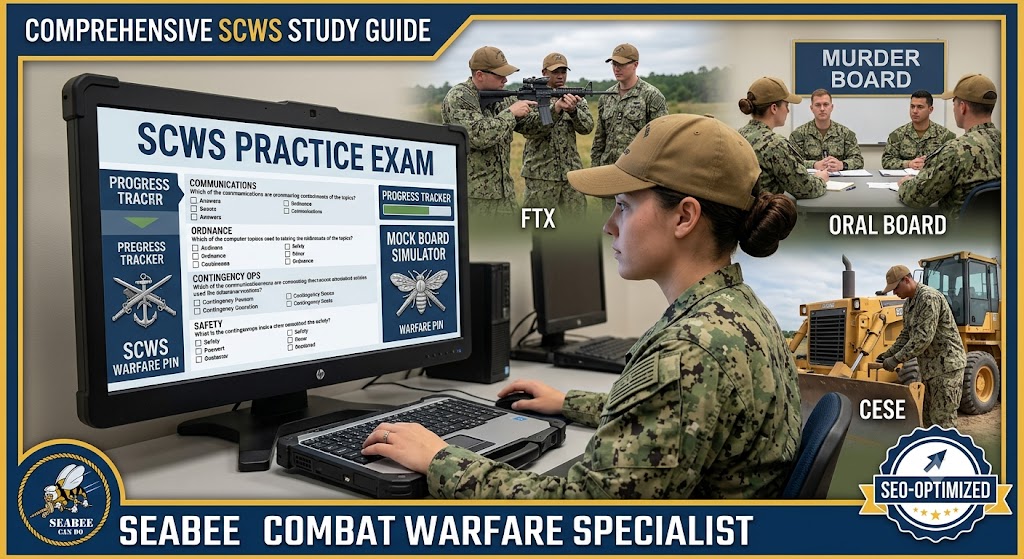
Additional Information
What the Course Entails and Exam Details
The SCWS qualification process is not a single course, but a cumulative journey documented through Personnel Qualification Standard (PQS) books. The qualification consists of two main components: Common Core and Unit-Specific.
The Common Core PQS covers fundamental knowledge applicable across the Naval Construction Force, including:
101 Safety Fundamentals: (ORM, hazards, CPR, environmental safety)
102 Administration/Command and Control (C2): (battalion organization, CSE, COC/ACOC, Air Detachment)
103 Supply/Logistics Fundamentals: (Material Liaison Officer (MLO), Table of Allowance (TOA) procedures)
104 Communications Fundamentals: (communications security (COMSEC), radio procedures)
105 Ordnance/Weapons Fundamentals: (weapon characteristics, safety, marksmanship)
106 Contingency Operations Fundamentals: (expeditionary logistics, project planning, patrolling)
107 Embarkation Fundamentals: (movement of personnel and equipment)
108 Civil Engineer Support Equipment (CESE) Fundamentals: (maintenance, dispatch, operator responsibilities)
The Unit-Specific PQS details the unique equipment, organization, and missions of the Seabee’s current command.
In addition to completing the PQS, a Seabee must:
Complete specific Non-Resident Training Courses (NRTCs).
Qualify on a weapon within their unit's Table of Allowance (TOA).
Attend a Field Training Exercise (FTX) or equivalent field environment.
Maintain physical readiness standards.
What to Expect in the Final Exam
While 'practice test' often refers to a written exam, the final hurdle of the SCWS qualification is a multi-step evaluation.
A. The Written Exam: Most commands administer a comprehensive, closed-book written exam upon completion of all PQS sign-offs. This test consists of multiple-choice and short-answer questions drawn directly from the Common Core and Unit-Specific PQS. The format is similar to other Navy advancement exams. A passing score, usually 80% or higher, is required to proceed.
B. The Pre-Board and Final Oral Board: This is the defining component. The Final Oral Board is a rigorous, verbal examination conducted by a panel of three to five qualified personnel, typically including senior enlisted leaders and officers. Candidates can expect questions covering every topic within their PQS books, often for several hours. The board assesses not just recall, but a deep, practical understanding and the ability to apply knowledge under pressure. The process is famously challenging, and passing is a significant achievement.
How to Study and Exam Centers
Effective preparation is essential and combines study, practical application, and verbal rehearsal. Actionable strategies include:
PQS is your Bible: Dedicate time every day to studying specific sections of your Common Core and Unit-Specific books.
Hands-on Application: Don't just read; perform. Handle weapons, operate radios, and participate fully during FTXs to make the knowledge stick.
Study Groups: Forms or join a study group. Quiz each other on the PQS questions and discuss real-world scenarios.
Mock Boards ('Murder Boards'): This is critical. Regularly conduct mock oral boards. Ask qualified mentors to grill you with difficult questions to simulate the pressure and identify knowledge gaps.
Online Training Portals: Use Navy eLearning or similar authorized portals to complete all required NRTCs and access digital PQS resources.
Exam Centers: The SCWS process is command-managed. There is no centralized testing center. All components—the written exam, the pre-board, and the final oral board—are administered within your assigned Seabee unit or command, led by the Command SCW Coordinator.
Job Opportunities from the Course
Earning the SCWS pin is not a guarantee of a civilian job, but it is a major career enhancer within the Navy, directly unlocking leadership opportunities and advanced roles:
Eligibility for Leadership Positions: The SCWS qualification is frequently a prerequisite for advancement to E-6 and above, and for selection to key leadership roles within a battalion.
Advanced Operational Responsibility: Holders of the pin are qualified for more complex, high-visibility, and tactical assignments in expeditionary environments.
Prerequisite for Specific Instructor Billets: To become an instructor at Seabee training commands (like NCTC), holding the warfare pin is often mandatory.
Increased Value to the NCF: Your comprehensive understanding of warfare and construction makes you a more capable, well-rounded asset to the Naval Construction Force.
Distinction and Respect: It serves as a visual symbol of professionalism, expertise, and dedication, commanding respect from peers and leadership alike.
Frequently Asked Questions
Reviews
5.0
Based on 0 reviews
Leave a Review
No reviews yet. Be the first to review!