
Search and Rescue (SAR) Certification Practice Exam
$69.00
- Buy to unlock unlimited access to all Quiz questions and Answers in this Quiz.
- After purchase you can print a PDF of the whole quiz at any point. The PDF will contain the questions and the correct answers.
About this Exam
Search and Rescue (SAR) certifications are designed for individuals dedicated to a critical mission: finding and rescuing people in distress. These programs serve as the gold standard for both volunteer and professional responders, ensuring they possess the core knowledge, decision-making skills, and physical readiness required for hazardous operations. The certification validates your ability to operate safely and effectively in various challenging environments, from wilderness and suburban landscapes to maritime or urban disaster zones. Whether you are aiming to be a ground searcher, a canine handler, a team leader, or a coordinator, this is the essential first step to becoming a trusted member of the global SAR community.
Ready to test your knowledge?
Buy Now to Access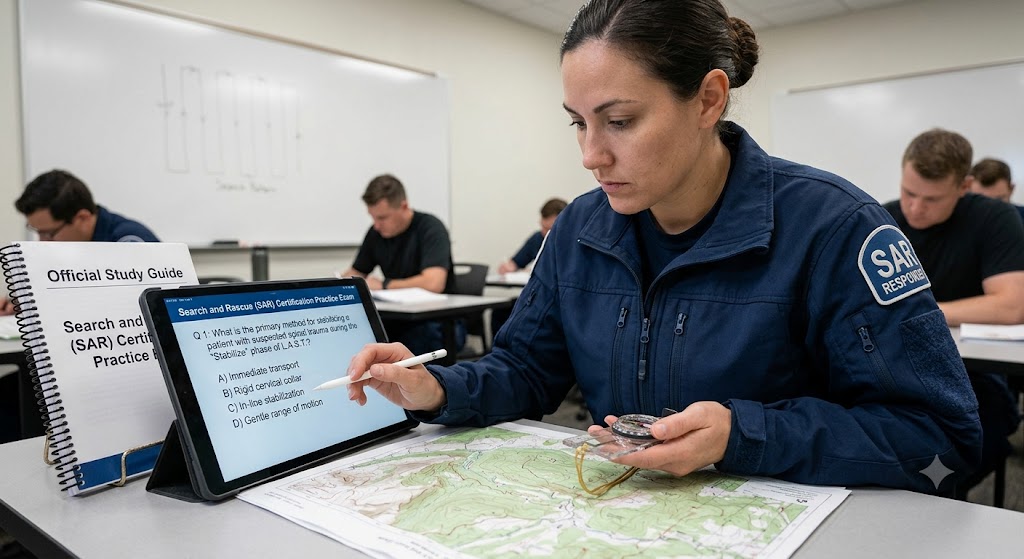
Additional Information
What the Course Entails and Exam Details
A comprehensive SAR course, which prepares you for a final certification exam, covers a blend of theoretical knowledge and practical, field-applicable skills. While specific programs (like those from NASAR, AERIE, or regional standards) may vary slightly, you can expect the syllabus to heavily emphasize the universal L.A.S.T. acronym: Locate, Access, Stabilize, and Transport. Core topics include:
SAR History and Organization: Understanding the structure of local, national, and international SAR systems.
Safety and Risk Management: Comprehensive knowledge of hazard assessment, risk mitigation, and personal safety protocols in the field.
Incident Command System (ICS): Training in the standardized on-scene incident management model used for multi-agency response.
Ethics and Legal Concepts: Implied consent, authorization for care, the Good Samaritan Laws, and patient privacy (HIPAA) standards.
Search Operations and Management: Planning, strategy, and execution of area-type searching using POS (Probability of Success) and understanding lost person behavior.
Field Skills (Ground SAR specific): Specialized knowledge in area search, clue awareness, clue interpretation, and protection.
Map & Compass Navigation: Proficiency in reading topographic maps, plotting coordinates, and utilizing a compass (often including a mandatory non-field practical element).
Communications and Technology: Use of satellite emergency beacons (PLBs, EPIRBs), GPS units, and radio protocols.
Medical and Survival: Prerequisites or concurrent certifications, such as CPR (including AED), Basic First Aid, and Wilderness First Aid, are almost always required.
What to Expect in the Final Exam
The final exam is a rigourous assessment, often composed of two key components to ensure both cognitive understanding and practical skill mastery. For certifications such as SAR Responder 3 or SARTECH II, candidates can typically expect:
A Written Knowledge Exam: This section usually involves an 80+ question multiple-choice test that covers the theoretical knowledge listed above. Some exams, like the SARResponder 3, also incorporate a non-field map & compass navigation practical as part of this written portion.
Passing Score Requirements: To succeed, you must generally score a minimum of 80% on the overall written examination. For exams with a mandatory navigation component, a minimum passing score of 70% or 80% is often required specifically for the navigation problems, regardless of your overall score.
Time Limits: Candidates are typically given 2 to 4 hours to complete the written knowledge portion. Practical assessments may have separate scheduling or continuous evaluation over a multi-day field exercise.
Field Practical Evaluation: Many certifications, especially for ground and wilderness roles, require the successful completion of field practical stations. Evaluators will observe and score your ability to perform tasks like clue detection, hasty search, area search, map navigation in the field, and basic rescue techniques. These are often graded on a pass/fail basis.
Required Proof of Prerequisites: Before being fully certified, you must provide proof of your concurrent certifications, such as current CPR/AED, Basic First Aid, and completion of FEMA IS-100 or higher.
How to Study and Exam Centers
Effective preparation requires a multi-pronged approach that blends study, practice, and physical readiness.
Actionable Study Strategies:
Utilize Official Guides: Obtain the specific textbook or study guide recommended by your certifying body (e.g., Introduction to SAR for SARTECH III or Fundamentals of SAR for SARTECH II). These materials are the foundation of the exam content.
Take Mock Practice Tests: Engaging with practice exams, like the one illustrated in this article, is essential. These mock questions help you identify knowledge gaps, familiarize yourself with the phrasing of multiple-choice questions, and improve your test-taking speed and confidence.
Prioritize Navigation: If your certification has a navigation component, practice map and compass work extensively. Build skill in reading contours, plotting points, taking bearings, and calculating back-bearings. This cannot be overlooked, as navigation failures often lead to automatic exam failure.
Review the L.A.S.T. Acronym: Use this as your cognitive framework for decision-making. Ensure you can apply it to every situational question: How do you first Locate the missing? How do you safely Access them? How do you Stabilize them medically? And how will you Transport them to safety?
Exam Centers:
Search and Rescue certification exams are not typically hosted at common online test portals. Instead, they are administered through authorized channels:
Authorized Training Schools and Academies: These special-purpose institutions are approved to deliver the training and host the subsequent certification exams.
Approved SAR Agencies: Many state and local emergency services, law enforcement agencies, or dedicated volunteer SAR teams that adhere to specific standards (like ASTM F3069) are authorized to proctor the exams for their members or the public.
Physical Testing Centers: Some specialized, regional centers may be set up by certifying bodies like NASAR to host regular written and field practical examination sessions. You must register through the specific organization’s website to find and schedule a test at one of these approved locations.
Job Opportunities from the Course
A Search and Rescue (SAR) certification is a vital credential that opens doors to diverse and critical career paths in both the paid and volunteer sectors. Below are specific job titles and career tracks that this qualification unlocks:
Ground SAR Team Member: Performing wilderness, urban, or suburban searches as part of a structured team.
SAR Medical Responder: Providing critical initial care and stabilization during rescue missions (when combined with EMS certifications).
Canine (K9) SAR Handler: Specializing in using trailing, air-scent, or avalanche detection dogs.
Field Team Leader: A supervisory role responsible for leading a small field team during active search operations.
Technical Rope Rescue Specialist: Utilizing specialized gear for high-angle or complex extractions.
Avalanche Rescue Technician: Focused on operations in alpine and high-snow environments.
Maritime Search and Rescue Crew: Roles on boat crews (coxswain, engineer, medic) or airborne crews (helicopter pilot, technical crew/winch operator).
SAR Coordinator/Logistics Manager: Overseeing planning, logistics, and resource allocation at the Incident Command Post (ICP).
Park Ranger / Law Enforcement Officer: Where SAR is a primary, mandatory, or specialized duty of the role.
Deputy Logistics Coordinator / Technical Logistics Manager: Key administrative and support leadership within larger rescue operations.
FEMA Urban Search & Rescue (US&R) Task Force Member: Participating in complex structural collapse and disaster response operations.
Frequently Asked Questions
Reviews
5.0
Based on 0 reviews
Leave a Review
No reviews yet. Be the first to review!