
Seattle PSP Certification Practice Exam
$69.00
- Buy to unlock unlimited access to all Quiz questions and Answers in this Quiz.
- After purchase you can print a PDF of the whole quiz at any point. The PDF will contain the questions and the correct answers.
About this Exam
The Seattle Planning and Scheduling Professional (PSP) Practice Exam is a targeted study aid crafted to mirror the rigor and scope of the full AACE International PSP certification exam. The PSP certification itself is a globally recognized credential that distinguishes individuals with a deep understanding of planning and scheduling principles, advanced techniques, and their application in real-world projects.
This practice exam is a localized resource for the Pacific Northwest community, ensuring that aspirants can gauge their readiness against the highest global standard without leaving the region. It is designed for experienced schedulers, project managers, project controls professionals, and consultants, primarily within the construction, engineering, and manufacturing industries, who must master the critical path method (CPM) and advanced schedule analysis to drive project success.
Ready to test your knowledge?
Buy Now to Access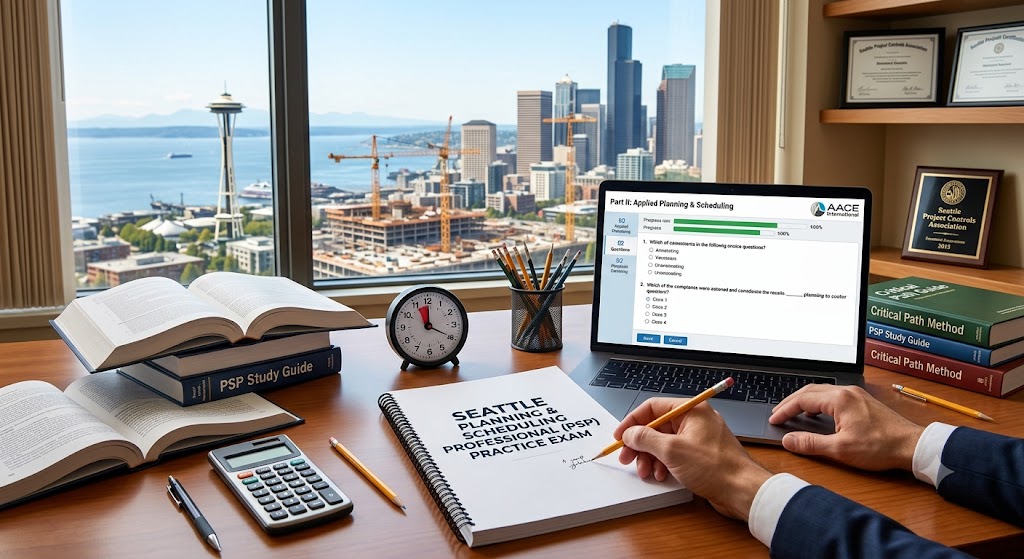
Additional Information
What the Course Entails and Exam Details
This localized practice exam does not replace a comprehensive AACE PSP study course but acts as a final, critical checkpoint. To succeed on both this practice exam and the final AACE test, you must be proficient in the following domains and specific knowledge areas:
Core Knowledge Areas Covered:
Planning and Scheduling Framework: Comprehensive knowledge of project life cycles, the planning process, and the distinction between planning and scheduling.
Work Breakdown Structure (WBS): The ability to create, manage, and utilize a WBS to define project scope and structure schedules.
Activity Network Development: Proficiency in defining activities, establishing logical relationships, and calculating activity durations, including identifying lags, leads, and constraints.
Critical Path Method (CPM): Expertise in the fundamentals and advanced application of CPM, including forward and backward passes, float calculations (total and free float), and identification of the critical path.
Resource and Cost Integration: The skills to load resources, develop cost-loaded schedules, and integrate scheduling with cost control systems.
Earned Value Management (EVM): Applying EVM principles to track schedule performance and forecast project outcomes.
Schedule Maintenance and Controlling: Techniques for updating the schedule, analyzing progress, and developing recovery plans.
Communication and Reporting: The ability to present schedule information, analysis, and risks clearly to diverse stakeholders.
3. What to Expect in the Final Exam
While this tool is a Practice Exam, it is essential to understand the final AACE International PSP certification exam, which it emulates. The final exam is a four-part assessment that combines theoretical knowledge with practical, scenario-based problem-solving.
Part I: Planning and Scheduling Knowledge (Multiple Choice): This section tests your recall and understanding of basic and advanced definitions, terminology, and core methodologies. It usually consists of 119 multiple-choice questions.
Part II: Applied Planning and Scheduling Knowledge (Multiple Choice): This part focuses on the application of principles, requiring you to analyze data, interpret schedules, and make decisions based on complex scenarios.
Part III: Practical Exercise: You will be given a specific scenario and project data and required to develop a mini-schedule, identifying the critical path, calculating float, and responding to project changes.
Part IV: PSP Essay: This final section requires you to write a comprehensive essay response, demonstrating your ability to communicate complex scheduling concepts, analyze risks, or recommend a course of action.
Passing Score and Time Limit:
The final AACE PSP exam is extensive and rigorous, typically lasting up to 5 hours. Candidates must achieve a score of at least 70% on each of the four parts to be awarded the PSP certification.
How to Study and Exam Centers
Preparation is paramount for the PSP. To maximize your chances of success, you should integrate this Seattle Planning and Scheduling Professional (PSP) Practice Exam into a structured study plan:
AACE Recommended Reading: Start by mastering the primary source, the AACE International PSP Study Guide. Complement this with other foundational texts like the CPM in Construction Management and the Project Management Body of Knowledge (PMBOK® Guide).
Structured Practice: Use our Seattle PSP Practice Exam as a diagnostic tool. Take it under timed conditions to identify your weak areas, then focus your study on those specific domains.
Master the Essay: Do not underestimate the essay portion. Practice writing clear, concise, and structured responses that demonstrate both technical knowledge and professional communication skills.
Exam Center Locations: The actual AACE International certification exams are administered by KRYTERION, AACE’s global testing partner. While you can take the exam via online proctoring from your home or office in Seattle, physical testing centers are also available. You can locate an authorized KRYTERION testing center near Seattle by visiting the KRYTERION or AACE websites to schedule your official exam. This local practice exam is an invaluable preparation step before you schedule that final, decisive session.
Job Opportunities from the Course
Earning your PSP certification after rigorous preparation and successfully passing the practice exam unlocks an advanced, high-impact career path, especially within Seattle's booming technology and infrastructure sectors. The specialized skills validated by this credential open doors to many key roles and career advancements.
Here is a clear list of job titles and career paths this certification enables:
Planning and Scheduling Manager
Senior Project Controls Specialist
Lead Project Scheduler
Project Controls Manager
CPM Schedule Consultant
Director of Project Controls
Senior Construction Manager
Earned Value Management (EVM) Analyst
Claim and Dispute Resolution Specialist
Frequently Asked Questions
Reviews
5.0
Based on 0 reviews
Leave a Review
No reviews yet. Be the first to review!