
Security Analyst Incident Response Practice Exam
$69.00
- Buy to unlock unlimited access to all Quiz questions and Answers in this Quiz.
- After purchase you can print a PDF of the whole quiz at any point. The PDF will contain the questions and the correct answers.
About this Exam
The Security Analyst Incident Response certification is designed for cybersecurity professionals specializing in detecting, responding to, and mitigating security breaches. This exam validates a candidate's ability to handle the entire lifecycle of a cyber incident, from initial identification to final recovery and lessons learned. It is ideal for Tier 1 and Tier 2 Security Analysts, Incident Responders, and SOC (Security Operations Center) personnel looking to formalize their specialized skillset and advance their careers in digital forensics and threat response.
Ready to test your knowledge?
Buy Now to Access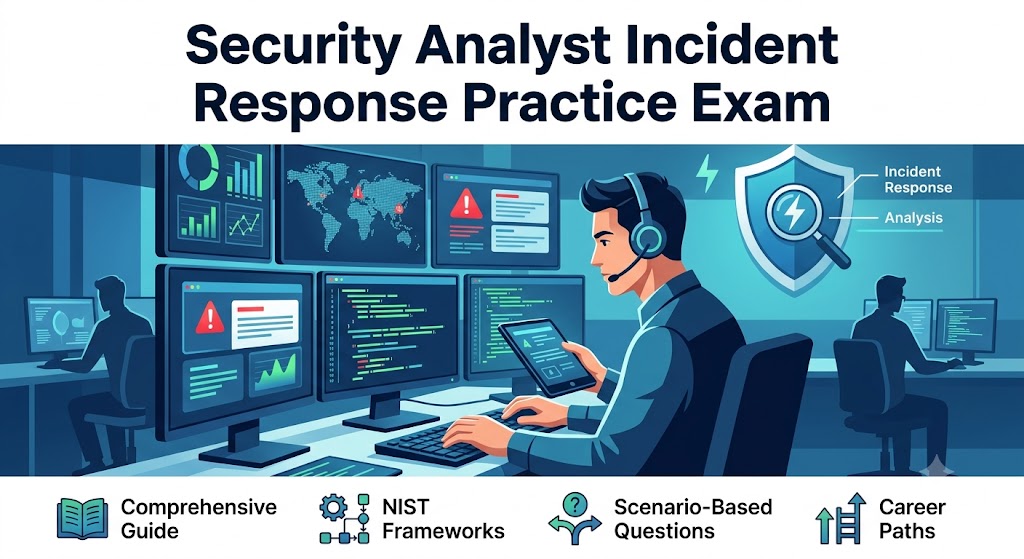
Additional Information
What the Course Entails and Exam Details
This comprehensive practice test covers the core domains essential for effective incident handling, ensuring candidates are prepared for real-world scenarios.
The curriculum focuses on the structured steps of incident response. First, you must master Preparation, including developing incident response plans, defining team roles, and ensuring necessary tools are deployed. The next major focus is Detection and Analysis, which involves monitoring security alerts, analyzing logs (SIEM, firewall, endpoint), and distinguishing between true positives and false positives.
A significant portion of the course covers Containment, Eradication, and Recovery. Candidates learn strategies to isolate affected systems, remove threats (such as malware or unauthorized access), and safely restore services. Finally, the test validates knowledge in Post-Incident Activity, emphasizing documentation, identifying the root cause, and implementing improvements to prevent future occurrences.
What to Expect in the Final Exam
The Security Analyst Incident Response Final Exam is a rigorous assessment that challenges both your theoretical knowledge and practical application skills.
The exam format typically consists of 60 to 75 multiple-choice and scenario-based questions. You must analyze complex situations and choose the most effective response based on standard incident handling frameworks. Candidates are given 90 minutes to complete the exam.
The passing score requirement varies slightly by testing iteration but generally falls between 70% and 75%. This is a closed-book examination. You may not access any outside resources, notes, or digital devices during the test. For those taking the exam remotely, strict online proctoring rules apply, requiring a clean workspace and a functional webcam and microphone throughout the session.
How to Study and Exam Centers
Preparation is critical for success. To begin, thoroughly review standard Incident Response Frameworks, such as the NIST SP 800-61 Rev. 2 (Computer Security Incident Handling Guide) and the CERT/CC guidelines.
Create a robust study plan that balances theoretical learning with practical application. Utilize practice exams, like this one, to familiarize yourself with the question format and identify knowledge gaps. When taking practice tests, focus not just on the correct answer, but on understanding why the other options are incorrect in the given context. Hands-on experience is invaluable; practice analyzing mock logs, interpreting PCAP files, and responding to simulated malware outbreaks in a lab environment.
The final certification exam is administered through authorized testing channels. You can register and take the test at proctored Pearson VUE testing centers worldwide, which provide a secure, controlled physical environment. Alternatively, the exam is available via online proctored testing portals, allowing you to take the certification from your home or office, provided you meet the strict technical and environmental requirements.
Job Opportunities from the Course
Earning the Security Analyst Incident Response certification significantly enhances your resume and opens doors to specialized roles within the cybersecurity sector.
Organizations across all industries, including finance, healthcare, and government, require dedicated professionals to defend their infrastructure. The specific career paths this certification unlocks include:
Cybersecurity Incident Responder: The primary role, focusing entirely on reacting to and mitigating active threats.
Tier 2/Tier 3 Security Analyst: Senior SOC roles responsible for deep-dive analysis and complex alert investigation.
Digital Forensics Analyst: Specializing in investigating breaches, collecting evidence, and reconstructing attacker activities.
Threat Hunter: A proactive role using incident response knowledge to search for undetected threats hidden within the network.
SOC Supervisor/Manager: Leading the Security Operations Center team and managing overall incident response coordination.
Frequently Asked Questions
Reviews
5.0
Based on 0 reviews
Leave a Review
No reviews yet. Be the first to review!