
Security Training Practice Exam Guide
$69.00
- Buy to unlock unlimited access to all Quiz questions and Answers in this Quiz.
- After purchase you can print a PDF of the whole quiz at any point. The PDF will contain the questions and the correct answers.
About this Exam
The Security Training Practice Test is designed as a crucial step for individuals aspiring to enter the private security industry.
This comprehensive exam serves as a final evaluation for students who have completed their required foundational security guard training course. It ensures they possess the essential knowledge, skills, and ethical understanding necessary to perform the duties of a security professional effectively and safely.
The exam is designed for new security guard candidates looking to obtain their initial certification or license. It is also an excellent tool for experienced security professionals seeking to refresh their knowledge and prepare for license renewals.
Successfully passing this practice test builds confidence and indicates readiness for the official state or provincial licensing exam that often follows.
Ready to test your knowledge?
Buy Now to Access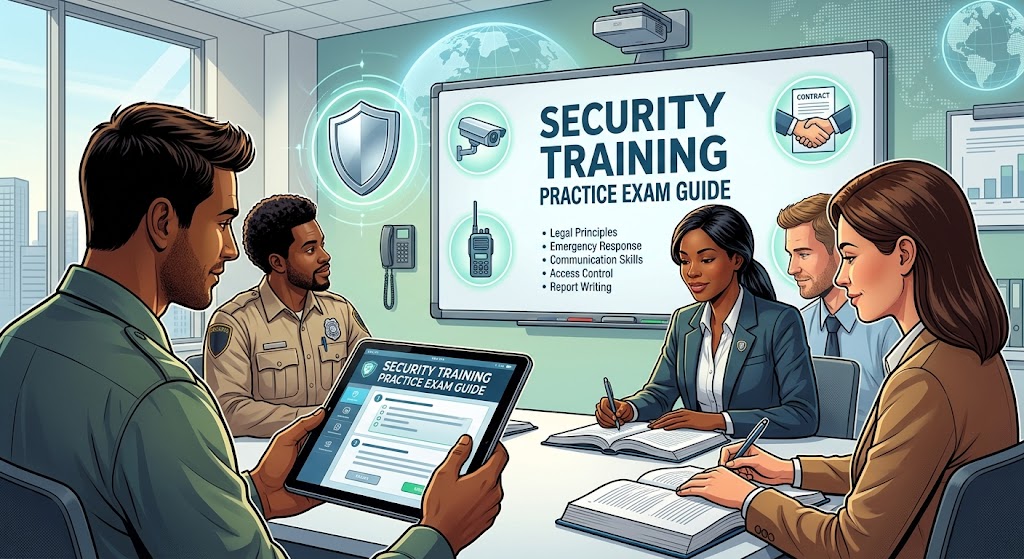
Additional Information
What the Course Entails and Exam Details
This training program covers the core competencies required for modern security personnel, blending theoretical knowledge with practical scenarios.
Candidates will master a wide range of topics, including legal principles and limitations, understanding the power of arrest, search and seizure laws, and the use of force continuum. A significant emphasis is placed on effective communication skills, including de-escalation techniques, public relations, and conflict resolution, ensuring guards can handle tense situations with professionalism.
The course also covers essential operational skills such as:
Observation and documentation, including accurate incident report writing.
Emergency response procedures, including fire safety, basic first aid (CPR/AED awareness), and evacuation protocols.
Access control systems, patrol techniques, and asset protection strategies.
Ethics, professionalism, and understanding the role of security within the legal system.
What to Expect in the Final Exam
While "Security Training Practice Test" can be the name of this evaluation, the final licensing exam typically follows a specific format.
The actual final exam is usually a proctored, closed-book assessment administered via a computer-based testing center. The format is predominantly multiple-choice, though some regions might include interactive scenario-based questions to assess practical judgment.
Candidates are often required to achieve a minimum passing score, frequently around 70% to 75%, depending on the specific state, province, or regulatory body.
The time limit for the exam generally ranges from 60 to 90 minutes. Strict rules prohibit the use of any reference materials, mobile devices, or external assistance during the test. For the "practice test" itself, the rules may be slightly relaxed to facilitate learning, but standard exam conditions should always be simulated to ensure maximum preparation.
How to Study and Exam Centers
Effective preparation for this critical exam requires a structured study approach.
Start by utilizing official resources. Your primary study material should be the comprehensive training manual provided by your accredited security school or state regulatory department.
Implement dynamic study techniques:
Take Multiple Practice Tests: Make "The Security Training Practice Test" a central part of your routine. These tests, found online and in study guides, are the single most effective way to understand the exam's structure and timing.
Simulate Exam Conditions: When taking practice tests, find a quiet space, set a timer, and complete the test without breaks or study aids to build stamina and confidence.
Review Incorrect Answers: The value of a practice test is not just in your score, but in understanding why you got an answer wrong. Analyze explanations and return to your course materials for that topic.
The final licensing exam must usually be taken at an authorized testing center. In many regions, this is done through specialized testing partners like Pearson VUE or at testing facilities designated by your state's Department of Public Safety (or equivalent agency). Your certified training provider will typically guide you on where and how to schedule your official exam once your course is complete.
Job Opportunities from the Course
A security training certification unlocks numerous career paths in diverse settings. The skills gained are high-demand and offer opportunities for both specialized roles and career advancement.
Completing this course can lead to the following positions:
Unarmed Security Guard
Armed Security Officer (requires additional training)
Event Security Personnel
Corporate Security Specialist
Retail Loss Prevention Officer
Hotel Security Officer
Airport Security Agent
Mobile Patrol Officer
Access Control Specialist
Security Shift Supervisor (requires experience)
Executive Protection Agent (requires specialized training)
Frequently Asked Questions
Reviews
5.0
Based on 0 reviews
Leave a Review
No reviews yet. Be the first to review!