
Seed Treatment Category 4 Practice Exam
$69.00
- Buy to unlock unlimited access to all Quiz questions and Answers in this Quiz.
- After purchase you can print a PDF of the whole quiz at any point. The PDF will contain the questions and the correct answers.
About this Exam
The Seed Treatment Category 4 certification is an essential credential for professionals involved in applying pesticides to agricultural seeds. This exam is specifically designed for individuals who oversee or perform seed treatment operations, ensuring they have the knowledge and skills necessary to apply these crucial products safely, effectively, and in compliance with state and federal regulations. Achieving this certification demonstrates a commitment to agricultural best practices, environmental stewardship, and safety in the workplace.
Ready to test your knowledge?
Buy Now to Access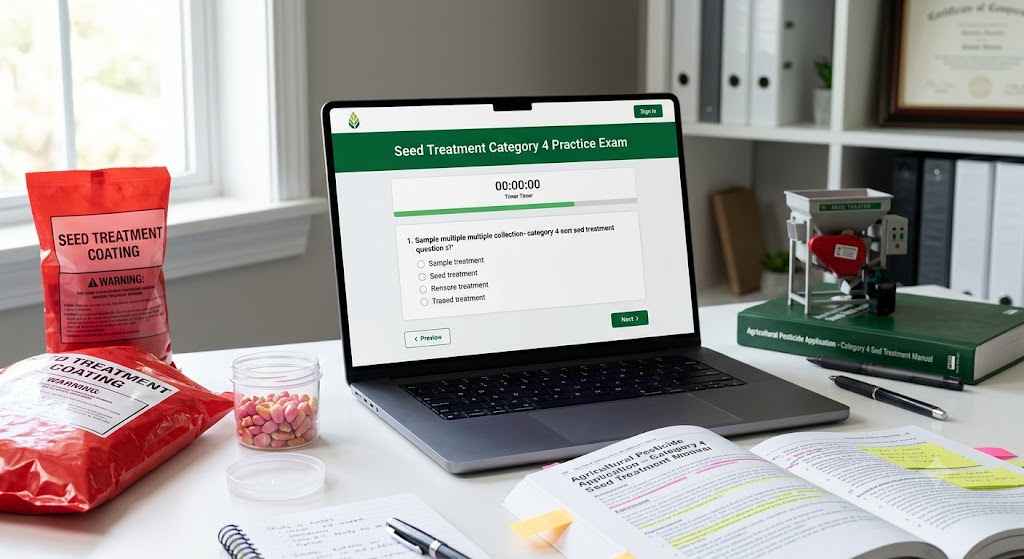
Additional Information
What the Course Entails and Exam Details
This specialized certification covers a broad range of topics critical to the seed treatment industry. The material you study will prepare you for practical challenges and regulatory requirements in the field. Core topics include:
Pesticide Safety: Comprehensive understanding of toxicity, personal protective equipment (PPE), handling, storage, and emergency response procedures.
Regulations and Laws: Federal (FIFRA) and state-specific laws governing pesticide use, record-keeping, and application.
Seed Treatment Products: Knowledge of different types of fungicides, insecticides, and other treatments, how they work, and their appropriate application.
Application Equipment: Detailed study of various seed treatment machines, calibration methods, and maintenance for accurate dosing.
Environmental Protection: Strategies to prevent pesticide runoff, drift, and contamination of water sources or non-target organisms.
Pest and Disease Management: Identification of key seed-borne and soil-borne pests and diseases controlled by seed treatments.
Label Comprehension: Interpreting and following pesticide labels, which are legal documents, with absolute accuracy.
What to Expect in the Final Exam
The Seed Treatment Category 4 Final Exam is generally a proctored, computer-based test, often composed entirely of multiple-choice questions. Depending on your state's specific requirements, there may be 50 to 100 questions. You will be given a specific time limit, typically between 1.5 to 3 hours, which is ample if you are well-prepared.
A passing score is generally set around 70% or higher. While this is the standard, it is vital to confirm the exact passing requirement with your local pesticide regulatory agency, as it can vary. The exam focuses heavily on applying theoretical knowledge to practical scenarios, testing your ability to solve problems you will face on the job.
How to Study and Exam Centers
Effective preparation is key to success on this exam. Here are actionable study strategies:
Utilize the Official Study Guide: The cornerstone of your preparation should be the official Category 4 Seed Treatment training manual provided by your state's lead pesticide agency (often the Department of Agriculture) or a cooperating university extension office. This manual is exactly what the exam is based on.
Take Practice Exams: Leverage reputable online practice tests, like the one simulated in the image below. These practice exams familiarize you with the question format, time constraints, and help you identify areas where you need further study.
Focus on Label Interpretation: Dedicate significant time to reading and understanding actual pesticide labels. The exam will frequently require you to find specific information from a sample label.
Hands-on Application: If possible, spend time with the equipment and products you will be using. Connecting the theory in the manual to practical application makes the concepts much easier to retain.
Form Study Groups: Collaborating with colleagues who are also preparing can provide new perspectives and motivation.
Where to Take the Exam: Pesticide certification exams are typically administered by state regulatory agencies. They may offer testing at specific physical testing centers, university extension offices, or, increasingly, through approved online proctoring portals. Some states also utilize third-party testing centers like Pearson VUE. Check your state pesticide regulatory agency’s website for the most current information on exam registration and testing locations.
Job Opportunities from the Course
Obtaining your Seed Treatment Category 4 Certification opens doors to several specialized roles within the agricultural sector. This qualification is highly regarded by employers who require certified applicators to meet regulatory standards. Potential job titles include:
Certified Seed Treatment Applicator
Seed Plant Manager / Supervisor
Agricultural Custom Applicator (Specializing in Seed Treatment)
Seed Production Specialist
Pesticide Sales Representative (Specializing in Seed Treatments)
Seed Quality Control Technician
Agrochemical Field Researcher (Involved in Seed Treatment Trials)
Regulatory Compliance Officer (Agriculture)
Frequently Asked Questions
Reviews
5.0
Based on 0 reviews
Leave a Review
No reviews yet. Be the first to review!