
SEG Fundamentals Warrior Practice Exam
$69.00
- Buy to unlock unlimited access to all Quiz questions and Answers in this Quiz.
- After purchase you can print a PDF of the whole quiz at any point. The PDF will contain the questions and the correct answers.
About this Exam
The Secure Email Gateway (SEG) – Fundamentals Warrior Certification is a crucial stepping stone for IT professionals looking to solidify their expertise in email security infrastructure. This practice exam is meticulously crafted to simulate the actual test environment, providing you with the opportunity to evaluate your knowledge of threat prevention, data loss prevention, and secure message routing. It is designed for cybersecurity beginners, network administrators, and anyone tasked with deploying, managing, or troubleshooting Secure Email Gateway solutions. By testing your understanding of core SEG principles, this practice exam helps bridge the gap between theoretical knowledge and practical certification success.
Ready to test your knowledge?
Buy Now to Access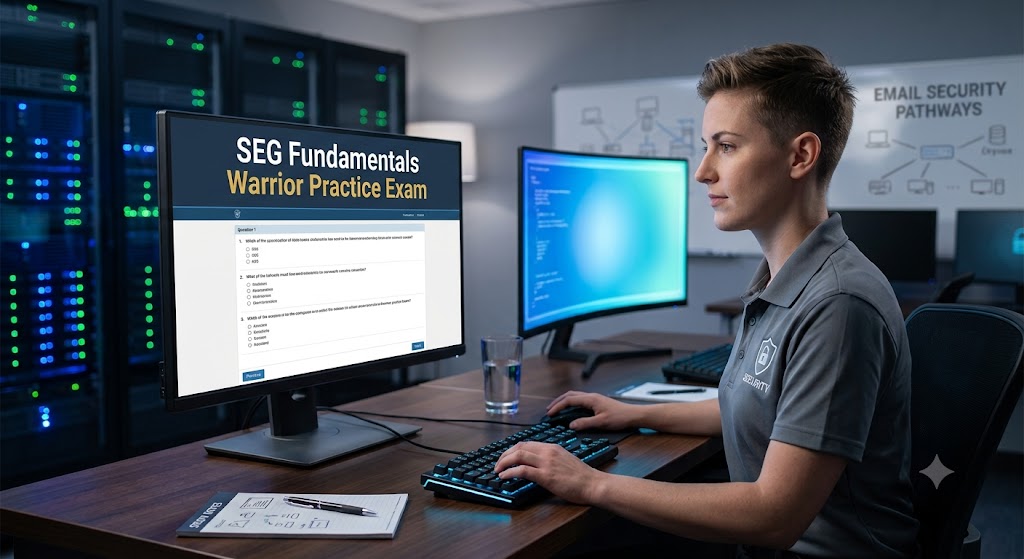
Additional Information
What the Course Entails and Exam Details
This certification validates your core competency across the entire email security landscape. The syllabus and practice exam focus on the critical areas you will encounter in real-world scenarios and the final exam:
Email Protocol Mastery: In-depth understanding of how email flows using SMTP, IMAP, and POP3, and the critical role the SEG plays in this chain.
Inbound Threat Defense: Confidently configuring and troubleshooting anti-spam, anti-malware, and graymail filtering techniques.
Advanced Phishing & BEC Protection: Learning how to identify and mitigate sophisticated social engineering, impersonation, and Business Email Compromise attacks.
Authentication Frameworks: Demonstrating clear knowledge of implementing and validating SPF, DKIM, and DMARC records to prevent spoofing.
Outbound Data Loss Prevention (DLP): Understanding content scanning, lexical rules, and encryption to protect sensitive organizational data from leaking.
Deployment & Management: Practical understanding of SEG architecture, policy creation, reporting, and message tracking.
What to Expect in the Final Exam
While actual exam specifications can vary by vendor and platform, the standard SEG Fundamentals Warrior Final Exam typically follows a consistent format. Candidates should prepare for a professional, timed environment with the following characteristics:
Question Format: The exam primarily consists of Multiple-Choice (single answer) and Multiple-Response (select all that apply) questions. Some versions may include scenario-based questions where you must select the correct configuration step.
Number of Questions: You can expect between 50 and 70 questions on the official test.
Time Limit: The final exam is usually timed between 90 and 120 minutes, demanding efficient time management.
Passing Score: The passing score is often around 70% to 80%, depending on the specific exam version and passing criteria.
How to Study and Exam Centers
Preparation is the key to success. This practice exam is your first tool, but a multi-faceted study approach will guarantee you are ready:
Deep Dive into Official Documentation: Your primary study resource should always be the official vendor documentation for the SEG solution you are being tested on. Thoroughly review the administration and deployment guides.
Hands-on Lab Experience: Nothing beats practical application. If you have access, practice configuring policies, generating reports, and testing different email scenarios in a lab or virtual environment.
Identify Your Weaknesses: Use the results of this practice exam to create a focused study plan. Don't just learn the answers; understand why the correct answer is correct and why the distractors are wrong.
Leverage Official Training (if available): If the certification offers official instructor-led or on-demand training courses, prioritize completing them.
Exam Centers: The final certification exam is often vendor-specific. Depending on the issuer, you can typically take the exam at recognized, authorized physical testing centers (like Pearson VUE or Prometric) or via secure, online proctored testing from your home or office. Always verify the specific testing options with the certification vendor.
Job Opportunities from the Course
Earning your SEG – Fundamentals Warrior Certification validates critical skills in modern cybersecurity. This credential can open doors to various specialized roles and career paths, including:
Email Security Specialist
Information Security Analyst
Security Operations Center (SOC) Analyst (Tier 1/Tier 2)
Network Security Engineer
System Administrator (with Security Focus)
IT Security Coordinator
Cybersecurity Support Engineer
Frequently Asked Questions
Reviews
5.0
Based on 0 reviews
Leave a Review
No reviews yet. Be the first to review!