
Self-Aid and Buddy Care (SABC) Practice Exam
$69.00
- Buy to unlock unlimited access to all Quiz questions and Answers in this Quiz.
- After purchase you can print a PDF of the whole quiz at any point. The PDF will contain the questions and the correct answers.
About this Exam
The Self-Aid and Buddy Care (SABC) course is a critical, foundational life-saving program designed to equip individuals with the skills to provide immediate, essential medical care in an emergency. Originally developed and widely utilized by the United States Air Force and other military branches, SABC training is a mandatory requirement for millions of service members and is increasingly adapted for first responders and security professionals.
The course is designed for any individual who may be first on the scene of an accident, trauma, or medical emergency. Its primary purpose is to impart the immediate 'golden hour' care that minimizes injury, prevents death, and limits disability until professional medical help is available. While not a substitute for comprehensive medical training, it provides the definitive initial response that can make the difference between life and death.
Ready to test your knowledge?
Buy Now to Access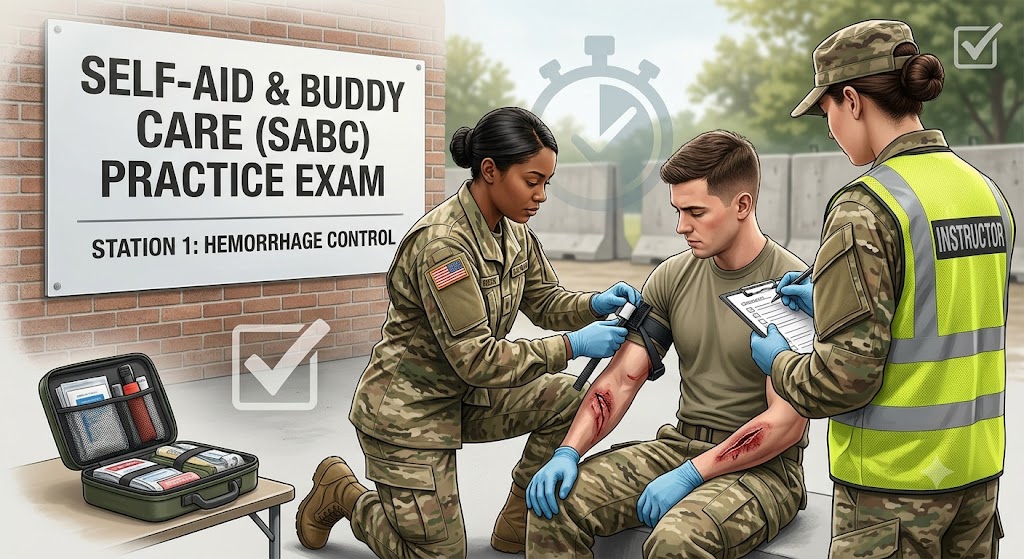
Additional Information
What the Course Entails and Exam Details
The SABC course is structured to be both comprehensive and accessible, often combining self-paced theoretical learning with intensive hands-on practical training. The curriculum focuses on the most critical, limb-saving, and life-sustaining interventions.
Core topics and skills covered include:
Principles of SABC: Understanding the scope of care and the importance of immediate action.
Airway Management: Techniques to open and maintain a patient’s airway, including addressing obstructions and positioning.
Recognition and Control of Bleeding: Mastering the use of direct pressure, pressure bandages, and, most critically, the proper application of a combat tourniquet.
Shock Management: Identifying signs of shock and administering initial care, including proper positioning and temperature control.
Dressings and Bandaging: Applying various types of dressings for different wounds, including chest seals for penetrating injuries.
Fracture and Splinting: Identifying fractures and applying field-expedient splints.
Environmental Injuries: Recognition and treatment of heat and cold-related injuries.
Casualty Movement: Safe methods for moving an injured person.
The End-of-Course (EOC) practice test is a simulated version of the final requirement. It is an essential tool for students to gauge their understanding of both the theory and the application of these life-saving skills before the official evaluation.
What to Expect in the Final Exam
The official SABC EOC exam is a two-part process designed to test both knowledge and proficiency.
The exam typically includes:
A Written (Multiple-Choice) Test: This section assesses your theoretical understanding of SABC principles. It covers topics like anatomy, physiology, communicable diseases, and the steps for each intervention. You will encounter questions on the 'why' and 'when' of treatment, scenario-based decisions, and correct procedures. A high passing score, often 80% or higher, is usually required to proceed.
A Hands-On Practical Skill Verification: This is the most crucial part of the exam. You will be placed in a controlled, realistic scenario (often with a simulated 'casualty') and must demonstrate a perfect application of key skills. Evaluators will watch for:
Proper Tourniquet Application: Correct placement, tightening, and timing (stopping the bleed).
Airway Intervention: Correct assessment and procedure.
Wound Care: Proper dressing and bandaging.
Scenario Management: Demonstrating calm, correct procedural flow under pressure.
Students are given a finite amount of time for both sections and must achieve "Go" or "Pass" criteria on all critical practical tasks. There are often zero-tolerance criteria for certain safety or critical procedure violations.
How to Study and Exam Centers
Preparation for the SABC exam requires a balanced approach. It is not enough to just memorize facts; you must be able to perform under pressure.
Effective study strategies:
Review Official Materials: Scour the user manuals, AFI (Air Force Instruction) guidelines, and any computer-based training (CBT) modules.
Practice, Practice, Practice: SABC is a hands-on skill. The best way to study is to repeatedly perform the techniques. If possible, practice with a partner, taking turns as the 'rescuer' and 'casualty'. Buy a practice tourniquet and application trainer.
Scenario-Based Training: Create realistic scenarios with your study group. "Your buddy has a severe leg bleed" or "Your colleague is unconscious after a fall." Work through the steps of assessment, care, and movement.
Utilize a Practice Test: The SABC EOC practice test is invaluable. Use it as a diagnostic tool early in your studies and again as a final readiness check. Analyze the questions you miss to focus your review.
Exam Centers:
Military Personnel: SABC testing is administered through official military channels. The CBT portion is often taken on authorized secure online portals, and the practical skill verification is conducted by certified SABC instructors at your unit or a designated training facility.
Non-Military/Adapted Courses: If you are taking an adapted version, the exam will be held at authorized training schools, authorized first responder centers, or, for the written portion, via proctored online testing. Consult your course administrator for specific details.
Job Opportunities from the Course
A SABC certification, or the fundamental skills it provides, is highly valued and often required across a wide range of career paths that demand a high level of responsibility and emergency preparedness.
Specific job opportunities and career paths:
All Military Occupations: SABC is a foundational expeditionary skill required for deployment readiness across all branches and ranks.
Security Forces/Military Police: First line of response for security and medical emergencies on base.
Police Officers and Law Enforcement: Essential for initial response to trauma, active shooter scenarios, and accidents.
Firefighters and Emergency Medical Technicians (EMTs): Provides the foundational trauma skills for initial responder care.
Paramedics: The basic care knowledge is a starting point for advanced life support training.
Flight Attendants and Aviation Safety Personnel: Critical for on-board medical emergencies.
Security Guards and Loss Prevention: First-aid and trauma response are key.
Wilderness and Outdoor Guides: Life-saving skills in remote environments.
Oil and Gas/Industrial Safety Personnel: Vital for high-risk work sites.
Frequently Asked Questions
Reviews
5.0
Based on 0 reviews
Leave a Review
No reviews yet. Be the first to review!