
Senior Gunner Course Practice Exam: Your Study Guide
$69.00
- Buy to unlock unlimited access to all Quiz questions and Answers in this Quiz.
- After purchase you can print a PDF of the whole quiz at any point. The PDF will contain the questions and the correct answers.
About this Exam
The Senior Gunner Course is an elite, intensive certification designed for high-performing Non-Commissioned Officers (NCOs) within armored and mechanized units of the military, such as the U.S. Army and Army Reserve. This course is not for beginners; it targets accomplished NCOs, often those who are already qualified Master Gunners or seek to complementary skills for larger-scale operations. The course equips graduates to serve as primary advisors to commanders on all aspects of weaponry, gunnery training, and tactical employment, with a specific focus on the Integrated Weapons Training Strategy (IWTS). If you are an NCO looking to become the definitive subject matter expert (SME) on direct-fire platforms and gunnery program design, this is the course that certifies your expertise.
Ready to test your knowledge?
Buy Now to Access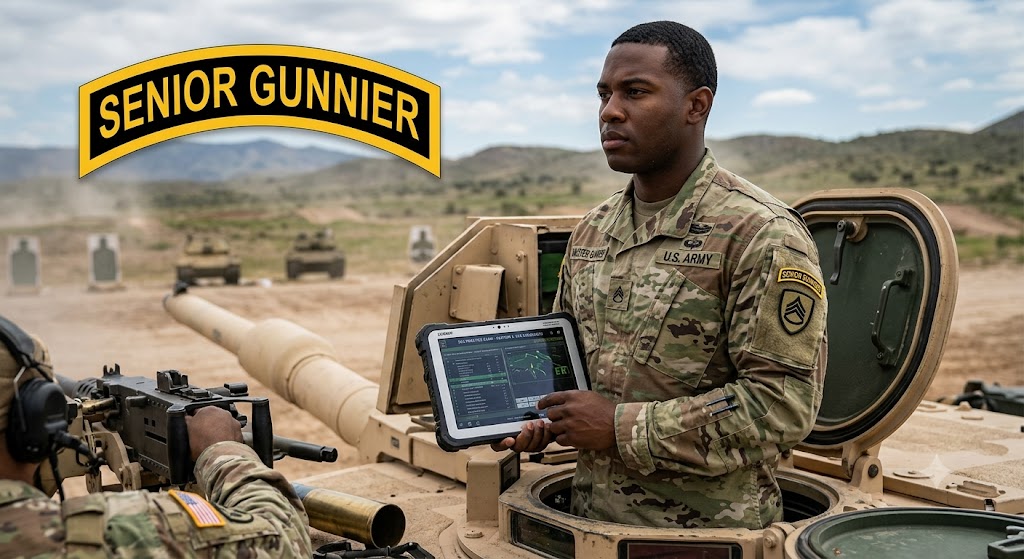
Additional Information
What the Course Entails and Exam Details
The Senior Gunner Course covers a vast, technical, and tactical syllabus over several weeks. It moves beyond individual platform proficiency to program management and evaluation. Students will master the planning, execution, and evaluation of crew direct-fire gunnery from CAT 1 through CAT 6. Core topics include:
Integrated Weapons Training Strategy (IWTS): Understanding and implementing the entire cycle of weapons training readiness.
Vehicle Crew Evaluator (VCE) Standards: Certifying as the evaluator for all vehicle crews.
Advanced Gunnery Methodology: Tactical direct-fire engagement process and advanced gunnery skills on various platforms (e.g., M1A2 Abrams, M2 Bradley, or Mounted Machine Guns/Unstabilized platforms like M240B, M2A1, MK19).
Range Operations & Safety: Designing, managing, and certifying safe and effective gunnery ranges, including Surface Danger Zone (SDZ) calculations.
Maintenance & Troubleshooting: Advanced maintenance and fire control system troubleshooting for organic weapons.
Unit Training Management: Developing 12-month unit gunnery training plans (UTP).
Ammunition & Vehicle ID: Expert knowledge of ammunition types, capabilities, forecasting, and both friendly and threat vehicle identification.
What to Expect in the Final Exam
The Senior Gunner Course final assessment is a comprehensive, multi-phase examination designed to test your knowledge, practical skill, and ability to make expert decisions under pressure. You can expect three distinct types of evaluations:
Comprehensive Written Examination: This component tests theoretical knowledge and often includes 100+ questions covering all syllabus areas. Format ranges from multiple choice and matching (for ammo/vehicle ID) to scenario-based planning questions (e.g., designing a UTP). A high passing score, typically 80% or higher, is required, with time limits.
Practical Evaluations (Hands-On): You must demonstrate physical mastery in specific areas. This includes:
Weapons Detailed Breakdown and Troubleshooting: Disassembling, cleaning, and repairing crew-served or main gun weapon systems, identifying induced faults, and returning them to operational status within strict time standards.
VCE Practical: Actively evaluating a crew in a simulation or live-fire scenario, correctly applying VCE standards, and providing a proper after-action review (AAR).
Range Management/SDZ Construction: Correctly calculating and overlaying a Surface Danger Zone for a specific weapon system and range scenario.
Command Board/Oral Evaluation: In some cases, candidates must appear before a board of Master Gunners and senior leaders to defend a training plan or answer complex, tactical, and ethical questions regarding gunnery, showing their competence to advise at the highest battalion level.
How to Study and Exam Centers
Preparation for the Senior Gunner Course and its practice exams must be rigorous. Because it targets existing subject matter experts, "cramming" is ineffective. Here are actionable strategies:
Master the Prerequisites: The course builds on foundational knowledge. Ensure your skills in basic gunnery, VCE standards, and direct-fire methodology (TC 3-20.31 or equivalent) are absolute. Take practice exams focused on these foundation skills to identify gaps.
Deep-Dive into Doctrine: The course is heavily rooted in technical manuals and training circulars. Your study should focus on mastering specific Army/military doctrine, including IWTS, CAT standards, and weapon-specific manuals (e.g., TM 9-2350-264-10 for Abrams). Practice converting doctrinal steps into checklists you can execute.
Use Simulation Tools: Leverage available institutional training devices like the Unstabilized Gunnery Trainer-Individual (UGT-I), Virtual Convoy Operations Trainer (VCOT), or Virtual Battle Space (VBS) to practice fire commands, target acquisition, and scenario-based planning.
Develop Your Own Scenarios: Practice creating Surface Danger Zones or writing 12-month training plans for hypothetical units. Critique your own plans using doctrinal standards.
Exam Centers and Locations
This is a physical, institutional course. You cannot take the official final exam online or at a commercial testing center like Pearson VUE. It is administered exclusively by authorized military training institutions. The course is typically held at:
U.S. Army Senior Gunner Academies (e.g., the 84th Training Command's "Stormbreaker").
U.S. Army Warrior Training Center (WTC), often via Mobile Training Teams (MTT) that bring the course to specific bases.
Regional Training Institutes (RTI) (e.g., the 101st Regional Training Institute in Massachusetts).
Job Opportunities from the Course
A Senior Gunner Course certification unlocks specialized, high-impact career paths for Non-Commissioned Officers. It designates you as a critical technical expert in your field. While it is a military skill, it prepares you for significant responsibility within the armed forces, and the management skills transfer to civilian leadership roles.
Here is a list of job opportunities and career paths:
Battalion Senior Gunner / Master Gunner: Serving as the primary advisor to the Battalion Commander on all aspects of lethality, gunnery training, and weapons maintenance.
Company/Troop Master Gunner: Overseeing the gunnery program for a specific company or troop, ensuring crew certification and readiness.
Vehicle Crew Evaluator-Senior (VCE-S): Leading and certifying other evaluators during live-fire gunnery.
Operations NCO (S-3 Section): Planning and managing large-scale, complex collective training events and ranges.
Weapons System SME / Platform Manager: Working as a doctrinal expert for a specific platform (e.g., Abrams, Bradley) to influence future training and doctrine.
Gunnery Instructor / Senior Instructor: Teaching future gunners and leaders at military schools and training centers.
Frequently Asked Questions
Reviews
5.0
Based on 0 reviews
Leave a Review
No reviews yet. Be the first to review!