
Sergeants Leadership II Practice Exam
$69.00
- Buy to unlock unlimited access to all Quiz questions and Answers in this Quiz.
- After purchase you can print a PDF of the whole quiz at any point. The PDF will contain the questions and the correct answers.
About this Exam
The Sergeants Course Leadership II represents a pivotal advanced training step for non-commissioned officers, designed to cultivate the critical thinking and mentorship skills essential for effective leadership.
This exam is designed for sergeants and aspiring leaders in military, law enforcement, and similar organizations who have foundational leadership experience and are ready to assume greater responsibility and influence.
The course delves into complex interpersonal dynamics, decision-making, and advanced leadership principles, aiming to develop well-rounded, effective leaders capable of guiding their teams through various operational and interpersonal challenges.
Passing this exam and completing the associated course demonstrates a commitment to professional growth and prepares individuals for the next level of non-commissioned officer responsibilities.
Ready to test your knowledge?
Buy Now to Access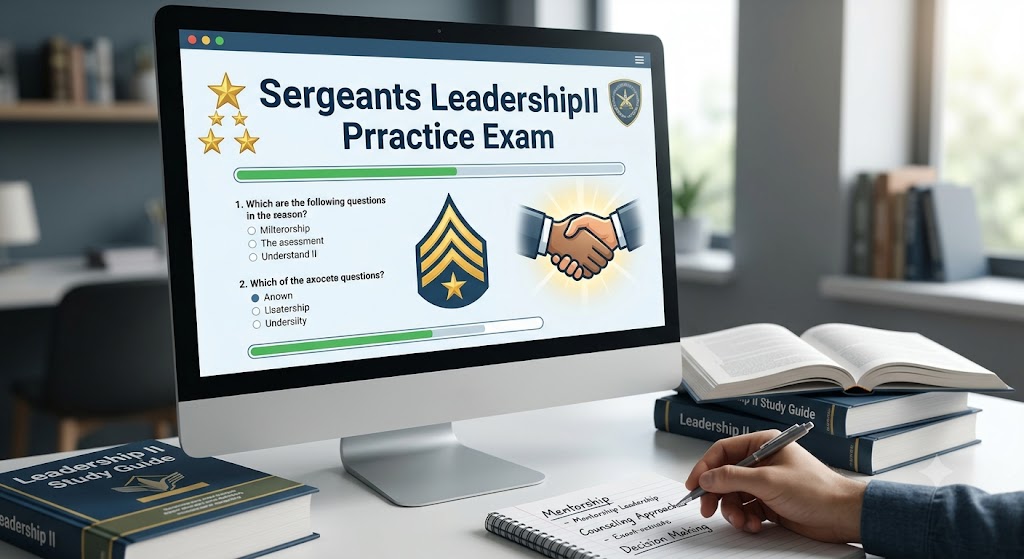
Additional Information
What the Course Entails and Exam Details
The Sergeants Course Leadership II provides a comprehensive and challenging curriculum, building upon the skills established in earlier leadership levels. Key core topics include:
Advanced Communications: Enhancing both oral and written communication skills for clarity, persuasion, and effective operational directives.
Developing a Bias for Action: Fostering the ability to make timely, informed decisions under pressure, aligned with commander's intent.
Mentorship and Counseling: Mastering effective mentoring skills (empathy, feedback, role modeling) and structured counseling approaches (directive, non-directive, combined) for personnel development and conflict resolution.
Critical Thinking & Decision Making: Applying analytical frameworks to complex leadership scenarios and operational problems.
Ethical Leadership: Navigating complex ethical dilemmas and setting a high standard of conduct within the unit.
Operational Stress and Resiliency: Understanding, identifying, and mitigating the effects of stress on personnel and maintaining unit performance.
Organizational Policies: Deep knowledge of specific administrative, justice, promotion systems, and operational procedures relevant to a sergeant’s duties.
Warfighting Principles & Small Unit Operations: Integrating tactical tools and strategic understanding for mission success, where applicable.
The practice test closely mirrors these topics, presenting multiple-choice questions, realistic scenarios, and application-based assessments to evaluate a student's grasp of both theoretical knowledge and practical application.
What to Expect in the Final Exam
Prepare to be tested comprehensively on your ability to apply leadership principles and manage complex personnel situations. The final exam for the Sergeants Course Leadership II generally follows a structured format that you should be prepared for:
Format: Typically includes multiple-choice questions, matching exercises, and scenario-based questions requiring critical analysis and appropriate leadership responses. Some versions may include a practical evaluation component.
Passing Score: Requirements can vary widely by organization but typically require a notable majority of correct answers, often demanding a score in the range of 70% to 80% to demonstrate proficiency. The specific pass mark will be provided by your official testing source.
Time Limit: Expect the final exam to be timed, often ranging from 2 to 3 hours. Managing your time effectively across all sections is crucial for success.
Specific Rules: Adherence to organizational honor codes and testing protocols is paramount. The final exam is often taken in secure, monitored environments or on official, designated online platforms. No outside materials or assistance are generally permitted during the test unless explicitly stated for specific open-book sections.
How to Study and Exam Centers
Developing a robust study plan is essential for excelling in both the practice and final examinations. Here are actionable strategies:
Deep Dive into Official Materials: Thoroughly review all course curricula, manuals, and official study guides. Create detailed notes for each module.
Master the Scenarios: Pay close attention to the scenario-based learning. Practice applying different mentoring skills, counseling approaches, and decision-making frameworks to various hypothetical situations.
Leverage Flashcards: Build flashcards for key leadership terms, counseling steps, feedback types, and critical organizational policies. Use them regularly for quick recall.
Engage in Practice: Take full advantage of the practice test. Take it multiple times to identify areas of weakness and to get a realistic feel for the question types, difficulty, and time constraints. Review both correct and incorrect answers to understand the rationale.
Collaborate with Peers: Discuss course topics and scenarios with your colleagues. Leadership is best understood through interaction and diverse perspectives.
Seek Feedback: In a course setting, ask for feedback on your understanding of key concepts from instructors and mentors.
Exam Centers & Access:
Practice Tests: Practice tests like the one described here are commonly accessed through various online educational platforms and study resource websites. They are often flexible, allowing for self-paced study. Check with your initial course provider or search reputable educational resources for associated practice materials.
Final Exams: The final, official exam is administered through designated organizational channels. This may include:
Authorized testing centers within your installation or organization.
Specific command-designated testing locations.
Secure official online testing portals as directed by your service or department.
Check your organization’s standard procedures and consult with your training NCO or educational officer for precise details on final exam scheduling, location, and necessary permissions.
Job Opportunities from the Course
Successful completion of the Sergeants Course Leadership II and its final exam unlocks critical career paths and demonstrates the advanced leadership capabilities required for increased responsibility within non-commissioned officer ranks. This qualification prepares individuals for numerous roles including:
Sergeant / NCO Leadership Roles: Core proficiency within the Sergeant rank for all leadership duties.
Squad Leader / Team Leader: Providing operational and administrative leadership to small units.
Section Chief: Leading a specialized section within a larger unit.
Unit Mentor / Counselor: Guiding junior personnel and assisting with development.
Operations NCOIC (Non-Commissioned Officer in Charge): Assuming higher responsibilities in unit operations and planning.
Foundation for Promotion: Serves as a vital prerequisite for progression to higher Staff NCO ranks (e.g., Staff Sergeant, Gunnery Sergeant, or equivalent depending on the service) and competitive leadership assignments.
Lead Specialized Teams: Qualified to lead specific operational, logistical, or training teams.
Enhanced Performance within Existing Role: More effective and impactful leadership at your current rank, fostering greater unit cohesion and mission readiness.
Frequently Asked Questions
Reviews
5.0
Based on 0 reviews
Leave a Review
No reviews yet. Be the first to review!