
Service Technician Best Practices (RWSV210) Practice Exam
$69.00
- Buy to unlock unlimited access to all Quiz questions and Answers in this Quiz.
- After purchase you can print a PDF of the whole quiz at any point. The PDF will contain the questions and the correct answers.
About this Exam
The Service Technician Best Practices (RWSV210) practice exam is an essential preparatory tool designed for aspiring and practicing service technicians who intend to validate their skills through official certification. This exam is specifically crafted for professionals working in fields such as field service engineering, industrial maintenance, HVAC, and complex machinery repair. It sets a standardized benchmark for the technical knowledge, safety consciousness, and diagnostic proficiency required to excel in modern, high-stakes service environments. By using this practice exam, candidates can rigorously assess their readiness, identify critical knowledge gaps, and familiarize themselves with the complexity of the questions they will encounter on the final certification test.
Ready to test your knowledge?
Buy Now to Access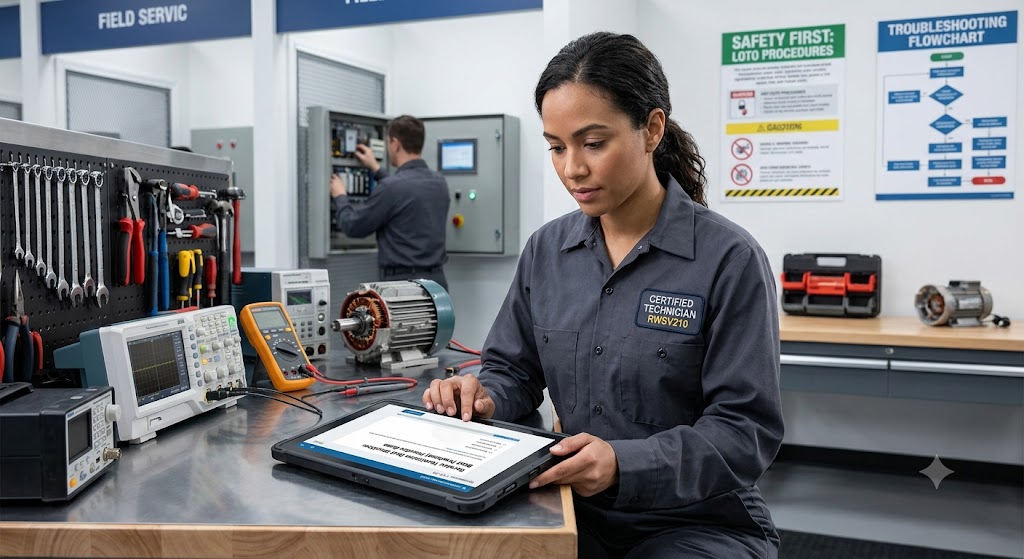
Additional Information
What the Course Entails and Exam Details
The RWSV210 curriculum focuses on the core competencies demanded of modern technicians. This practice exam comprehensively replicates the five primary domains covered in the full certification:
(1) Advanced Diagnostics and Troubleshooting: This section tests your ability to interpret complex technical schematics, analyze equipment performance data, and apply logical fault-isolation methodologies.
(2) Safety and Compliance Protocols: Candidates must demonstrate mastery of OSHA standards, lock-out/tag-out (LOTO) procedures, hazardous materials handling, and environmental regulations relevant to service operations.
(3) Component Replacement and System Repair: This domain validates skill in the proper removal, installation, and calibration of mechanical, electrical, and electronic components using manufacturing specifications.
(4) Customer Interaction and Professionalism: Effective communication, managing customer expectations, active listening, and upholding ethical service standards are prioritized here.
(5) Documentation and Service Reporting: Accurate maintenance of service logs, parts inventory management, and generating clear, professional service reports are essential skills assessed.
What to Expect in the Final Exam
While exact parameters are set by the certifying body, the official RWSV210 certification exam is typically a comprehensive, computer-based testing experience. Candidates can generally expect 75–100 multiple-choice and scenario-based questions. The time limit is approximately 90–120 minutes. A passing score usually falls within the 70–80% range, depending on the specific iteration of the exam and the vendor. Questions emphasize the practical application of troubleshooting logic to hypothetical real-world service scenarios. This practice exam is designed to mirror that level of rigor, helping you practice time management and question analysis under pressure.
How to Study and Exam Centers
Effective study for the RWSV210 requires a proactive approach. Do not treat this practice exam as a one-time test. Take the practice exam early to establish your baseline. After completing a session, meticulously review every single question you missed, utilizing the provided explanations to understand the underlying technical principles. Supplement this review by diving deep into your official textbooks, manufacturer training manuals, and schematics. Candidates are encouraged to simulate the final exam environment: take the practice test in a quiet room, timed, and without external aids.
Regarding the actual exam location, the RWSV210 certification is delivered via authorized channels. You must register through the specific authorized trade school, community college, or corporate training portal where you undertook your technician training. For larger global certifications, the exam may be hosted at professional testing centers like Pearson VUE or offered through an integrated, proctored learning management system (LMS) specific to the certifying organization. Always confirm the current testing availability and location directly with your certification provider or course administrator.
Job Opportunities from the Course
Successfully validating your expertise through the RWSV210 certification unlocks diverse career opportunities across critical engineering and technical sectors. By demonstrating proficiency in service best practices, you signal your value to employers seeking highly qualified technical staff. This certification supports advancement into roles such as:
Certified Field Service Technician
Industrial Equipment Maintenance Mechanic
HVAC Service Technician (Advanced)
Customer Support Engineer (Technical Support)
Biomedical Equipment Technician
Maintenance Supervisor (Career Pathway)
Automotive Service Advisor
Renewable Energy Systems Technician
Facility Services Manager
Commercial Kitchen Equipment Repair Technician
Frequently Asked Questions
Reviews
5.0
Based on 0 reviews
Leave a Review
No reviews yet. Be the first to review!