
Sewage Treatment Worker Practice Exam
$69.00
- Buy to unlock unlimited access to all Quiz questions and Answers in this Quiz.
- After purchase you can print a PDF of the whole quiz at any point. The PDF will contain the questions and the correct answers.
About this Exam
The Sewage Treatment Worker certification is a critical credential for individuals seeking to enter and advance in the vital field of wastewater management. This exam is designed for aspiring and entry-level operators, validating their understanding of the fundamental principles required to safely and effectively treat domestic and industrial sewage. Certified workers are the unsung heroes of public health, ensuring that our water resources are protected and our communities remain safe. This comprehensive practice guide is tailored to help you navigate the essential knowledge areas, offering the practice needed to build confidence and achieve success on your journey to becoming a certified professional in this essential sector.
Ready to test your knowledge?
Buy Now to Access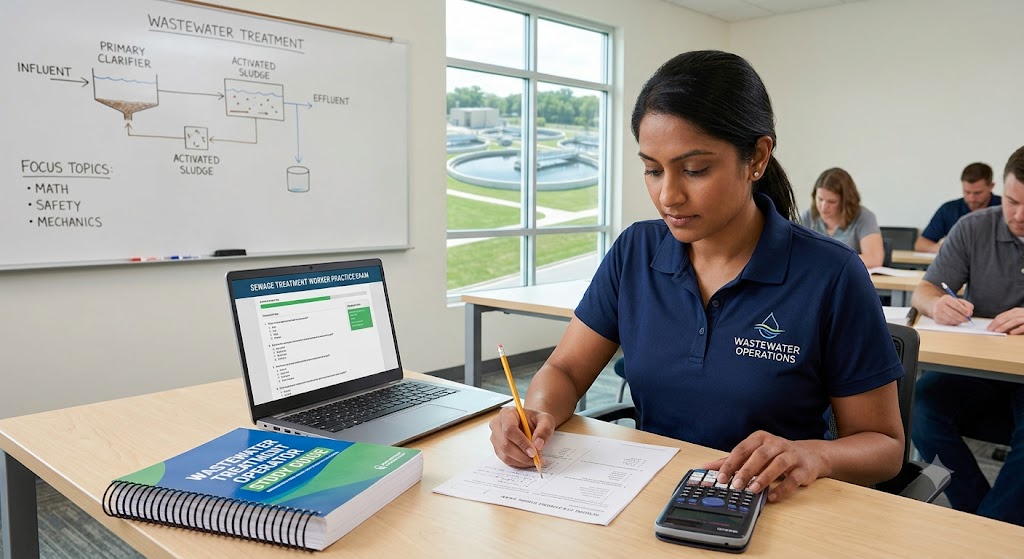
Additional Information
What the Course Entails and Exam Details
While specific "course" content can vary by state and certifying body, the core competencies for a Sewage Treatment Worker are standardized. The practice test and final certification exam are designed to evaluate knowledge in several key domains, which are commonly covered in preparatory materials and vocational programs. The exam is not just about rote memorization; it's about applying practical skills to real-world scenarios.
The foundational pillars tested include:
Safety Practices: This is paramount. Expect questions on personal protective equipment (PPE), hazard communication (e.g., SDS sheets), lockout/tagout (LOTO) procedures, confined space entry requirements, and responding to emergency situations like chemical spills.
Wastewater Treatment Fundamentals: You must understand the journey from influent to effluent. This includes primary treatment (screening and grit removal), secondary biological processes (activated sludge, trickling filters, rotational biological contactors), and tertiary treatment/disinfection (chlorination, UV, ozone).
Basic Mathematics: Calculations are part of the daily routine. Be prepared to solve arithmetic problems involving addition, subtraction, multiplication, and division. Questions will frequently involve calculating flows, dosages (e.g., ppm), ratios (like F:M and BOD), averages, and basic geometry for tank volumes and surface areas.
Mechanical Aptitude and Tools: The exam tests your ability to identify and understand the basic operation of equipment like pumps, motors, valves, and gears. You may be shown diagrams and asked about their function or simple troubleshooting. You should also be familiar with common tools and the correct way to read various scales, gauges (pressure, flow, etc.), and meters.
Process Monitoring and Analysis: This includes interpreting laboratory results and making operational adjustments. You'll need to know about key parameters such as Biochemical Oxygen Demand (BOD), Total Suspended Solids (TSS), pH, dissolved oxygen (DO), and how composite and grab sampling are conducted.
What to Expect in the Final Exam
The final exam is a structured, comprehensive evaluation. While specific state details vary, you can generally anticipate the following format:
Question Format: The vast majority of certification exams are multiple-choice. Each question will present a situation, calculation, or regulatory query with multiple potential answers, with only one correct choice.
Number of Questions: For an entry-level certification, the number of questions often ranges from 50 to 100, designed to be a thorough yet manageable test of your core competencies.
Time Limit: A clear time limit will be provided, typically between two to four hours. It is essential to manage your time wisely, as you may encounter challenging math problems that require careful attention.
Passing Score: The standard minimum passing score is usually 70%. Your results will likely be provided in a numerical score and a pass/fail notification.
Practical Component: In many jurisdictions, the comprehensive "Final Exam" may be broken down into a "Practical/Hands-On" section and a separate "Written" exam. While this guide focuses on the written component, always check your local regulations to understand if a demonstration of physical skills is also required.
Exam Rules: The exam environment is strictly proctored. No outside materials are allowed. You may be permitted to use a scientific calculator, but this will be specified by your local certification board, and often, only specific models are approved.
How to Study and Exam Centers
Effective preparation is the single biggest factor in passing. Here’s a strategy for success:
Obtain Your State's Study Guide: This is your primary resource. Most state or regional environmental departments provide a free official study manual that lists every topic the exam will cover. This is your bible.
Create a Consistent Study Plan: Don’t cram. Dedicate regular, focused blocks of time each week. Break down the syllabus into manageable sections.
Take Practice Tests Repeatedly: Utilize this practice test and others to simulate the exam experience. This will help you identify your weak areas, get comfortable with the multiple-choice format, and improve your time management. Analyze every question you get wrong.
Master the Math: Do not skip the calculations. Practice math problems daily until you can perform the required formulas quickly and accurately. Many candidates find the math section to be the most challenging part, and practice is the only cure.
Review Regulatory and Safety Standards: Pay close attention to local and federal regulations (e.g., from the EPA and OSHA). Understanding these is crucial not only for the test but for your future daily operations.
Where to Take the Exam
The actual certification exam is typically administered by a state or municipal regulatory agency, such as a Department of Environmental Protection (DEP) or similar body.
Testing Centers: Exams are often held in designated testing facilities, which could be government buildings, authorized testing vendors like Pearson VUE, or the offices of vocational training institutions.
Physical Locations: For the practical or final exam, you may need to go to a specific water or wastewater treatment training center or a government office on scheduled dates.
Online Portals: An increasing number of states offer computerized testing, which can be booked through their online portals and taken at an approved testing center or, in some cases, remotely via an online proctoring service. Always consult your state's certification webpage for the most current information.
Job Opportunities from the Course
A Sewage Treatment Worker certification opens the door to a stable and essential career in the water sector. Potential job titles and career paths include:
Wastewater Treatment Operator / Plant Operator
Sewage Treatment Worker
Industrial Wastewater Treatment Operator
Sewer Maintenance Worker
Lift Station Operator
Environmental Field Technician
Wastewater Collection System Operator
Process Control Technician
Wastewater Operator Trainee
With experience and advanced certification, you can progress to supervisory roles like:
Chief Plant Operator
Operations Manager
Wastewater Superintendent
Environmental Compliance Officer
Frequently Asked Questions
Reviews
5.0
Based on 0 reviews
Leave a Review
No reviews yet. Be the first to review!