
Shadow Health Mental Health Practice Exam
$69.00
- Buy to unlock unlimited access to all Quiz questions and Answers in this Quiz.
- After purchase you can print a PDF of the whole quiz at any point. The PDF will contain the questions and the correct answers.
About this Exam
The Shadow Health Mental Health (Tina Jones) experience is an advanced, interactive digital simulation designed primarily for nursing students, particularly those in mental health or advanced assessment courses. It places the learner in a realistic clinical environment where they must engage with a virtual patient, Ms. Tina Jones, to perform a comprehensive mental health assessment.
This practice test is designed to evaluate a student's ability to gather a thorough psychiatric and psychosocial history, perform a focused mental status examination, build therapeutic rapport, and demonstrate appropriate clinical reasoning. Tina Jones, a 28-year-old female, presents with complex psychosocial stressors and symptoms that require skillful, empathetic exploration. Mastering this assessment prepares students for real-world patient interactions in diverse healthcare settings.
Ready to test your knowledge?
Buy Now to Access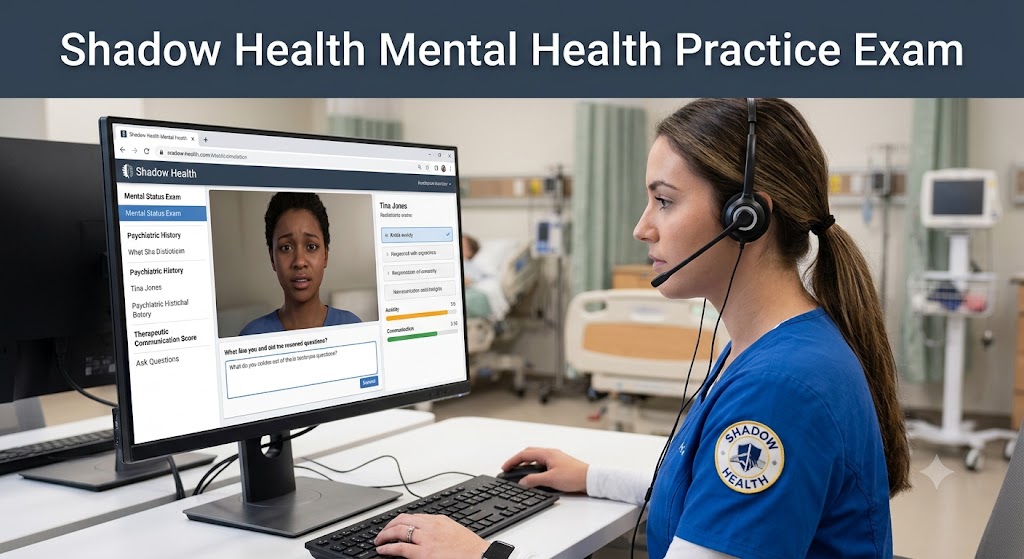
Additional Information
What the Course Entails and Exam Details
The course component for the Shadow Health Mental Health simulation involves navigating a digital platform that assesses both Subjective Data (through a comprehensive interview) and Objective Data (through observable findings and a mental status exam). The key areas covered in the Tina Jones mental health assessment include:
Therapeutic Communication: Applying empathetic listening, open-ended questioning, and validation techniques to build trust and elicit sensitive information.
Mental Status Examination (MSE): Assessing the patient’s appearance, behavior, mood and affect, speech, thought process, thought content, and cognition.
Psychiatric History: Gathering details on the chief complaint, history of present illness (including sleep disturbances, stress, and anxiety), past psychiatric history, family history, and substance use history.
Social and Developmental History: Understanding the patient's support systems, educational and occupational background, stressors, and coping mechanisms.
Safety Assessment: Screening for risk factors including suicidal or homicidal ideation.
Clinical Reasoning and Documentation: Recording findings accurately and identifying potential nursing diagnoses or areas for intervention based on the data collected.
What to Expect in the Final Exam
In the context of the Shadow Health platform, the practice test serves as a final, high-stakes assignment that often mirrors the structure of an official examination within a nursing program. Students should expect the following format:
Format: The exam is an immersive, web-based simulation. You do not select multiple-choice answers; instead, you actively type questions to interview the virtual patient and select physical examination techniques on an interactive avatar. The platform uses natural language processing to understand your questions and generate Tina’s responses.
Assessment Components: The exam is typically broken into distinct segments:
Interview/Subjective Data: The comprehensive history-taking session with Tina.
Objective Data/MSE: Performing the mental status exam and documentation.
Self-Reflection: A post-simulation opportunity to analyze your performance and therapeutic approach.
Time Limit: While individual sections are not usually timed, nursing programs often provide an overall estimated completion time for the assignment, which can be substantial (e.g., 2–4 hours). The goal is thoroughness rather than speed.
Passing Score: As a practice tool, Shadow Health provides extensive feedback but does not have a single "passing" score. However, many nursing programs use the generated "Proficiency Score" (often a percentage or total points based on data collected and therapeutic communication accuracy) as a major grading component. Your instructor will set the specific benchmarks for success. It is common to have a required proficiency score, such as 80% or 90%, for full credit.
Attempts: Programs may allow students two or three attempts to achieve their desired score, emphasizing the mastery-learning model of the platform.
How to Study and Exam Centers
The key to success in the Shadow Health Mental Health Practice Exam is active, repeated practice within the platform itself. Traditional study methods like reading textbooks are supporting tools, but simulated performance is paramount.
Actionable Study Strategies:
Engage with the Platform Early and Often: Do not wait until the exam date to explore. Complete all assigned preparatory Shadow Health simulations and review the tutorials.
Master Therapeutic Communication Techniques: Review guidelines on therapeutic communication. Focus on asking open-ended questions (e.g., "Tell me more about...") and practice empathetic responses to hypothetical scenarios before starting the simulation.
Review the Mental Status Exam (MSE): Memorize the core components of the MSE (Appearance, Behavior, etc.) and know how to document findings professionally. Create a checklist for yourself.
Simulate the Exam Conditions: dedicate a block of uninterrupted time to complete a practice run. Avoid outside resources and focus solely on the patient interaction.
Deconstruct Your Feedback: After each simulation, carefully review the standard Shadow Health feedback report. Pay attention to the "Missing Data" and "Therapeutic Communication" sections to identify your weaknesses. Re-try the simulation focusing only on the missed elements.
Form a Study Group: Practice the patient interview and mental status exam components with peers to refine your questioning and observational skills.
Exam Centers:
Because the Shadow Health Mental Health Practice Exam is a digital simulation, there are no physical exam centers or designated sites like Pearson VUE. The "exam center" is the Shadow Health online portal itself.
Access: Students access the exam remotely via any compatible computer with a high-speed internet connection, using the unique login credentials provided by their university or program.
Proctoring: While the simulation itself is taken individually online, instructors may use institutional proctoring software or require completion within a set timeframe. Always confirm specific requirements with your course instructor.
Job Opportunities from the Course
While completing the Shadow Health simulation does not bestow an official job title, it provides essential skills that significantly enhance a candidate's readiness for diverse healthcare roles. Mastering mental health assessment, therapeutic communication, and clinical reasoning makes graduates more competitive for a range of positions, including:
Psychiatric-Mental Health Registered Nurse (PMH-RN)
Medical-Surgical Registered Nurse (with enhanced psychosocial skills)
Emergency Department Registered Nurse (skilled in crisis assessment)
Geriatric Registered Nurse (proficient in delirium/dementia assessment)
Public Health Nurse
Case Manager
Intake/Triage Coordinator
Substance Abuse Nurse
Home Health Nurse
Hospice Nurse
Frequently Asked Questions
Reviews
5.0
Based on 0 reviews
Leave a Review
No reviews yet. Be the first to review!