
Sheppard Air CFI Practice Exam
$69.00
- Buy to unlock unlimited access to all Quiz questions and Answers in this Quiz.
- After purchase you can print a PDF of the whole quiz at any point. The PDF will contain the questions and the correct answers.
About this Exam
The Sheppard Air Certified Flight Instructor (CFI) Practice Exam is a comprehensive study tool designed for pilots aspiring to become FAA-certified flight instructors. A CFI rating is a pivotal milestone, allowing a pilot to teach others to fly, and is widely considered the first true step on the path to a professional aviation career. This practice exam is specifically created to help candidates master the extensive knowledge required for the various FAA CFI knowledge tests (often referred to as 'written tests'). Candidates usually aim for the initial CFI-Airplane (CFI-A) rating, but this study aid is also invaluable for subsequent ratings, including the Instrument Instructor (CFII) and Multi-Engine Instructor (MEI). It provides a focused environment for applicants to review and test themselves on a vast database of FAA questions, ensuring they are fully prepared for the actual testing experience.
Ready to test your knowledge?
Buy Now to Access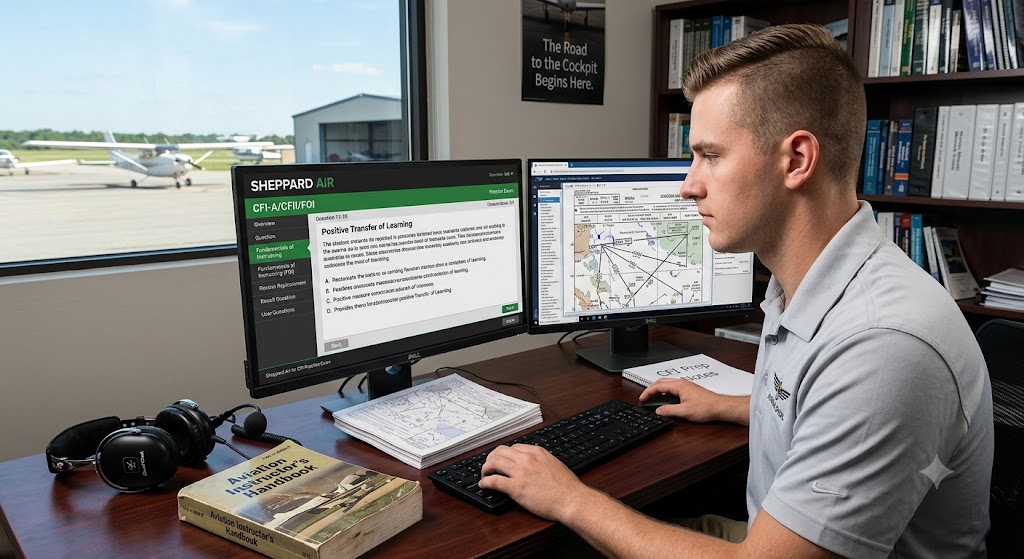
Additional Information
What the Course Entails and Exam Details
This practice exam simulates the content and environment of the official FAA CFI knowledge tests. While Sheppard Air provides proprietary study software and access to their refined question bank, the material covered is derived from extensive FAA-approved sources. The practice exam does not teach fundamental knowledge from scratch but is an advanced "check-of-learning" system. It focuses on assessing proficiency in areas such as:
Fundamentals of Instructing (FOI): Required for an initial CFI, covering the learning process, human behavior, effective communication, and teaching methods.
Aerodynamics, Aircraft Systems, and Performance: Advanced application of these principles from an instructional perspective.
Navigation, Weather, and Regulations (FARs): In-depth knowledge required for all aspects of flight planning and instructional compliance.
Flight Instructor Responsibilities: Ethical considerations, safety-management systems, and operational requirements.
The practical application of teaching these topics to a student.
The practice exam typically focuses on the "Flight Instructor - Airplane" (FIA) and, optionally, the "Flight Instructor - Instrument Airplane" (FII) and "Fundamentals of Instructing" (FOI) written exams. The actual "course" entails using the Sheppard Air software to study the questions and understanding the explanations provided, with the goal of scoring 90% or above on practice tests.
What to Expect in the Final Exam
While Sheppard Air's practice exams are highly effective, candidates must ultimately take the official FAA CFI written tests to advance toward the rating. It's crucial to understand the distinct steps:
FAA Knowledge Tests: These are computer-based multiple-choice exams taken at authorized testing centers. For an initial CFI, you must pass the Fundamentals of Instructing (FOI) and a Flight Instructor knowledge test (e.g., FIA for Airplane). The tests vary in length (typically 50-100 questions) and have a time limit of several hours. A passing score is always 70% or higher, though aspiring instructors aim much higher, as these scores are part of their professional record.
CFI Practical Test (Checkride): Passing the written exams is just the first hurdle. The culminating event is the CFI Practical Test, which is a rigorous, multi-hour evaluation with an FAA examiner. It consists of an extensive oral exam and a comprehensive flight test. The examiner will evaluate not only the applicant's piloting skills but, crucially, their ability to teach all maneuvers and concepts, and will demand a high level of situational awareness, judgment, and adherence to safe, standardized procedures. In the context of the Sheppard Air practice exam, candidates are preparing only for the written portion.
How to Study and Exam Centers
Sheppard Air provides a unique, memory-based study methodology. Their system isn't designed to teach principles from scratch but to teach candidates how to answer the questions in the actual FAA bank, utilizing memory aids, mnemonics, and specific study steps. Effective study strategies using this method include:
Consistency is Key: Dedicate regular, focused time to work through the software's modules.
Understand, Don't Just Memorize: While the system utilizes mnemonics, good candidates review the underlying FAA Handbooks (like the Airplane Flying Handbook, PHAK, and Aviation Instructor's Handbook) to deepen their knowledge, which is essential for the eventual oral and flight evaluations.
Take Mock Exams: Simulate the real testing environment by taking full-length practice tests within the software, aiming for consistent high scores.
Review Wrong Answers: Pay close attention to question explanations provided by Sheppard Air.
To take the official FAA Knowledge Tests, candidates do not use Sheppard Air's portal for testing. Instead, they must schedule the exams at an FAA-authorized testing center. These centers are typically located at airport fixed-base operations (FBOs), flight schools, or educational testing facilities and are administered by a third-party testing service, such as PSI. Applicants will need to present an endorsement from a flight instructor or, in some cases, proof of graduation from an approved ground or home-study course to take the test.
Job Opportunities from the Course
A Certified Flight Instructor rating opens the door to a wide range of rewarding career paths in the aviation industry. It is the single most common "entry-level" job for pilots aiming to build the flight time and experience required by major airlines and corporate operators. Common job opportunities include:
Flight Instructor (Full-time or Part-time): Working at a Part 61 or Part 141 flight school, teaching private, commercial, and instrument students.
Freelance Flight Instructor: Providing instruction as an independent operator, managing your own clients and schedule.
Corporate or Charter Co-Pilot/First Officer: Many Part 135 and Part 91 operators require CFI experience for entry-level positions.
Scenic Tour Pilot: Conducting aerial tours in specific locations, often a role requiring a minimum experience base.
Airline First Officer (After Time Building): The ultimate goal for many CFIs is to build the 1,500 hours (or less, in specific programs) needed for the R-ATP certificate to join a regional or major airline.
Flight School Manager or Chief Flight Instructor: Advancing within the instruction field into leadership roles.
Aviation Insurance or Safety Consultant: Roles that benefit from deep operational and instructional experience.
FAA or Government Aviation Safety Inspector: Employed by the FAA to conduct evaluations and ensure regulatory compliance.
Frequently Asked Questions
Reviews
5.0
Based on 0 reviews
Leave a Review
No reviews yet. Be the first to review!